
Contrarian Breakthrough: Who Is Quietly Leading the Exchange Platform Token Race?

Source: Cointelegraph
Reporter: Eva Xiang

Recently, the global cryptocurrency market has experienced significant volatility and adjustment, with most assets facing downward pressure. However, in the niche track of native tokens issued by mainstream exchanges, we have observed significant performance divergence. Among them, Gate.io's native token GateToken (GT) has demonstrated remarkable relative strength, becoming the focus of market attention.
1. Data Comparison: GT's Price Increase Takes the Lead Among Mainstream Exchange Tokens
The most intuitive way to measure asset performance is through price trends. According to public data, in the past 90 days, the performance of several major exchange tokens has shown significant differences:
GateToken (GT): Achieved a price increase of approximately +20.68%
OKX Token (OKB): Recorded a price increase of approximately +10.5%
Binance Coin (BNB): Experienced a price decrease of approximately -19.05%
Bitget Token (BGB): Underwent a significant decline of approximately -35.53%
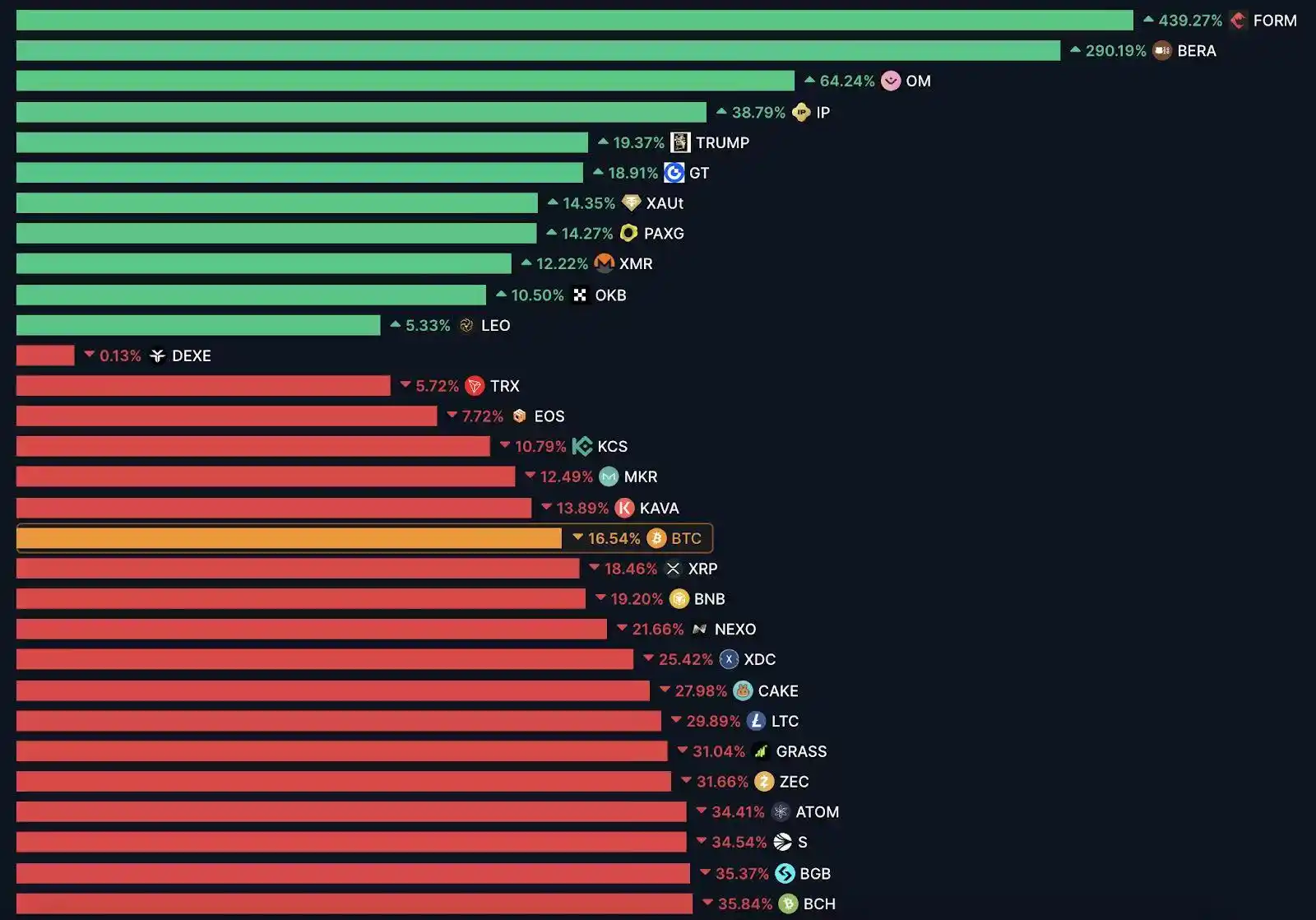
This set of data clearly outlines the recent landscape of the exchange token market: in the same market cycle and macro environment, GT not only achieved positive growth but also surpassed the modest increase of OKB significantly, standing in stark contrast to the sharp declines of BNB and BGB. With a price increase of over 20%, GT undoubtedly takes the lead among mainstream exchange tokens, and its relative strength is particularly prominent in the current market environment.
2. Analysis of GT's Competitive Advantages: Why Can It Stand Out in a Correcting Market?
For GT to achieve such a remarkable price increase amid a market-wide correction, there must be factors supporting its competitive advantage. Although the value proposition of exchange tokens is complex and diverse, it is usually closely related to the following points, and GT may have demonstrated unique strengths in these areas:
1. Market Confidence and Platform Expectations: The price of a platform token is often a barometer of the market's confidence and expectations for the exchange's future development. The contra-market rise of GT may partially reflect market participants' recognition of Gate.io's long-term stable operation, continuous innovation capabilities, and user base growth. During market downturns, funds tend to gravitate towards assets with a greater safety margin or growth potential. GT's performance may be a manifestation of this risk-averse or value discovery sentiment.
2. Intrinsic Economic Model and Supply-Demand Dynamics: GT has a relatively sound deflationary mechanism (such as using a portion of platform revenue for buyback and burn) and diverse use cases (e.g., fee discounts, Startup participation rights, GateChain fuel, etc.). These mechanisms may provide GT with a more solid value foundation and internal demand during market fluctuations, making its supply-demand dynamics relatively healthier compared to some competitors, thereby demonstrating stronger resilience to price declines and even the ability to rise against the trend.
3. Valuation and Market Positioning: Compared to some platform tokens with already substantial market capitalization, GT may still be in a relatively undervalued position or in a growth period, offering greater elasticity and space for market cap growth. During market rotations or in search of new growth points, some funds may flow from assets with high valuations to targets like GT that exhibit strong growth momentum and have a relatively moderate market cap.
4. User Stickiness and Community Consensus: An active and loyal user community is crucial for the stability of a platform token's value. The user base Gate.io has accumulated over the long term, along with the community consensus formed around GT, may act as stabilizers when market panic spreads, with holders more inclined to long-term holding rather than panic selling.
It is important to emphasize that the above analysis is based on the general market trends and publicly available information about GT, and the specific reasons may be the result of multiple overlapping factors. However, GT's excellent performance does indeed indicate some of its distinctive competitive advantages in the current market environment.
Three, Dollar-Cost Averaging Perspective: Why is GT More Worthy of Attention?
For long-term investors, choosing the right target is crucial. The core logic of dollar-cost averaging is to buy in batches at different market stages to smooth out costs and share in long-term growth. When choosing targets for dollar-cost averaging, factors such as the asset's long-term potential, risk resistance, and performance in market downturns are all important considerations.
From recent performance, GT has exhibited several qualities that are worth attention from dollar-cost averaging investors:
1. Bear Market Resilience: As shown in the previous data, GT demonstrated significant anti-downtrend and even counter-trend abilities during an overall market downturn. This indicates that its value support is relatively robust and can better protect portfolio value in extreme market conditions. For dollar-cost averaging, this means that chips accumulated in the bottom range of the market may have a higher safety margin and future rebound potential.
2. Relative Strength: Compared to platform coins such as BNB and BGB, which experienced significant declines during the same period, GT's strong performance itself is a signal. Investing funds into relatively stronger assets theoretically allows for faster value recovery and growth when the market heats up. GT's recent leadership trend makes it a notable choice among similar assets.
3. Growth Potential: While past performance is not indicative of the future, GT's continued value capture ability (through its economic model and use cases) and the development potential of the Gate.io platform have laid the foundation for its long-term value growth. Dollar-cost averaging is an effective strategy to capture this long-term value growth.
Of course, any investment decision should be based on comprehensive research and risk assessment. Dollar-cost averaging GT also faces multiple risks such as market volatility, regulatory policy changes, and platform operational risks. However, it is undeniable that based on market data and performance in the past 90 days, GT has indeed exhibited greater resilience and attractiveness compared to some mainstream platform coins, making it an option worth considering for dollar-cost averaging.
Finally:
In the recent cryptocurrency market correction, GateToken (GT) stood out among mainstream platform coins with a 90-day gain of over 20%, outperforming OKB, BNB, and BGB. This differentiated market performance may stem from market confidence in the Gate.io platform, GT's robust economic model and supply-demand dynamics, relatively reasonable valuation, and strong community consensus, among other factors. For investors adopting a dollar-cost averaging strategy, GT's demonstrated bear market resilience and relative strength make it a target worth closely monitoring and researching. In a market full of uncertainty, GT's impressive data provides a clear case study of value and resilience.
Related Recommended: Gate.io Founder Dr. Han: New Tariff Policy Can Be Seen as an Opportunity to Promote the Upgrade and Long-term Development of the Crypto Industry
This article is a contribution and does not represent the views of BlockBeats.
You may also like

Galaxy Deep Research Report: How Hyperliquid's HIP-4 Upgrade Changes the Landscape of Prediction Markets?

ZachXBT: Humanity private key leak and abnormal surge in H token should be viewed separately
On June 9, according to related disclosures, on-chain investigator ZachXBT posted an update on Humanity’s roughly $31 million security incident, saying that after further analyzing fund flows, he currently tends to believe the project team was not involved in an “inside job” or a self-staged attack. According to him, the official explanation about the private key leak was broadly accurate, but before the token unlock, the price of H had been artificially pushed higher, and the hacker later took advantage of that market environment; therefore, the private key leak and the earlier abnormal price pumping should be regarded as two separate and independent events. This reframing has shifted the market’s understanding of the nature of the incident. Earlier discussion around Humanity had focused on whether the team directly participated in the attack or used the security incident to cover up internal operations. ZachXBT’s latest remarks shift the focus from “whether it was self-theft” to “whether there were pre-unlock market structure issues.” He also questioned whether the team may have.

Morning Report | OpenAI has submitted an S-1 registration statement draft to the U.S. SEC; Morpho completes $175 million financing

Morning Report | BitMine increased its holdings by 126,971 ETH last week; trader Eugene announced his exit from the crypto market

Wang Chuan: How can one not feel anxious after the neighbor Old Wang made thirty times profit by investing in storage stocks? (Seven) - A quarter-century cycle

Cryptocurrency CEXs are flocking to sell US stocks, and traditional brokerages are facing an "uninvited guest."
$75 billion in foreign capital has fled, and South Korean retail investors have absorbed it all using leverage

Japan’s Three Megabanks Plan Joint Stablecoin Issuance in Fiscal 2026
MUFG, SMBC, and Mizuho reportedly plan to jointly issue fiat-pegged stablecoins in fiscal 2026, signaling Japan’s growing push into bank-led digital payment infrastructure.

Humanity Discloses H Token Dual-Chain Attack Details, With Losses on Ethereum and BSC Exceeding $36 Million
Humanity said the H token attack across Ethereum and BSC caused more than $36 million in losses after leaked ProxyAdmin keys enabled malicious contract upgrades and token minting.
White House Discusses CLARITY Act With Law Enforcement Ahead of Senate Vote
The White House discussed the CLARITY Act with law enforcement ahead of a Senate vote, focusing on illicit finance risks and developer protections.

Bitcoin Trading Guide 2026: Strategies for Experienced Traders

What Is XAUT and PAXG? Why Tokenized Gold Is Booming in 2026

Will the SpaceX IPO Hurt Bitcoin? Here's What Traders Are Watching

Foreign selling in the South Korean stock market accelerates, with cumulative net sales reportedly reaching $75 billion this year
On June 9, The Kobeissi Letter, citing Goldman Sachs data, reported that global investors are selling South Korean stocks at an unusually rapid pace. In the latest trading session, foreign investors sold about $801 million worth of Kospi constituent stocks again; total foreign outflows last week reached about $10 billion, and the market has been in net foreign selling on nearly every trading day over the past month. According to the data cited in the report, foreign investors have sold about $75 billion worth of South Korean stocks so far this year. Meanwhile, South Korean retail and institutional investors together recorded roughly $69 billion in net buying over the same period, suggesting that the market’s main buying support has come from domestic capital rather than returning overseas funds. The information currently disclosed still mainly comes from The Kobeissi Letter’s retelling and Goldman Sachs data summaries, while public details on the statistical period and the specific definition of “selling” remain relatively limited.

Fortune Warns of Strategy’s Financing Structure Risks as Bitcoin Premium Narrows
Fortune warned that Strategy’s Bitcoin treasury model faces growing financing risks as MSTR’s net asset premium narrows and preferred stock dividend pressure increases.

Ferrari Challenge Le Mans: Carl Moon to Dominate in WEEX Livery

Sahara AI Responds to SAHARA’s Sharp Drop: No Contract or Product Security Issues Found, Internal Investigation Underway
Sahara AI responded to SAHARA’s 60% price drop, saying no token contract or product security issues have been found and an internal investigation is underway.

WEEX Deposit/Withdrawal Dynamic Island: Your Asset Status, Always in Sight
Galaxy Deep Research Report: How Hyperliquid's HIP-4 Upgrade Changes the Landscape of Prediction Markets?
ZachXBT: Humanity private key leak and abnormal surge in H token should be viewed separately
On June 9, according to related disclosures, on-chain investigator ZachXBT posted an update on Humanity’s roughly $31 million security incident, saying that after further analyzing fund flows, he currently tends to believe the project team was not involved in an “inside job” or a self-staged attack. According to him, the official explanation about the private key leak was broadly accurate, but before the token unlock, the price of H had been artificially pushed higher, and the hacker later took advantage of that market environment; therefore, the private key leak and the earlier abnormal price pumping should be regarded as two separate and independent events. This reframing has shifted the market’s understanding of the nature of the incident. Earlier discussion around Humanity had focused on whether the team directly participated in the attack or used the security incident to cover up internal operations. ZachXBT’s latest remarks shift the focus from “whether it was self-theft” to “whether there were pre-unlock market structure issues.” He also questioned whether the team may have.
Morning Report | OpenAI has submitted an S-1 registration statement draft to the U.S. SEC; Morpho completes $175 million financing
Morning Report | BitMine increased its holdings by 126,971 ETH last week; trader Eugene announced his exit from the crypto market
Wang Chuan: How can one not feel anxious after the neighbor Old Wang made thirty times profit by investing in storage stocks? (Seven) - A quarter-century cycle
Cryptocurrency CEXs are flocking to sell US stocks, and traditional brokerages are facing an "uninvited guest."


