
Cryptocurrency Market Experiencing "Choppy Accumulation": XRP Bandwidth Indicator Dips Below Annual Threshold, Whale Holdings Movement Suggests Shift in Market Direction



Original Title: XRP Resembles a Compressed Spring Poised for a Significant Price Move as Key Volatility Indicator Mirrors 2024 Patterns
Original Author: Omkar Godbole
Original Translation: Daisy, Mars Finance
XRP resembles a compressed spring, ready for a significant price move, as a key volatility indicator mirrors patterns from 2024. A technical indicator based on standard deviation suggests XRP and BTC may be in for another round of intense volatility.
Key Points:
The price action of XRP and Bitcoin appears like a compressed spring, signaling a potential major price swing. The Bollinger Bandwidth of these two cryptocurrencies has dropped to the lowest level since October 2024, indicating a buildup of market energy. While a contracting Bollinger Band may suggest an uptrend, it could also precede a sell-off, as seen after the FTX crash in October 2022.
The price trajectories of XRP and Bitcoin (BTC) resemble a tightly compressed spring that could unleash energy and see a rebound at any moment.
This signal comes from a key volatility indicator—the Bollinger Bandwidth. Bollinger Bands are volatility ranges set based on an asset's 20-period moving average (SMA) with an upper and lower boundary of two standard deviations (±2σ). The bandwidth measures the space between these ranges as a percentage of the 20-day moving average.
On XRP's 4-hour candlestick chart (each candle representing 4 hours of price action), the Bollinger Bandwidth has narrowed to the lowest level since October 2024. The 4-hour candlestick is popular in the 24/7 cryptocurrency market, with traders often using it to analyze and predict short-term price movements. Bitcoin's 4-hour candlestick chart also shows a similar Bollinger Bandwidth pattern to XRP.
The long-standing market consensus is that a narrowing Bollinger Bandwidth (reflecting a period of market calm) is like a compressed spring, often signaling a significant market movement on the horizon.
During these periods of market calm, energy continues to accumulate, and once the direction is clear, it will be released dramatically, often leading to a sharp price increase or decrease. The sharp rise of XRP and Bitcoin in November to December 2023 occurred after a long period of sideways movement, with the Bollinger Bands narrowing to a level similar to the current one.
However, narrowing of the bands does not always signal a bullish trend; it can also precede a sell-off. For example, in October 2022, the Bollinger Bands narrowing foretold a significant volatility, and the subsequent FTX collapse caused a steep market decline.
It is currently uncertain whether this "spring compression" will trigger a bullish move or lead to a downward spiral for these two tokens. Federal Reserve Chairman Jerome Powell's recent hawkish comments and the sell-off behavior of some whales lean more towards the latter.
Stay vigilant!
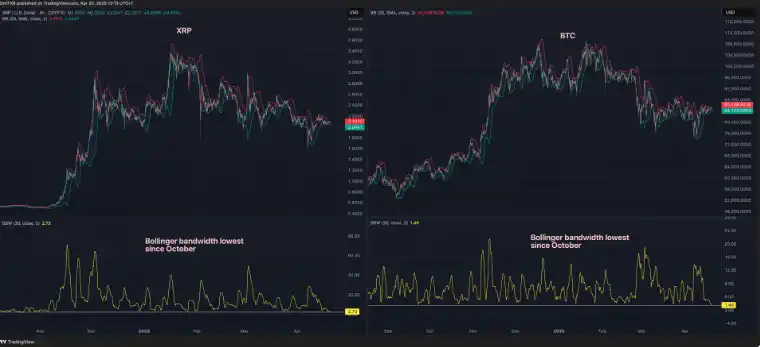
XRP and BTC with Bollinger bandwidth. (TradingView/CoinDesk)
You may also like

When the P2P illicit funds from ten years ago turned into 60,000 bitcoins

Morning News | CME Group launches Nasdaq Cryptocurrency Index futures; Asset management giant Janus Henderson strategically invests in Ethena

Why did Oracle deliver the strongest financial report in history, yet its stock price fell?

Bitcoin Layer 2 Network Botanix: Why Did We Choose to Dissolve?

Morning Report | OpenAI has submitted an S-1 registration statement draft to the U.S. SEC; Morpho completes $175 million financing

Galaxy Deep Research Report: How Hyperliquid's HIP-4 Upgrade Changes the Landscape of Prediction Markets?

Latest research from 13 top universities including Cornell University: The current state, challenges, and misconceptions of the fusion of Crypto and AI
Deconstructing Anthropic: The Best AI Company, Possibly Also a Type of Organizational Invention

Every exchange is a "Universal Exchange."

The counterattack of traditional finance: Alliance chains are quietly reviving
Pantera Capital Partner: How Tokenization is Restructuring the Private Equity and Early Investment Ecosystem?

Mastercard Launches Agent Pay for AI, Plans to Record AI Agent Payment Authorizations on Polygon
Mastercard launched Agent Pay for AI, a new payment protocol designed to help AI agents make small payments such as pay-per-use access to data and APIs. The system plans to record human-granted AI agent permissions on Polygon, focusing on verifiable authorization, identity, and payment controls.

Curve Deploys Llamalend v2 on Optimism With 250,000 OP Incentives
Curve launched Llamalend v2 on Optimism with 250,000 OP incentives from the Optimism Foundation. The upgrade expands Llamalend beyond its earlier crvUSD-focused model, adding broader collateral support, LlamaRisk market reviews, and the ability to use Curve LP tokens as collateral.

Raydium Old Liquidity Pool Reportedly Exploited, With $1.34 Million Moved to Ethereum and Tornado Cash
An old Raydium liquidity pool was reportedly exploited for around $1.34 million in USDC, RAY, and wSOL, with the stolen funds bridged to Ethereum and deposited into Tornado Cash. The incident highlights the tail risks of legacy DeFi pools, old contracts, and cross-chain fund laundering paths.
Kalshi Executive Challenges “SBF Backed AI Unicorns” Narrative, Says Leopold Aschenbrenner Was Key Figure
Kalshi executive John Wang questioned the “SBF backed AI unicorns” narrative, saying Leopold Aschenbrenner was the key figure behind major AI investment decisions.

New York Proposes Stricter Stablecoin Issuer Rules Aligned With Federal GENIUS Act
NYDFS proposed stricter stablecoin issuer rules aligned with the GENIUS Act, covering reserves, custody, redemption timelines, audits, and capital buffers.

CryptoQuant Says Bitcoin Profitable Supply Is Near 45% Pressure Zone as On-Chain Data Points to Market Repricing
CryptoQuant said Bitcoin’s profitable supply is nearing the 45% pressure zone, signaling rising market stress, unrealized losses, and a possible on-chain repricing phase.

Bitcoin Falls Below 200-Week Moving Average as On-Chain Data Shows Over Half of Supply in Loss
Bitcoin dropped below its 200-week moving average as on-chain data showed over 50% of circulating supply is now in loss, signaling rising market stress.
When the P2P illicit funds from ten years ago turned into 60,000 bitcoins
Morning News | CME Group launches Nasdaq Cryptocurrency Index futures; Asset management giant Janus Henderson strategically invests in Ethena
Why did Oracle deliver the strongest financial report in history, yet its stock price fell?
Bitcoin Layer 2 Network Botanix: Why Did We Choose to Dissolve?
Morning Report | OpenAI has submitted an S-1 registration statement draft to the U.S. SEC; Morpho completes $175 million financing
Galaxy Deep Research Report: How Hyperliquid's HIP-4 Upgrade Changes the Landscape of Prediction Markets?


