
FDUSD Depegging Crisis: Justin Sun Accuses FDT of $456M Fraud, the Latter Denies Insolvency




Original Title: "Justin Sun Accuses FDT of $456 Million FDUSD Fraud: An In-Depth Look"
Original Author: CryptoLeo, Odaily Planet Daily
At 11:00 PM on April 2nd, TRON Foundation founder Justin Sun made a post accusing the stablecoin FDUSD issuer, First Digital Trust (FDT), of insolvency and inability to fulfill customer fund redemptions. As a result, FDUSD experienced a severe but temporary depegging, with the FDUSD/USDT pair on Binance dropping to a low of 0.87, and FDUSD/USDC momentarily falling to 0.76.
As one of the most important stablecoins on the Binance platform, FDUSD was also the entry ticket for users participating in the Binance Launchpool activity after BUSD. Many people held a certain amount in their hands. As panic spread, some users chose to sell at a discount. However, ultimately, with Binance founder Changpeng Zhao speaking out to refute the claims, the FDUSD price rebounded strongly from the bottom and eventually stabilized at 0.987 USDT.
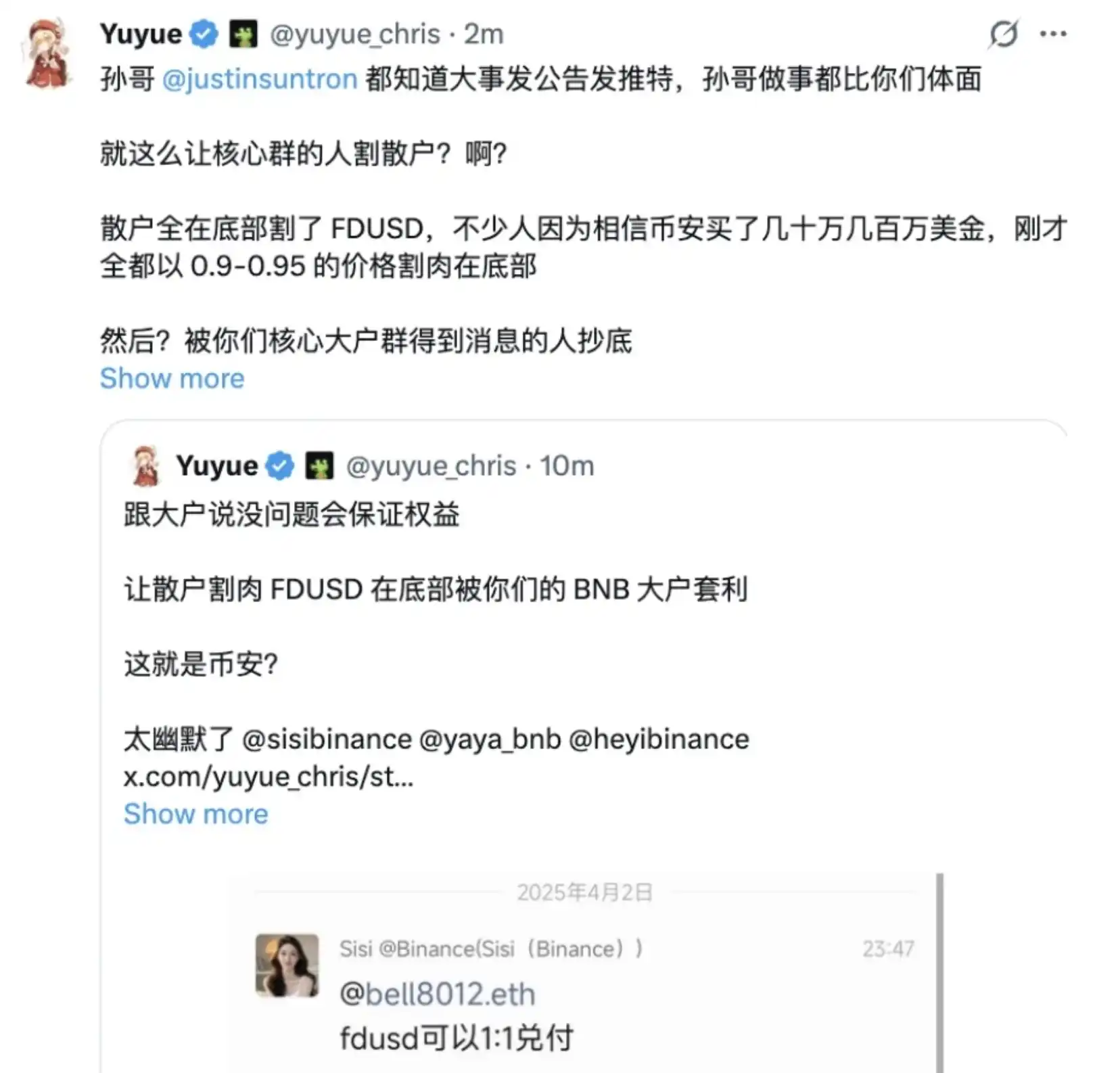
At 5:00 AM on April 3rd, Binance officially stated that, based on the recent completed audit, the stablecoin FDUSD had achieved 1:1 reserve backing. However, users were not convinced. They redirected their anger over losses towards Binance, questioning the long announcement delay and alleging that important news was first notified in the "whale community," causing discontent in the market.
The Odaily Planet Daily has summarized the events as follows.
Justin Sun Issues Late-Night Post Accusing FDUSD Issuer First Digital Trust (FDT) of Insolvency
Justin Sun stated: "The stablecoin FDUSD issuer First Digital Trust (FDT) is actually insolvent and unable to fulfill customer fund redemption obligations. I strongly recommend that users take immediate action to protect their assets and urge regulatory bodies and law enforcement agencies to promptly address these issues to prevent further significant losses."
In the previous days, Justin Sun had been releasing messages indicating that a "major industry event" was forthcoming on April 3rd. The pre-released version seen on social media was an invitation letter from Justin Sun, hinting at an event in Hong Kong uncovering an international financial fraud case, involving traditional financial institutions in Hong Kong and Web3 platforms.
At this point, Justin Sun's actions in the past few days seem to have some connection, acting as a kind of "appetizer before the main course of industry news."
Impacted by his post, FDUSD briefly dropped below $0.9, hitting a low of $0.8726. On Binance, FDUSD/USDT dropped to a minimum of 0.87, and FDUSD/USDC momentarily fell to 0.76.
Binance's Clarification: The Lawsuit Involves TUSD, Not FDUSD
However, amidst the FUD surrounding FDUSD, a small incident occurred. Wintermute took a different approach and, through on-chain analysis by Ai Yi, it was observed that within 20 minutes of Justin Sun's post, Wintermute withdrew a total of 31.36 million FDUSD from Binance in 4 transactions, becoming the largest FDUSD holder outside of Binance, with approximately 65.46 million tokens, representing around 2.5% of the total circulation.
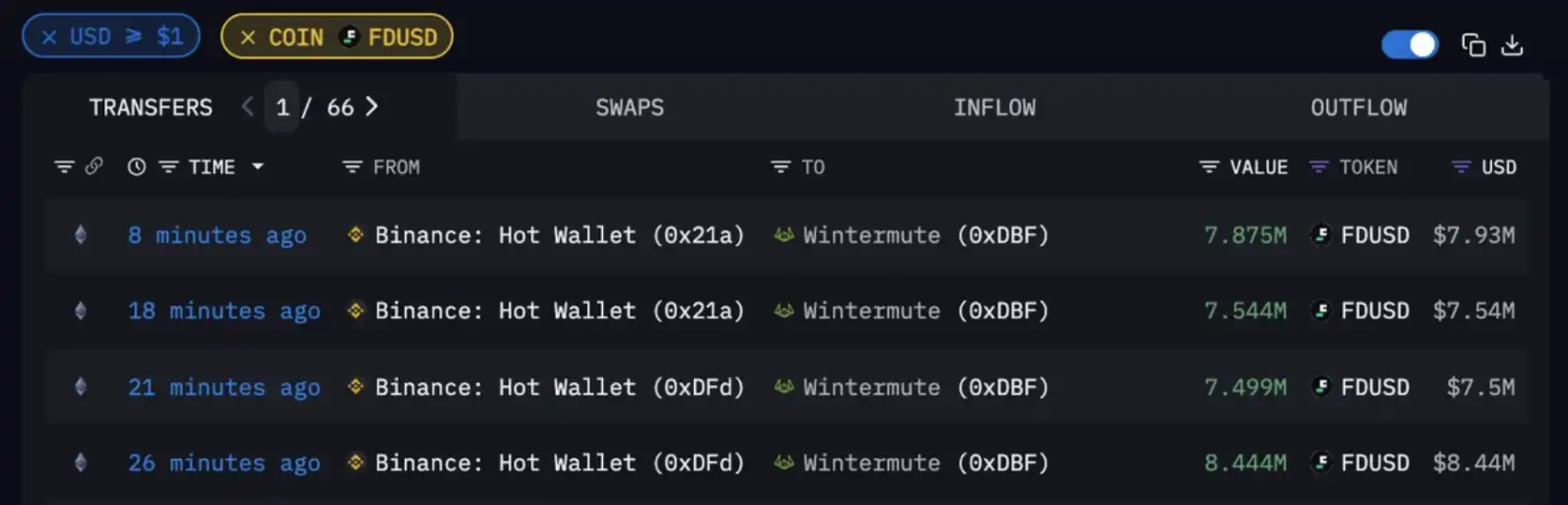
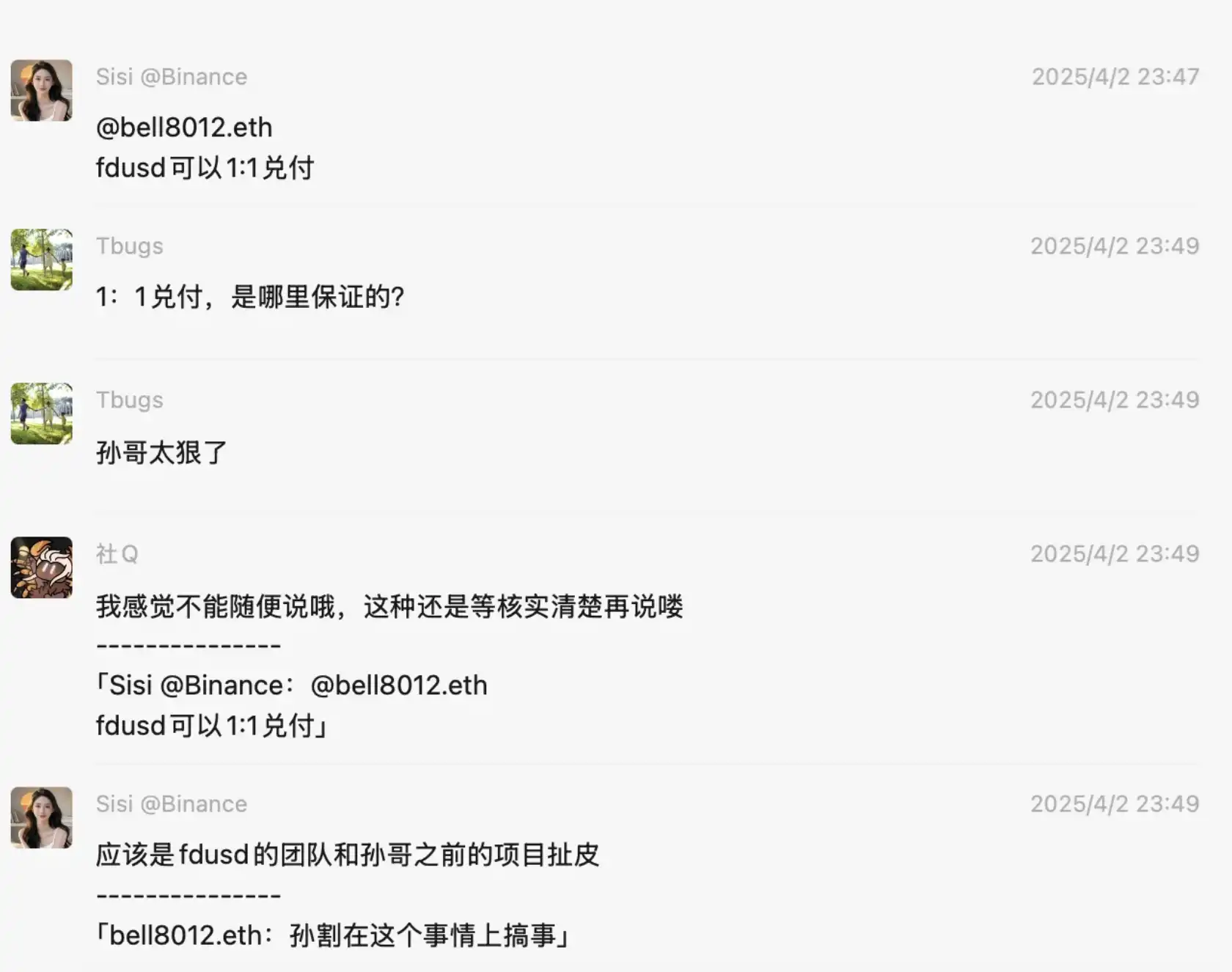
Of course, Wintermute was merely arbitraging FDUSD, and its actions did not trigger a rebound in FDUSD. Users are still eagerly awaiting Binance's response. Initially, Binance's Sisi stated in a certain group that FDUSD can be redeemed 1:1 and suggested that Justin Sun's post may be related to some past issues between FDT and Justin Sun's previous projects.
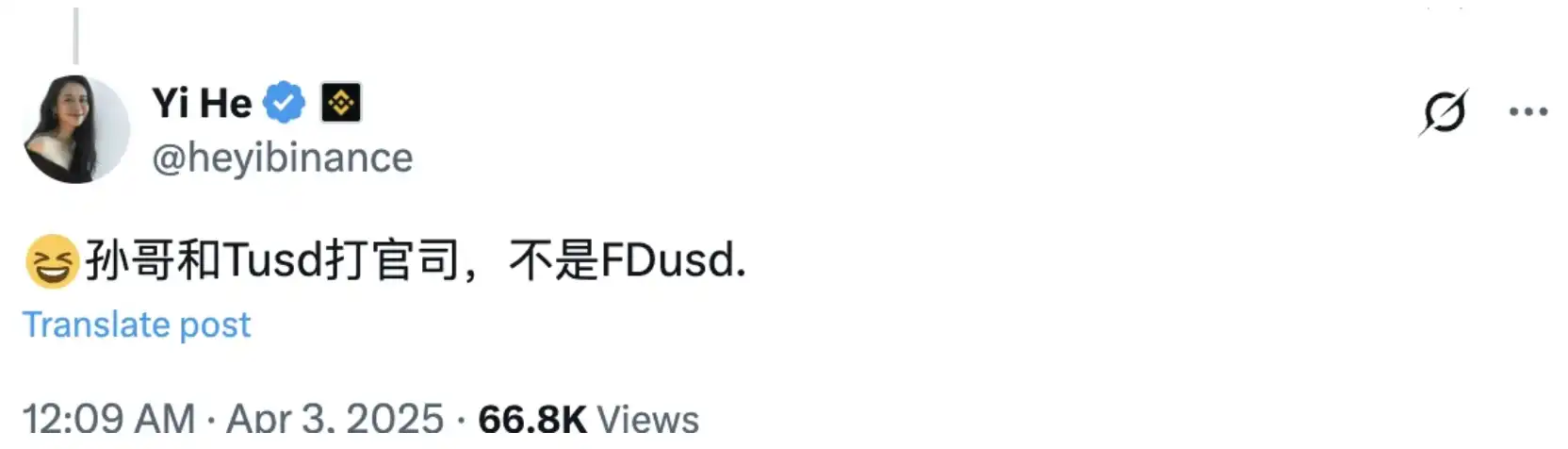
Subsequently, Binance co-founder He Yi also posted on X, saying, "This event is due to Justin Sun's lawsuit with TUSD, not FDUSD."
However, many retail investors, driven by panic, sold off their FDUSD holdings, and under the words of an official Binance representative, began to slowly stabilize. Users criticized Binance for responding first in a group chat rather than issuing an official announcement. In response to this, He Yi mentioned that the Binance team is also in contact with FDUSD, and any announcements should come from them rather than Binance. Binance has conducted thorough auditing, but the core issue lies in the legal dispute between Justin Sun and FDT, which Binance is not fully clear about.

The TUSD Saga: FDT's "Misconduct" and Justin Sun's Intervention
Coindesk also promptly published an article confirming the previous dispute between Justin Sun and FDT. FDT not only serves as the issuer of FDUSD but also as the asset manager of TUSD.
The story dates back to 2020 when, in December 2020, TrueCoin handed over the management of TrueUSD to the Hong Kong-based trustee organization First Digital Trust (FDT). In subsequent court filings, it was revealed that FDT engaged in some misconduct:
1. FDT invested the stablecoin reserves in the Aria Commodity Finance Fund (Aria CFF) registered in the Cayman Islands. However, approximately $456 million was misappropriated to an unauthorized independent entity, Aria DMCC, based in Dubai (both entities being controlled by a married couple). The plaintiff alleges that the funds transferred to Aria DMCC were blatant misappropriation and money laundering, unauthorized by the plaintiff.
2. First Digital CEO Vincent Chok was accused of transferring approximately $15.5 million in undisclosed commissions to an entity named "Glass Door" and separately providing around $15 million in unauthorized trade finance loans from FDT to Aria DMCC, which were later retrospectively misclassified as legitimate fund investments.
Subsequently, FDT's CEO, Chok, denied any wrongdoing or involvement in any fraudulent scheme. He stated that FDT acted solely as a trustee intermediary, executing transactions strictly according to the instructions provided by Techteryx and its representatives, without being responsible for independently assessing or advising on these investment decisions.
Justin Sun's dispute with FDT also comes into play here. Due to FDT's "investment and misuse," when Techteryx attempted to redeem its investment from Aria CFF between mid-2022 and early 2023, it almost failed to recover the funds, with Aria-related entities facing accusations. Justin Sun intervened during this period, providing emergency liquidity support for TUSD, which was structured as a loan.
Justin Sun's primary involvement with TUSD is often seen in his actions of minting TUSD, converting it to stUSDT, and depositing it into JustLend. JustLend has been a significant use case for TUSD, allowing users to pledge TUSD for other assets. Currently, the circulating supply of TUSD exceeds 495 million, with approximately 167 million on the TRON network, ranking second in terms of proportion.
Currently, $456 million of the funds have not been returned, and Justin Sun's loan remains outstanding.
FDT Late-Night Space and FDUSD Audit Report
Returning to FDUSD, as mentioned earlier, the clarification regarding FDUSD should be done by FDT. One of FDT's accounts, First Digital, also conducted a "Statement Regarding Justin Sun's False Accusations" Space on X. FDT CEO Vincent Chok interacted with users in real-time to answer questions. After summarizing by Odaily, Vincent Chok's responses can be divided into several points:
1. Justin Sun's accusation stems from an ongoing legal case involving TUSD that has been ongoing for over two years (as mentioned in a previous CoinDesk article). I'm not sure why this matter is being brought up now. Furthermore, Hong Kong companies are all following legal and regulatory compliance;
2. We will not go bankrupt. We have third-party asset verification, which is right on the official website for everyone to check at any time. The reserve is more than sufficient and can support immediate 1:1 FDUSD redemption;
3. Our funds and client funds are completely separated. Clients have their funds in our operated FDD accounts. If we become insolvent, client fund reserves will not be affected;
4. We are a fully regulated entity. We have passed all compliance checks, such as AML and KYC, and have partnerships with banks that are very satisfied with us. I cannot control the FUD outside. But in reality, the way to sustain in this industry is to ensure full transparency for our clients and users.
After the Space ended, Odaily visited their official website to view the reserve proof. In the reserve proof announced by FDT in March, the reserve proof for February showed that as of 9:00 AM HKT on March 1, 2025 (9:00 PM ET on February 28, 2025)
FDUSD Total Circulation: 2,041,924,819.94 coins, Total Reserve Assets for FDUSD: $2,051,348,188.70, with the reserve assets consisting of:
1. Total Holding of U.S. Treasury Bills: $1,733,452,142.60 (approximately 84.5% of total)
2. Overnight Reverse Repo Agreements (Overnight Reverse Repo Agreements) Position: $33,000,000.00 USD (approximately 1.6% share)
3. Fixed Deposits Position: $145,880,000.00 USD (approximately 7.1% share)
4. Cash in U.S. Dollars Account Cash Balance: $139,016,046.10 USD (approximately 6.8% share)
In other words, if the reserve proof is completely accurate, FDUSD is redeemable at a 1:1 ratio.
Stablecoin Being Slashed Again? Sun Yige's Feud with FDT, Retail Investors Holding the Bag
Finally, Justin Sun once again issued a statement emphasizing that FDT has gone bankrupt and indicated that everything will be decided by the judicial and regulatory authorities.
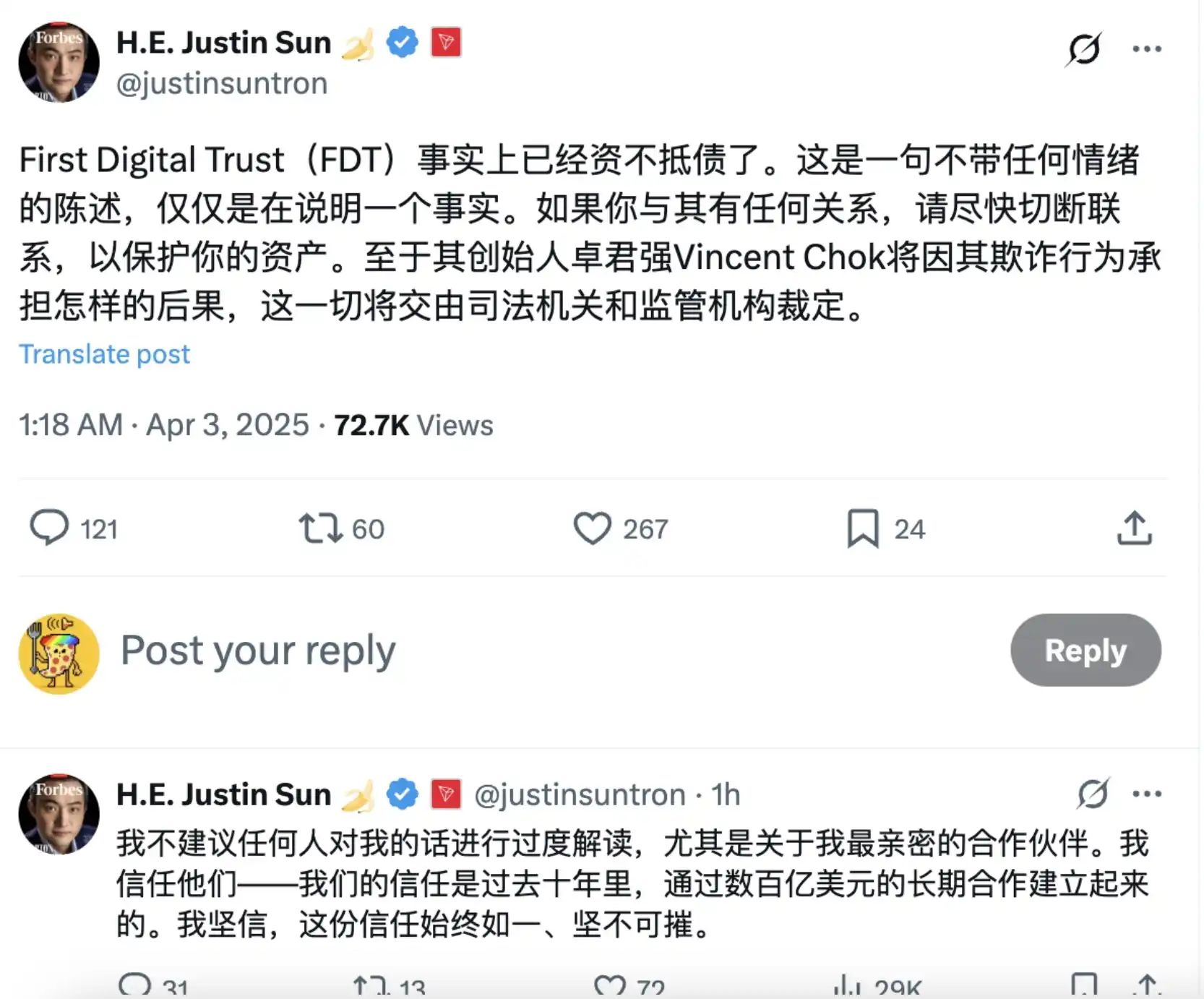
As of the time of writing, Justin Sun's statements have not provided any additional significant evidence, and the court case regarding "Techteryx's lawsuit against FDT" is still ongoing. This FUD against FDUSD can be considered mostly resolved. While FDUSD has not fully restored its peg, it has gradually re-anchored above $0.98. Due to the previous UST incident, many users are very cautious about stablecoin de-pegging, with most fleeing at the first sign of FUD, and some even selling at the lowest point before the rebound.
It seems like today is April Fools' Day: FDUSD is back around $0.98, Justin Sun is still emphasizing FDT's bankruptcy, FDT litigation is ongoing, and Binance still supports FDUSD, but your money is 10% less.
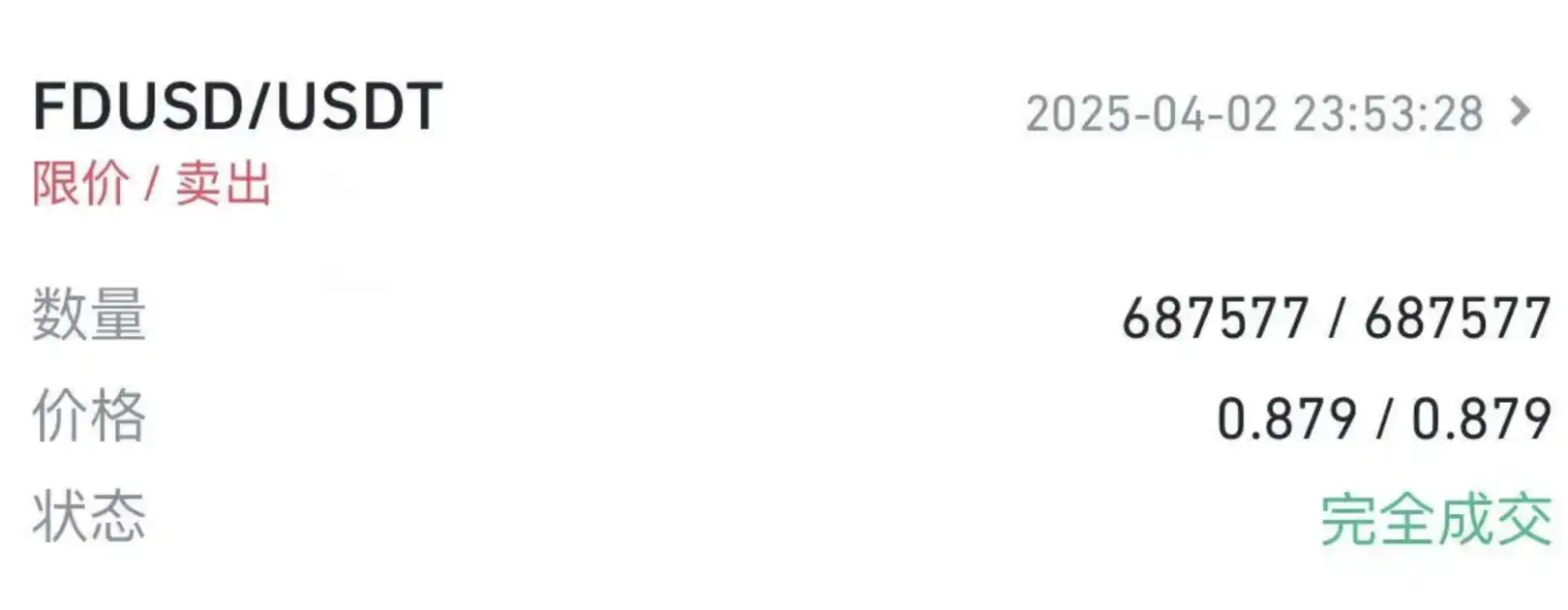
As mentioned earlier, the community has many users questioning why Binance only came out on social media to clarify the FDUSD incident once FDUSD had fallen below $0.90. They believe it was to let retail investors cut losses at the bottom while allowing exchange whales to buy the dip.
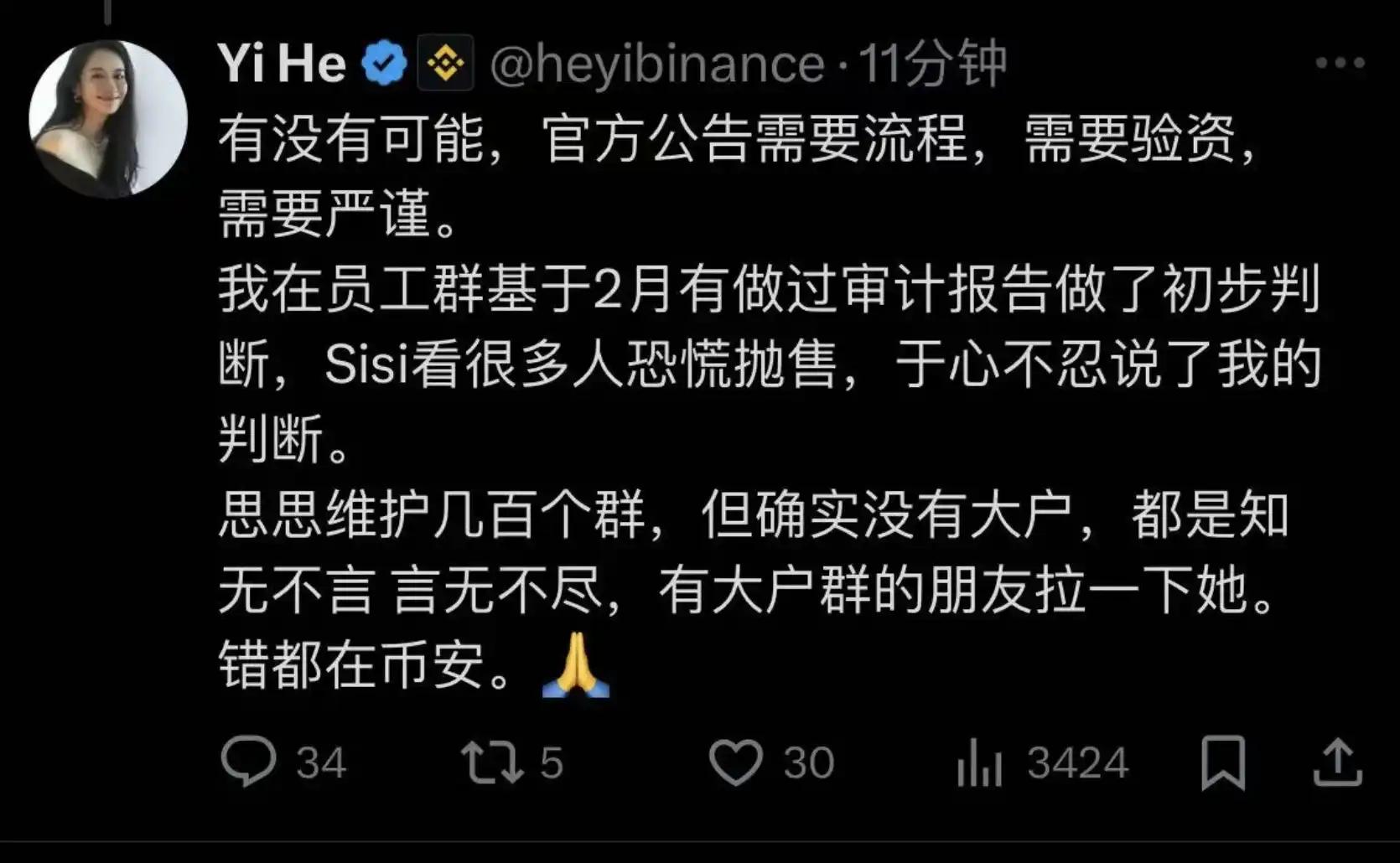
In response, Heco co-founder He Yi mentioned that the official announcement of FDUSD requires a process, including verification and time. Binance's Sisi only made the judgment that FDUSD can be redeemed 1:1 after seeing some people panic selling in the group and feeling sorry for them.
According to the Hong Kong press conference by Justin Sun at 1:30 PM on April 3, there is less than 10 hours remaining. Odaily will continue to track and report on the relevant developments from the conference.
You may also like

Japan’s Three Megabanks Plan Joint Stablecoin Issuance in Fiscal 2026
MUFG, SMBC, and Mizuho reportedly plan to jointly issue fiat-pegged stablecoins in fiscal 2026, signaling Japan’s growing push into bank-led digital payment infrastructure.

Humanity Discloses H Token Dual-Chain Attack Details, With Losses on Ethereum and BSC Exceeding $36 Million
Humanity said the H token attack across Ethereum and BSC caused more than $36 million in losses after leaked ProxyAdmin keys enabled malicious contract upgrades and token minting.

White House Discusses CLARITY Act With Law Enforcement Ahead of Senate Vote
The White House discussed the CLARITY Act with law enforcement ahead of a Senate vote, focusing on illicit finance risks and developer protections.

$75 billion in foreign capital has fled, and South Korean retail investors have absorbed it all using leverage

Bitcoin Trading Guide 2026: Strategies for Experienced Traders

What Is XAUT and PAXG? Why Tokenized Gold Is Booming in 2026

Cryptocurrency CEXs are flocking to sell US stocks, and traditional brokerages are facing an "uninvited guest."

Will the SpaceX IPO Hurt Bitcoin? Here's What Traders Are Watching
Foreign selling in the South Korean stock market accelerates, with cumulative net sales reportedly reaching $75 billion this year
On June 9, The Kobeissi Letter, citing Goldman Sachs data, reported that global investors are selling South Korean stocks at an unusually rapid pace. In the latest trading session, foreign investors sold about $801 million worth of Kospi constituent stocks again; total foreign outflows last week reached about $10 billion, and the market has been in net foreign selling on nearly every trading day over the past month. According to the data cited in the report, foreign investors have sold about $75 billion worth of South Korean stocks so far this year. Meanwhile, South Korean retail and institutional investors together recorded roughly $69 billion in net buying over the same period, suggesting that the market’s main buying support has come from domestic capital rather than returning overseas funds. The information currently disclosed still mainly comes from The Kobeissi Letter’s retelling and Goldman Sachs data summaries, while public details on the statistical period and the specific definition of “selling” remain relatively limited.

Fortune Warns of Strategy’s Financing Structure Risks as Bitcoin Premium Narrows
Fortune warned that Strategy’s Bitcoin treasury model faces growing financing risks as MSTR’s net asset premium narrows and preferred stock dividend pressure increases.

Ferrari Challenge Le Mans: Carl Moon to Dominate in WEEX Livery

Sahara AI Responds to SAHARA’s Sharp Drop: No Contract or Product Security Issues Found, Internal Investigation Underway
Sahara AI responded to SAHARA’s 60% price drop, saying no token contract or product security issues have been found and an internal investigation is underway.

WEEX Deposit/Withdrawal Dynamic Island: Your Asset Status, Always in Sight
Scaling Crypto Derivatives: The Digital Asset Infrastructure Behind High-Volume Trading
In the fast-moving digital asset ecosystem, derivatives platforms face an extreme architectural test. High-leverage futures markets demand more than just standard security—they require absolute operational precision, zero-latency matching engines, and ironclad structural scalability, all while navigating intense market volatility.
As global platforms scale to meet these demands, the industry is shifting away from rigid, monolithic setups toward a more agile, "decoupled" infrastructure philosophy.
The Blueprint for High-Volume Copy TradingFor elite global exchanges like WEEX (founded in 2018), this architectural choice becomes critical when scaling high-volume retail features like social copy trading. When thousands of users automatically mirror the real-time strategies of elite traders simultaneously, it triggers sudden, monumental spikes in concurrent transactional volume.
To prevent execution latency or settlement bottlenecks during these peak volatility events, a platform's primary engine must remain entirely dedicated to risk management, copy-trade synchronization, and order matching.
The Architectural Rule: New-generation platforms must separate front-end user execution engines from heavy backend infrastructural overhead to eliminate operational friction.
By separating these layers, platforms can maintain complete sovereignty over their trading environments and user experiences while strategically aligning with institutional-grade infrastructure ecosystems. This strategic framework allows modern exchanges to leverage advanced Digital Asset Custody infrastructure such as Cobo’s behind the scenes, ensuring that backend wallet management scales elastically alongside trading spikes.
Capitalizing on Market Momentum and 400× LeverageIn a derivatives arena where platforms offer up to 400× leverage on perpetual contracts, capital efficiency and market agility are core business metrics. To capture market momentum, an exchange needs the ability to rapidly expand its asset offerings, supporting everything from legacy crypto assets to sudden, trending altcoins across a massive library of trading pairs.
Adopting a flexible, scalable Wallet-as-a-Service (WaaS) solution such as Cobo’s could completely rewrite the development timeline for high-growth exchanges. Instead of spending months of engineering capital building out custom backend wallet architectures for every new blockchain network, platforms can deploy localized infrastructure in days.
This agility allows platforms to instantly scale their listings to over a thousand trading pairs without compromising security or delaying time-to-market. It mirrors the exact operational advantages seen during high-velocity market events, similar to how advanced wallet infrastructure empowers platforms during sudden asset surges; allowing exchanges to pass that speed and liquidity directly to their global user base.
A Mature Foundation for GrowthThe synergy between trusted infrastructure ecosystems and global trading platforms represents the natural evolution of a maturing crypto market. As WEEX continues to scale its global spot and derivatives offerings for over 6 million users, adopting robust backend paradigms proves that platforms no longer have to compromise between cutting-edge trading velocity and uncompromised structural security.

Morning Report | BitMine increased its holdings by 126,971 ETH last week; trader Eugene announced his exit from the crypto market

Wang Chuan: How can one not feel anxious after the neighbor Old Wang made thirty times profit by investing in storage stocks? (Seven) - A quarter-century cycle

Get Paid to Onboard? Try WEEX’s New Homepage with Rewards for Registration, Deposit & Trade
WEEX Custom Layout: Build Your Perfect Trading Workspace in Seconds
Japan’s Three Megabanks Plan Joint Stablecoin Issuance in Fiscal 2026
MUFG, SMBC, and Mizuho reportedly plan to jointly issue fiat-pegged stablecoins in fiscal 2026, signaling Japan’s growing push into bank-led digital payment infrastructure.
Humanity Discloses H Token Dual-Chain Attack Details, With Losses on Ethereum and BSC Exceeding $36 Million
Humanity said the H token attack across Ethereum and BSC caused more than $36 million in losses after leaked ProxyAdmin keys enabled malicious contract upgrades and token minting.
White House Discusses CLARITY Act With Law Enforcement Ahead of Senate Vote
The White House discussed the CLARITY Act with law enforcement ahead of a Senate vote, focusing on illicit finance risks and developer protections.
$75 billion in foreign capital has fled, and South Korean retail investors have absorbed it all using leverage
Bitcoin Trading Guide 2026: Strategies for Experienced Traders
What Is XAUT and PAXG? Why Tokenized Gold Is Booming in 2026


