
Flowing with both Traffic and Capital: Interpreting the Rise and Growth of the "Wave Maker" Four.meme




During the last bull market cycle, BNB Chain was once the main battlefield for meme trading. Through efficient on-chain infrastructure and community-driven operation mechanisms, it propelled the attention economy of the crypto world to new heights. As market hotspots expanded, emerging public chains like Solana and the Ethereum L2 ecosystem successively made efforts to drive the narrative of crypto assets into a multi-chain co-opetition stage.
Entering the year 2024, with the clarification of the regulatory environment and founder CZ's strategic return, BNB Chain launched an ecosystem rebuilding plan. The meme track, due to its low barrier to entry and high virality, became a key leverage point for BNB Chain to regain vitality—this choice was not accidental and is deeply tied to CZ's iconic "4" cultural narrative. As early as the beginning of 2023, CZ used the "4" hand gesture as a symbol of the core focus goal, repeatedly reinforcing this symbol's community consensus through social media.
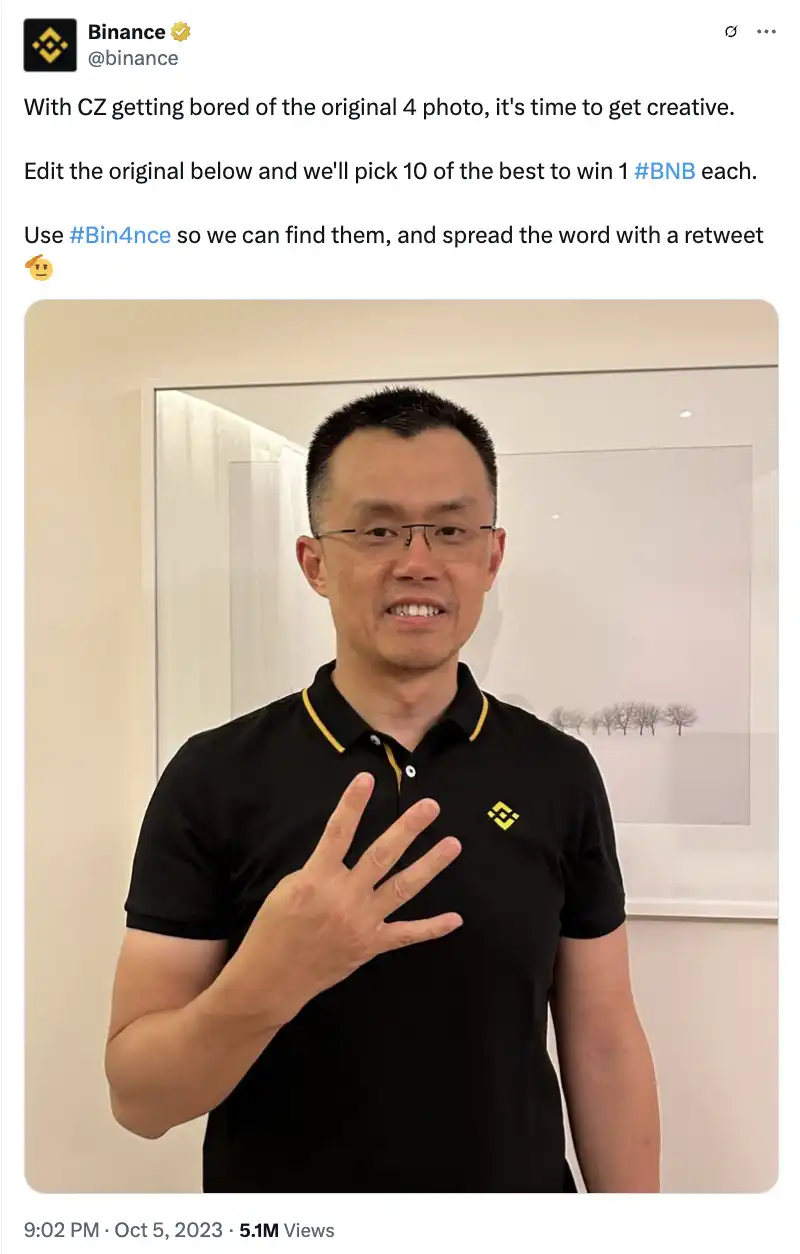
In this context, Four.meme, hatched by the Four (formerly BinaryX) team, was born, and its name and the $FOUR token's design directly mapped CZ's "4" gesture, transforming a cultural symbol into an on-chain asset. At the same time, the platform, through zero-cost issuance and mechanisms linking on-chain and off-chain trading, filled the meme infrastructure gap for BNB Chain, becoming a core vessel for retail influx and on-chain transaction volume surge.
Its model is similar to Pump.fun on Solana, where users can create tokens on Four.meme without paying platform fees, only needing to pay around 0.005 BNB network fee. In on-chain trading, the platform charges a 1% fee per transaction and supports various assets as trading pairs. When the token reaches a market value of around 24 BNB, the platform migrates the token and liquidity to the decentralized exchange PancakeSwap and charges a fixed 0.5 BNB as migration fee.
Why is the Hot Golden Dog on Four Continuously Popular
Actually, the Launchpad on BNB Chain is not few, such as GraFun proposed by the DWF and Floki collaboration. However, as a pioneer, Four Meme effectively cooperated with the BNB Chain, laying a solid foundation for attracting projects to launch on its platform. Last August, Four Meme also launched an accelerator program with the BNB Chain, obtaining comprehensive ecological support from both traffic and funds, providing traffic support and liquidity funds to high-quality Meme projects incubated by Four.meme, forming a "launch-incubate-expand" loop.
Related Reading: "Powered by BNB Chain, How Four.meme Built a Sustainable Meme Platform?"
One of the most typical representative cases is TST. In early February this year, CZ posted an article stating that the BNB Chain team had created a step-by-step video tutorial about launching meme tokens on the Four.meme platform, using the TST token as an example to demonstrate the complete process. "When we released the educational video yesterday, at the 1:18 mark, the token name was revealed. KOLs from the Chinese community began trading and promoting this token, and now the token's market value has reached $494,600." Thus, TST naturally became the protagonist that appeared at the beginning of the collaborative performance between BSC and Four.meme.
After the test coin, the BSC ecosystem once again stirred up the game of guessing dog names, and Four.Meme was still not absent. On February 13, CZ, who loves to joke around, responded to a netizen's question about whether he has a pet dog on social media and revealed the breed of his pet dog. He also stated, "You never know, I might even interact with a few memes on the BNB Chain." Subsequently, Four.Meme announced a unique guessing game centered around a meme token named after CZ's beloved dog, where all tokens created before CZ's tweet were eligible to participate in the competition. The token with the highest market value after 30 minutes of CZ's tweet would win.
The third wave of the meme craze came after Binance announced Abu Dhabi's MGX's $2 billion investment in Binance by acquiring a minority stake, CZ tweeted using the Middle Eastern blessing phrase "mubarak," and then a meme with the same name was launched on the Four.Meme platform, quickly showing strong market performance. Within 16 hours, the token's market value reached a peak of $6 million, with an increase of over 6000%, continuing the meme wealth creation craze in the BSC ecosystem.
This wave after wave of meme trendsetting rhythm is still ongoing, with the Four.meme team continuously playing the role of an on-chain "wave maker" based on their precise capture of market sentiment, deep integration with BNB Chain's official resources, and rapid response to community hot topics. Whether it is launching real-time guessing activities following CZ's social media dynamics or incubating cultural symbol assets based on Binance's strategic direction, Four.meme always tightly binds the ecological narrative with the wealth effect, becoming the hub of on-chain traffic and capital flow on the BSC network.
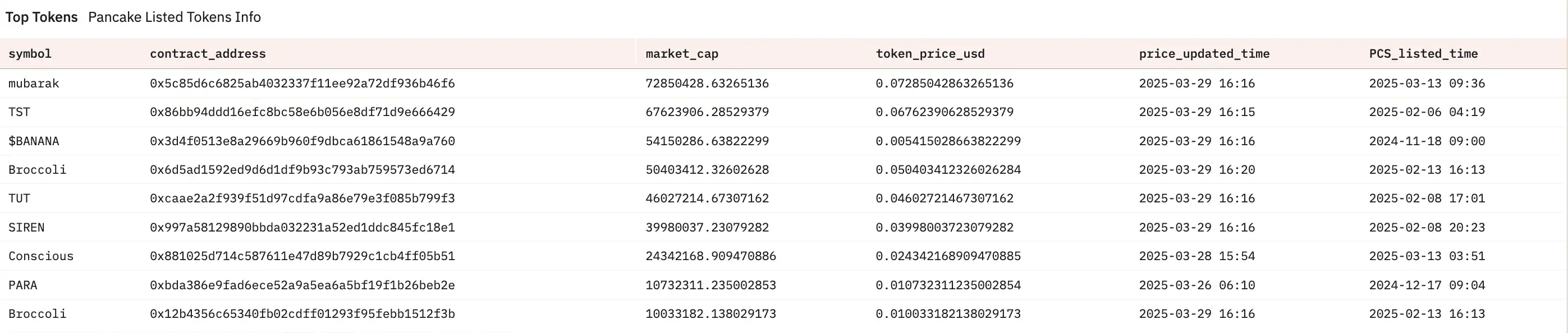
Four.meme Top-Ranked Meme Coins on the Market
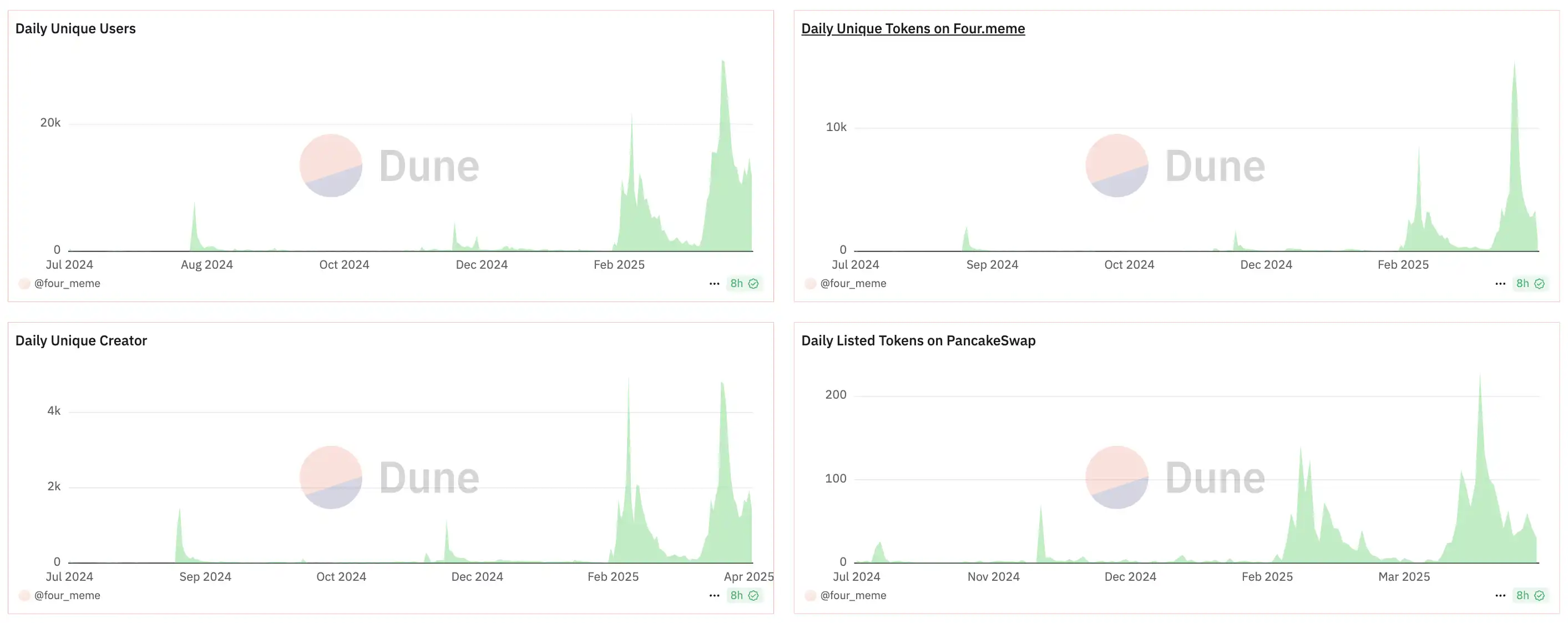
Four.meme Data Performance Overview
From the BANANA and AICell craze last November to the meme frenzy that hit BSC after February this year, picking up from Solana, the test coin concept, the thrilling drama of real and fake broccoli, the battle of the nine heirs, and other fascinating episodes, combined with black swan events on external trading platforms, the BSC ecosystem and Four.meme have undoubtedly become the "hottest character" in the first quarter of the crypto ecosystem.
According to Dune Analytics, as of the end of March 2025, Four.meme has launched over 166,587 token types, with a total of 2741 tokens listed on PancakeSwap. The platform has attracted a total of 245,154 unique users, 63,088 creators, and a trading volume exceeding 1,522,925 BNB, with 12,857 BNB converted into platform revenue.

Of note is that this growth has been concentrated post November 2024, especially showing explosive growth since February 2025, reflecting the rapid increase in Four.meme user activity and the overall on-chain atmosphere.
At the same time, the community has put forward many constructive suggestions regarding Four.meme's liquidity mechanism design. Particularly, compared to Pump.fun on Solana, which uses the V2 model and automatically recycles transaction fees, Four.meme previously utilized the PancakeSwap V3 model, which did not recycle transaction fees to the LP pool, causing some users to worry about insufficient liquidity depth and excessive volatility. In response, the platform swiftly announced a major upgrade scheduled for March 31, 2025: a full transition to the PancakeSwap V2 liquidity mechanism, with all new token listing liquidity tokens being directly burned.
This update not only addresses the community's demands for "LP rewards" and "project sustainability" but also signifies a crucial step forward for Four.meme in on-chain mechanism design. By putting liquidity into a "black hole" for burning, the project gains a fairer market starting point, reduces questioning of platform control, enhances ecosystem transparency and decentralization. The platform's rapid response to feedback has also to some extent solidified community trust, laying the groundwork for a more robust and vibrant Meme ecosystem in the future.
Ecosystem Collaboration: The Evolution of Four.meme
Four.meme has long been steadily building its influence, but its true surge in attention came after CZ began exploring and embracing meme culture. His involvement brought significant attention and made Four.meme a talking point—how it will break through the current narrative ceiling and further drive the development and expansion of the BNB Chain meme ecosystem.
Currently, the deep integration of the BNB Chain ecosystem is attempting to break free from the singular narrative of the Meme track. Four.meme maintains liquidity alignment with PancakeSwap, avoiding the common liquidity competition and fragmentation seen between Pump.fun and Raydium on Solana, providing a more stable trading environment for the platform token's market performance.
Through a strategic alliance with the AI project MyShell, such as co-incubating AI assets and establishing a $10 million ecosystem fund, this is also the first time in the BNB Chain ecosystem that AI technological capabilities have been systematically integrated into the MemeFi issuance logic system. The collaboration will include technology co-development, asset issuance, and potential project incubation, aiming to expand the boundaries of cultural assets beyond memes and drive the diversification and functional development of on-chain assets.
Combining community observers' views, this AI route is also considered part of BNB Chain's current ecosystem growth strategy. Some voices point out that BSC's current operational path is similar to a three-stage strategy of "attract attention—drive concepts—pivot to applications," with the meme explosion just being a prelude. The next phase will focus on directing traffic into the AI sector. In this context, Four.meme's ecosystem extension may be a forward-looking response to the market's rhythm.
In the future, whether Four.meme can find its stable position in the rapidly evolving on-chain culture depends on its ability to balance the tension between user popularity, platform governance, and ecosystem trust. From attracting funds to conveying emotions, and then empowering application scenarios, the path of all this is still under construction, and Four.meme has already taken up a position worth paying attention to in this race of on-chain cultural and economic integration.
The essence of memes is a kind of "tradable attention unit," and their value is closely related to the attention users give them. The attention arbitrage ability of Four.meme may be one of the most scarce infrastructural endowments in the crypto space.
You may also like

Morning Report | BitMine increased its holdings by 126,971 ETH last week; trader Eugene announced his exit from the crypto market

Wang Chuan: How can one not feel anxious after the neighbor Old Wang made thirty times profit by investing in storage stocks? (Seven) - A quarter-century cycle

Cryptocurrency CEXs are flocking to sell US stocks, and traditional brokerages are facing an "uninvited guest."

$75 billion in foreign capital has fled, and South Korean retail investors have absorbed it all using leverage

Japan’s Three Megabanks Plan Joint Stablecoin Issuance in Fiscal 2026
MUFG, SMBC, and Mizuho reportedly plan to jointly issue fiat-pegged stablecoins in fiscal 2026, signaling Japan’s growing push into bank-led digital payment infrastructure.

Humanity Discloses H Token Dual-Chain Attack Details, With Losses on Ethereum and BSC Exceeding $36 Million
Humanity said the H token attack across Ethereum and BSC caused more than $36 million in losses after leaked ProxyAdmin keys enabled malicious contract upgrades and token minting.
White House Discusses CLARITY Act With Law Enforcement Ahead of Senate Vote
The White House discussed the CLARITY Act with law enforcement ahead of a Senate vote, focusing on illicit finance risks and developer protections.

Bitcoin Trading Guide 2026: Strategies for Experienced Traders

What Is XAUT and PAXG? Why Tokenized Gold Is Booming in 2026

Will the SpaceX IPO Hurt Bitcoin? Here's What Traders Are Watching

Foreign selling in the South Korean stock market accelerates, with cumulative net sales reportedly reaching $75 billion this year
On June 9, The Kobeissi Letter, citing Goldman Sachs data, reported that global investors are selling South Korean stocks at an unusually rapid pace. In the latest trading session, foreign investors sold about $801 million worth of Kospi constituent stocks again; total foreign outflows last week reached about $10 billion, and the market has been in net foreign selling on nearly every trading day over the past month. According to the data cited in the report, foreign investors have sold about $75 billion worth of South Korean stocks so far this year. Meanwhile, South Korean retail and institutional investors together recorded roughly $69 billion in net buying over the same period, suggesting that the market’s main buying support has come from domestic capital rather than returning overseas funds. The information currently disclosed still mainly comes from The Kobeissi Letter’s retelling and Goldman Sachs data summaries, while public details on the statistical period and the specific definition of “selling” remain relatively limited.

Fortune Warns of Strategy’s Financing Structure Risks as Bitcoin Premium Narrows
Fortune warned that Strategy’s Bitcoin treasury model faces growing financing risks as MSTR’s net asset premium narrows and preferred stock dividend pressure increases.

Ferrari Challenge Le Mans: Carl Moon to Dominate in WEEX Livery

Sahara AI Responds to SAHARA’s Sharp Drop: No Contract or Product Security Issues Found, Internal Investigation Underway
Sahara AI responded to SAHARA’s 60% price drop, saying no token contract or product security issues have been found and an internal investigation is underway.

WEEX Deposit/Withdrawal Dynamic Island: Your Asset Status, Always in Sight
Scaling Crypto Derivatives: The Digital Asset Infrastructure Behind High-Volume Trading
In the fast-moving digital asset ecosystem, derivatives platforms face an extreme architectural test. High-leverage futures markets demand more than just standard security—they require absolute operational precision, zero-latency matching engines, and ironclad structural scalability, all while navigating intense market volatility.
As global platforms scale to meet these demands, the industry is shifting away from rigid, monolithic setups toward a more agile, "decoupled" infrastructure philosophy.
The Blueprint for High-Volume Copy TradingFor elite global exchanges like WEEX (founded in 2018), this architectural choice becomes critical when scaling high-volume retail features like social copy trading. When thousands of users automatically mirror the real-time strategies of elite traders simultaneously, it triggers sudden, monumental spikes in concurrent transactional volume.
To prevent execution latency or settlement bottlenecks during these peak volatility events, a platform's primary engine must remain entirely dedicated to risk management, copy-trade synchronization, and order matching.
The Architectural Rule: New-generation platforms must separate front-end user execution engines from heavy backend infrastructural overhead to eliminate operational friction.
By separating these layers, platforms can maintain complete sovereignty over their trading environments and user experiences while strategically aligning with institutional-grade infrastructure ecosystems. This strategic framework allows modern exchanges to leverage advanced Digital Asset Custody infrastructure such as Cobo’s behind the scenes, ensuring that backend wallet management scales elastically alongside trading spikes.
Capitalizing on Market Momentum and 400× LeverageIn a derivatives arena where platforms offer up to 400× leverage on perpetual contracts, capital efficiency and market agility are core business metrics. To capture market momentum, an exchange needs the ability to rapidly expand its asset offerings, supporting everything from legacy crypto assets to sudden, trending altcoins across a massive library of trading pairs.
Adopting a flexible, scalable Wallet-as-a-Service (WaaS) solution such as Cobo’s could completely rewrite the development timeline for high-growth exchanges. Instead of spending months of engineering capital building out custom backend wallet architectures for every new blockchain network, platforms can deploy localized infrastructure in days.
This agility allows platforms to instantly scale their listings to over a thousand trading pairs without compromising security or delaying time-to-market. It mirrors the exact operational advantages seen during high-velocity market events, similar to how advanced wallet infrastructure empowers platforms during sudden asset surges; allowing exchanges to pass that speed and liquidity directly to their global user base.
A Mature Foundation for GrowthThe synergy between trusted infrastructure ecosystems and global trading platforms represents the natural evolution of a maturing crypto market. As WEEX continues to scale its global spot and derivatives offerings for over 6 million users, adopting robust backend paradigms proves that platforms no longer have to compromise between cutting-edge trading velocity and uncompromised structural security.

Get Paid to Onboard? Try WEEX’s New Homepage with Rewards for Registration, Deposit & Trade
WEEX Custom Layout: Build Your Perfect Trading Workspace in Seconds
Morning Report | BitMine increased its holdings by 126,971 ETH last week; trader Eugene announced his exit from the crypto market
Wang Chuan: How can one not feel anxious after the neighbor Old Wang made thirty times profit by investing in storage stocks? (Seven) - A quarter-century cycle
Cryptocurrency CEXs are flocking to sell US stocks, and traditional brokerages are facing an "uninvited guest."
$75 billion in foreign capital has fled, and South Korean retail investors have absorbed it all using leverage
Japan’s Three Megabanks Plan Joint Stablecoin Issuance in Fiscal 2026
MUFG, SMBC, and Mizuho reportedly plan to jointly issue fiat-pegged stablecoins in fiscal 2026, signaling Japan’s growing push into bank-led digital payment infrastructure.
Humanity Discloses H Token Dual-Chain Attack Details, With Losses on Ethereum and BSC Exceeding $36 Million
Humanity said the H token attack across Ethereum and BSC caused more than $36 million in losses after leaked ProxyAdmin keys enabled malicious contract upgrades and token minting.


