
HackVC is launching a new VC investment model called the "Community Round" on Echo

Recently, the well-known blockchain venture capital firm HackVC announced the opening of a community investment group on Echo. As one of the first regulated major U.S. crypto fund management companies to participate in Echo's "community round," they hope to take this opportunity to make HackVC a truly community-driven VC. With the Crypto market gradually losing trust in VCs, VCs also seem to be seeking transformation, hoping to get closer to the market.
HackVC's founder Alexander Pack made his first cryptocurrency investment at the age of 22 at a fintech VC firm in Hong Kong. At that time, the cryptocurrency market was still in its early stages, but Pack believed it would be a future trend. He later returned to the U.S. to join Bain Capital, helping them invest in crypto. In 2018, Alexander ventured out on his own, co-founding the cryptocurrency venture fund Dragonfly Capital with Bo Feng and serving as its first managing partner. The firm has since become one of the largest crypto funds in Asia. In 2020, Alexander left Dragonfly Capital and founded HackVC.
Just from the name, it is clear that HackVC's investment focus heavily on technology. In Pack's own words, HackVC is a group of hackers investing in another group of hackers. Managing Partner Ed Roman initiated the well-known hackathon event "hack.summit()," while Research Partners Christopher Maree and Sean Brown come from the UMA oracle team. The former was a member of the Ethereum Foundation Devcon V Scholar, and the latter served as an IBM Blockchain Senior Consultant. It can be said that HackVC's investment preference to some extent focuses on the technical feasibility and scalability of the projects they invest in.
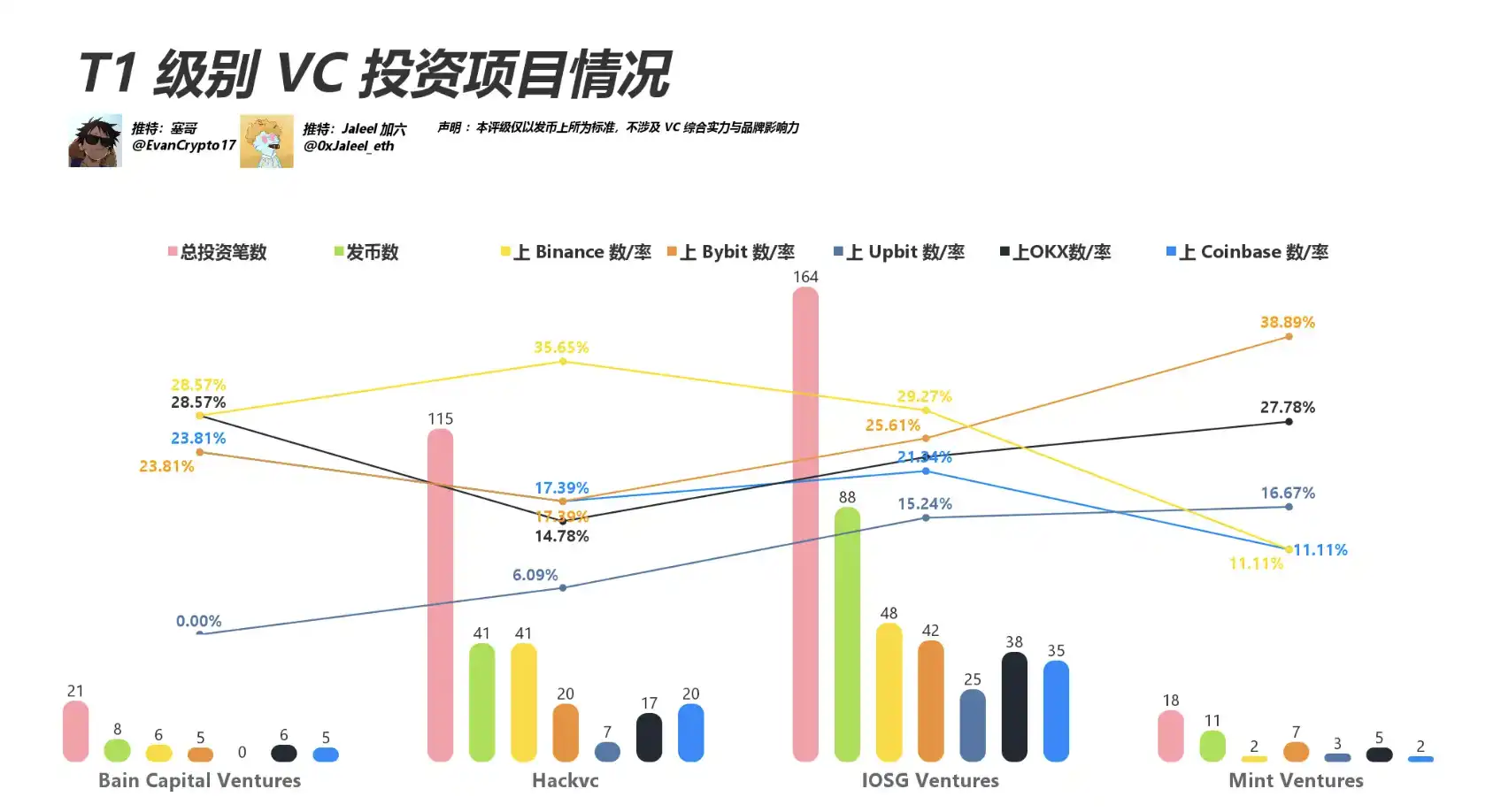
This has also enabled HackVC to achieve quite a good performance in this round of investments, having early investments in quality projects such as Berachain, EigenLayer, Morpho, Grass, and Soon.
Related Reading: "Everyone's Criticizing VC Coins, Let's See How VCs Are Performing This Round"
Rediscovering the Original Intention: The "Echo Model"
However, with the emergence of Agency Research and KOL Round in the investment ecosystem, the financing cycle has become shorter, and the participation in projects has become more profound, leading to a higher success rate in investment models. It seems that VCs also need to find a more excellent investment logic and model.
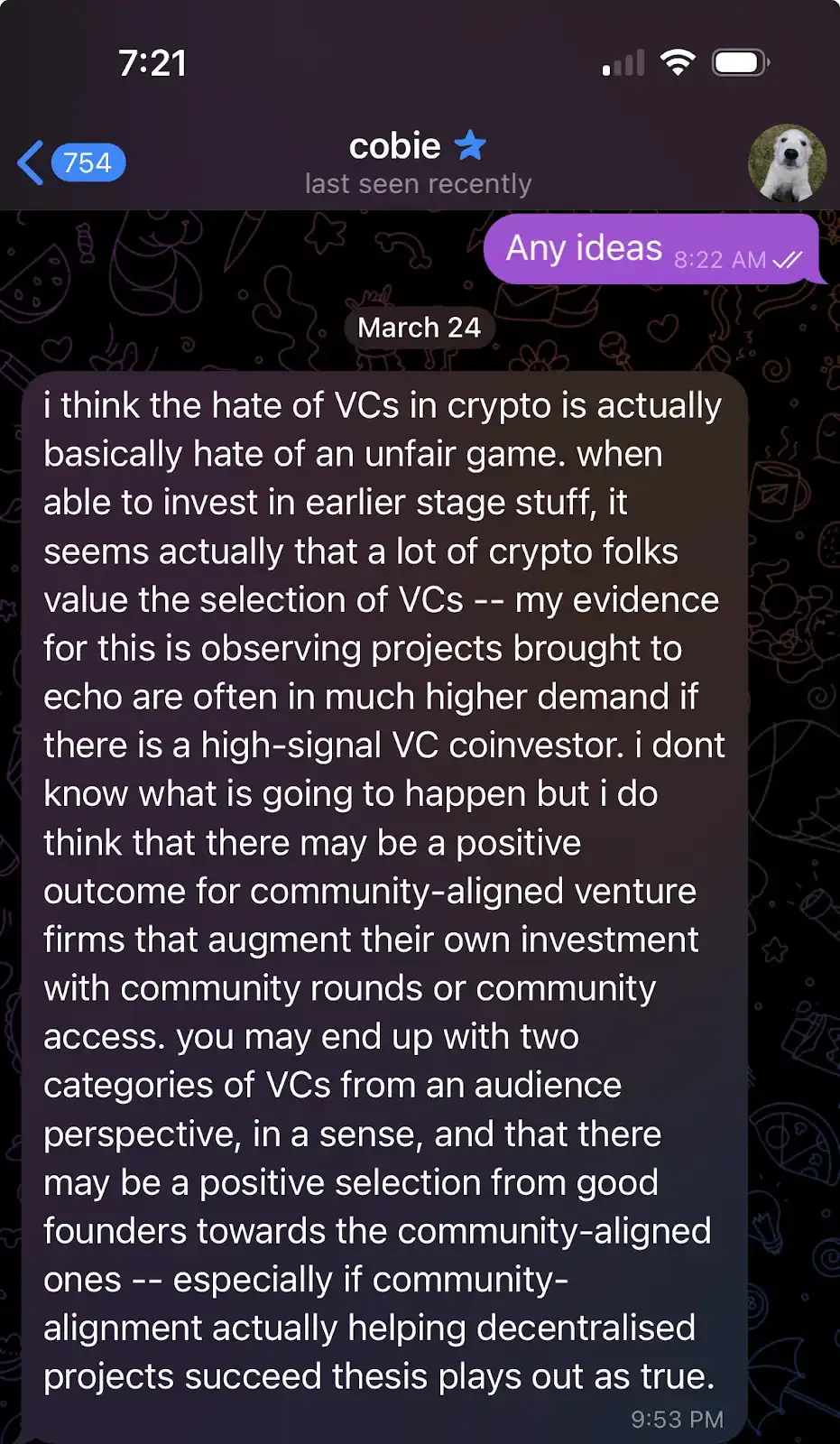
Furthermore, the conversation between Pack and Echo's founder Cobie highlighted the purpose of Echo. Cobie believes that the current cryptocurrency community's aversion to venture capitalists "VCs" is actually an aversion to unfair games. When individuals are able to invest at an early stage, projects invested in by high-signal VC firms usually have higher demand. Cobie believes that there may be a VC model that is community-friendly, which will strengthen its investment through a community round or community access. When community alignment can indeed help blockchain projects succeed, VCs will enable the community to positively select from good founders aligned with the community.
This undoubtedly resonates with Pack's ideology, as he stated on Twitter that he entered the cryptocurrency field 11 years ago because he believed that cryptocurrency could democratize the channels of tech investment. In the early stages of his career, he participated in the crowdfunding platform AngelList and became their first analyst, helping AngelList legalize crowdfunding through the CROWDFUND Act in 2012. However, it did not meet Pack's expectations, as regulatory complexities hindered progress along with the fact that most Web2 founders and venture capitalists did not see the value in bringing their "community" into the funding rounds.
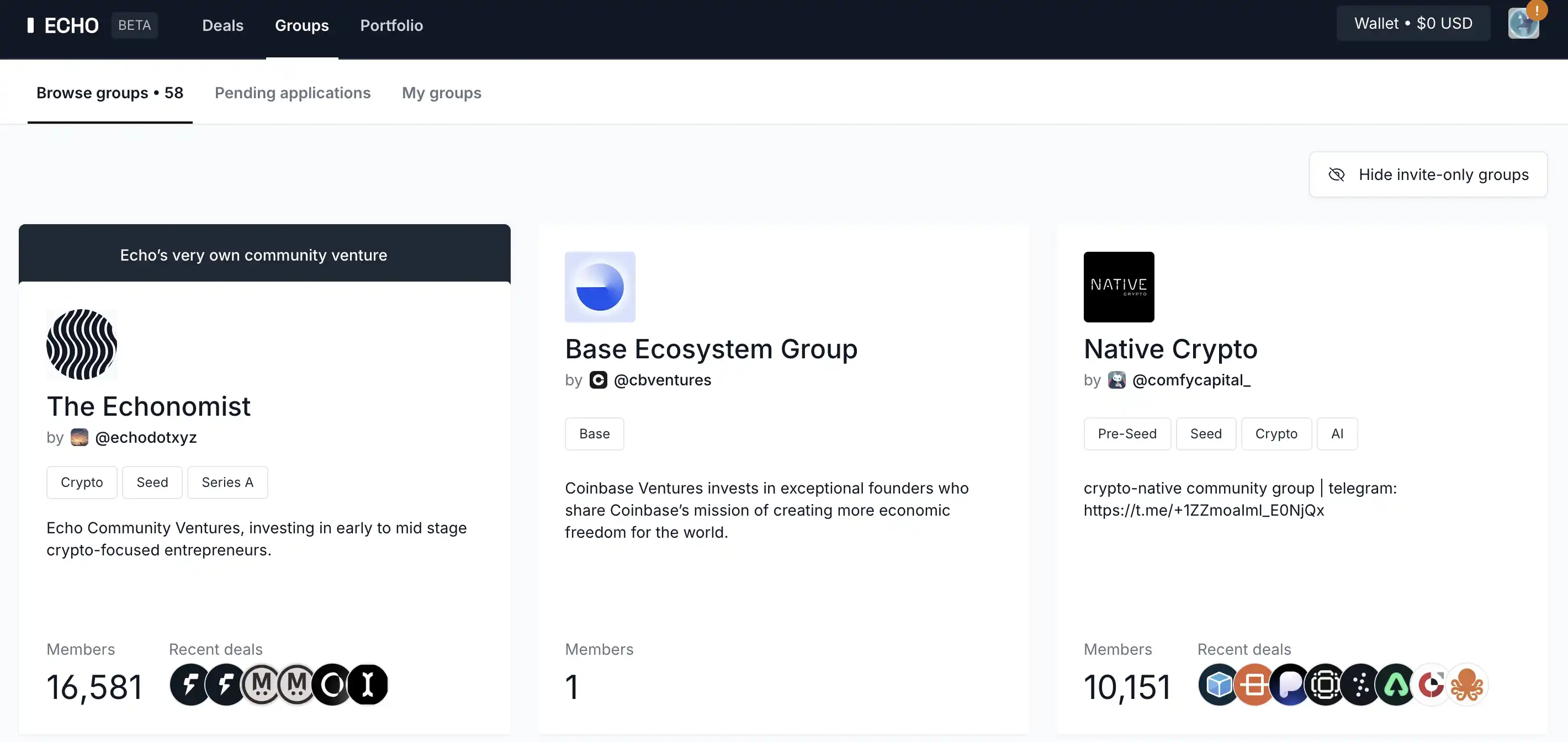
On the other hand, Echo's model is indeed different from traditional ICO platforms. Echo was founded by crypto KOL Cobie "@echodotxyz" in March 2024. Cobie was formerly the growth lead at Lido and hosted the popular Web3 podcast UpOnly. Echo's core revolves around the "Lead Investment Recommendation Mechanism," where users can act as lead investors to create investment communities, share projects with members, and earn a share of the returns.
Compared to the established ICO platform CoinList's model, where investors directly support projects to facilitate rapid fundraising, and investors receive token rights, Echo's business model focuses on facilitating the "token economy" through community capital formation. It allows native on-chain users to collectively invest in startups. The process involves lead investors creating investment groups, and group members can choose to follow the investment, with the investment flowing indirectly to the company through an intermediary investment tool. The investment not only involves token rights but may also include company equity. In simple terms, CoinList invests in the tokens of the company/project, while Echo directly invests in the company through intermediaries.
Since its launch, over 30 crypto projects have raised funds through Echo, including Ethena, Morph, Usual, Hyperlane, Dawn, Monad, Initia, MegaETH, and other well-known crypto projects. A total of $1 billion was raised within a year, with MegaETH completing two $10 million fundraisings through the Echo platform in December 2024. The first raise of $4.2 million was completed in 56 seconds, and the second raise of $5.8 million was completed in 75 seconds.
This model is similar to the "Investor Syndicate" of crypto investors, which tends to choose high-potential projects recognized by a small circle. Figures like The Block's CEO Larry Cermak and Aave founder Marc Zeller have created their own Echo communities. To join, users must first answer some questions and undergo identity KYC verification. Additionally, some communities have specific criteria for certain investment opportunities. Currently, 58 community leaders have created communities on Echo.
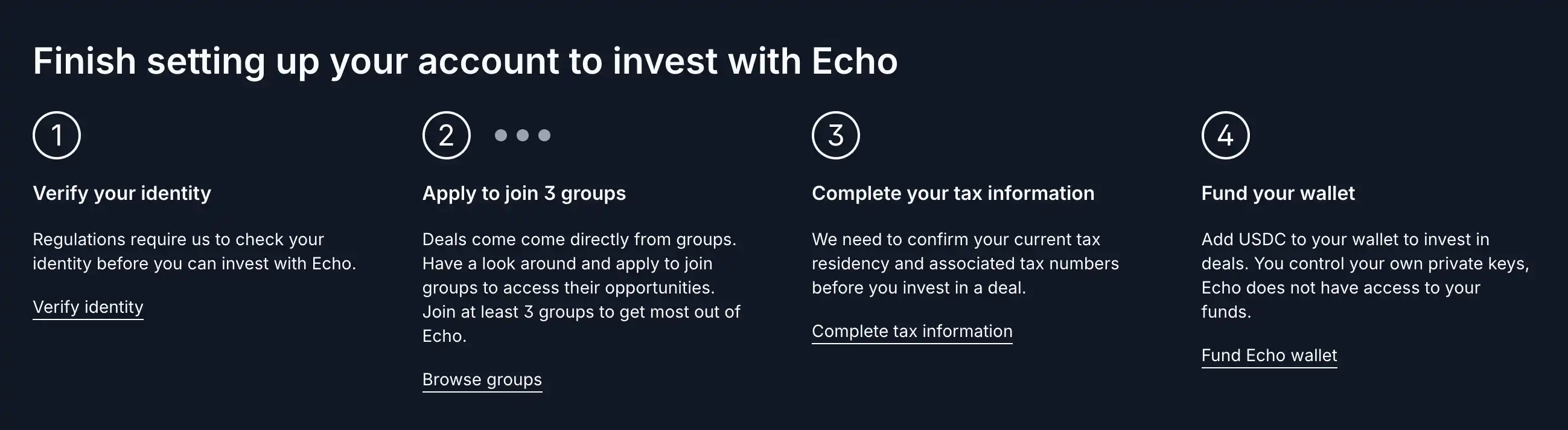
In this community-driven model, investment is managed through smart contracts to ensure that lead investors do not have access to user funds. Users can decide when to sell tokens. If a lead investor's investment is successful, they receive a percentage of the profits from co-investors, incentivizing high-quality project sharing. While the elite-oriented nature makes its user base relatively niche, this screening mechanism ensures project quality, attracting investors who value trust.
In a statement, Coinbase's VP of Corporate Development Shan Aggarwal and Base founder Jesse Pollak said, "On-chain investing allows eligible investors to participate in ways previously impossible, while enabling founders to access a broader, more vibrant capital base. We are excited to expand Base's capital channels for builders, allowing more people to participate in the next wave of innovation."
Some industry experts suggest that the more lenient regulatory environment in the United States may lead to a resurgence of public sales. Another hot ICO platform at the moment, Legion, co-founder Matt O'Connor, stated, "Once ICOs regain vitality, they may shift focus away from the memecoin craze." Currently, there are fewer products being genuinely developed, with wealth increasingly accumulating behind the scenes.
HackVC's Initial Venture with the Community
Hack VC has launched the Echo group, deciding to open up core project resources to screened high-quality community members through a private access mechanism, while also implementing a first-year zero performance fee policy. In addition, invested companies are required to set a community fundraising round and implement a "Community Priority Protection" principle in the valuation system, meaning that if it is the first investment, the community round valuation must be lower than the concurrent institutional round; if not the first, it must be lower than the latest VC entry valuation, ensuring a price advantage for the community through structural design.
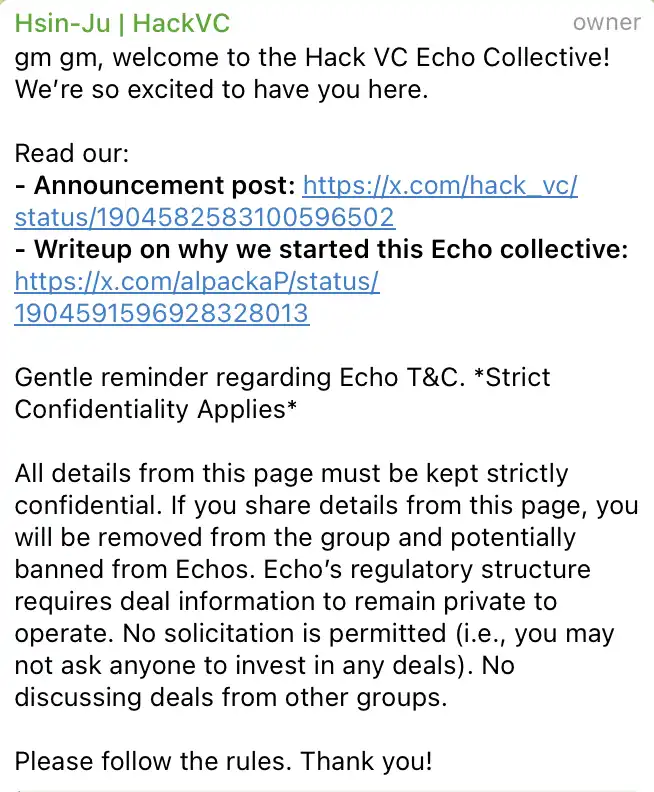
Although there are still many concerns in the community about this model not having a "governance token" or being a "Dao," regardless of the outcome of Hack VC's attempt this time, it has set a precedent for the future collaboration between VCs and communities. The evolutionary history of cryptocurrency fundraising models is a process of continuous innovation in community coordination mechanisms, from the Bitcoin PoW mechanism opening the era of fair mining, to Ethereum's $18 million crowdfunding in 2014 pioneering on-chain fundraising, to the ICO boom in 2017, community-driven approaches have always been at the core.
Then, the ICO era explored two paths, with centralized platforms like CoinList successfully operating projects like Solana but facing scalability limits, while on-chain airdrops and yield farming, although reducing barriers to entry, faced challenges of user commitment.
Today, against the backdrop of mature compliance frameworks and on-chain infrastructure, Echo is restructuring the crowdfunding process through a non-custodial Syndicate model, and Legion is introducing an on-chain reputation system to optimize investor screening, marking the next stage in community fundraising. It inherits the open genes of ICOs, balances efficiency and fairness through technological means, and a new golden age of compliance and precision operation may be on the horizon.
You may also like

Cryptocurrency CEXs are flocking to sell US stocks, and traditional brokerages are facing an "uninvited guest."

Will the SpaceX IPO Hurt Bitcoin? Here's What Traders Are Watching
Foreign selling in the South Korean stock market accelerates, with cumulative net sales reportedly reaching $75 billion this year
On June 9, The Kobeissi Letter, citing Goldman Sachs data, reported that global investors are selling South Korean stocks at an unusually rapid pace. In the latest trading session, foreign investors sold about $801 million worth of Kospi constituent stocks again; total foreign outflows last week reached about $10 billion, and the market has been in net foreign selling on nearly every trading day over the past month. According to the data cited in the report, foreign investors have sold about $75 billion worth of South Korean stocks so far this year. Meanwhile, South Korean retail and institutional investors together recorded roughly $69 billion in net buying over the same period, suggesting that the market’s main buying support has come from domestic capital rather than returning overseas funds. The information currently disclosed still mainly comes from The Kobeissi Letter’s retelling and Goldman Sachs data summaries, while public details on the statistical period and the specific definition of “selling” remain relatively limited.

Fortune Warns of Strategy’s Financing Structure Risks as Bitcoin Premium Narrows
Fortune warned that Strategy’s Bitcoin treasury model faces growing financing risks as MSTR’s net asset premium narrows and preferred stock dividend pressure increases.

Ferrari Challenge Le Mans: Carl Moon to Dominate in WEEX Livery

Sahara AI Responds to SAHARA’s Sharp Drop: No Contract or Product Security Issues Found, Internal Investigation Underway
Sahara AI responded to SAHARA’s 60% price drop, saying no token contract or product security issues have been found and an internal investigation is underway.

WEEX Deposit/Withdrawal Dynamic Island: Your Asset Status, Always in Sight

Scaling Crypto Derivatives: The Digital Asset Infrastructure Behind High-Volume Trading
In the fast-moving digital asset ecosystem, derivatives platforms face an extreme architectural test. High-leverage futures markets demand more than just standard security—they require absolute operational precision, zero-latency matching engines, and ironclad structural scalability, all while navigating intense market volatility.
As global platforms scale to meet these demands, the industry is shifting away from rigid, monolithic setups toward a more agile, "decoupled" infrastructure philosophy.
The Blueprint for High-Volume Copy TradingFor elite global exchanges like WEEX (founded in 2018), this architectural choice becomes critical when scaling high-volume retail features like social copy trading. When thousands of users automatically mirror the real-time strategies of elite traders simultaneously, it triggers sudden, monumental spikes in concurrent transactional volume.
To prevent execution latency or settlement bottlenecks during these peak volatility events, a platform's primary engine must remain entirely dedicated to risk management, copy-trade synchronization, and order matching.
The Architectural Rule: New-generation platforms must separate front-end user execution engines from heavy backend infrastructural overhead to eliminate operational friction.
By separating these layers, platforms can maintain complete sovereignty over their trading environments and user experiences while strategically aligning with institutional-grade infrastructure ecosystems. This strategic framework allows modern exchanges to leverage advanced Digital Asset Custody infrastructure such as Cobo’s behind the scenes, ensuring that backend wallet management scales elastically alongside trading spikes.
Capitalizing on Market Momentum and 400× LeverageIn a derivatives arena where platforms offer up to 400× leverage on perpetual contracts, capital efficiency and market agility are core business metrics. To capture market momentum, an exchange needs the ability to rapidly expand its asset offerings, supporting everything from legacy crypto assets to sudden, trending altcoins across a massive library of trading pairs.
Adopting a flexible, scalable Wallet-as-a-Service (WaaS) solution such as Cobo’s could completely rewrite the development timeline for high-growth exchanges. Instead of spending months of engineering capital building out custom backend wallet architectures for every new blockchain network, platforms can deploy localized infrastructure in days.
This agility allows platforms to instantly scale their listings to over a thousand trading pairs without compromising security or delaying time-to-market. It mirrors the exact operational advantages seen during high-velocity market events, similar to how advanced wallet infrastructure empowers platforms during sudden asset surges; allowing exchanges to pass that speed and liquidity directly to their global user base.
A Mature Foundation for GrowthThe synergy between trusted infrastructure ecosystems and global trading platforms represents the natural evolution of a maturing crypto market. As WEEX continues to scale its global spot and derivatives offerings for over 6 million users, adopting robust backend paradigms proves that platforms no longer have to compromise between cutting-edge trading velocity and uncompromised structural security.

Morning Report | BitMine increased its holdings by 126,971 ETH last week; trader Eugene announced his exit from the crypto market

Wang Chuan: How can one not feel anxious after the neighbor Old Wang made thirty times profit by investing in storage stocks? (Seven) - A quarter-century cycle

Get Paid to Onboard? Try WEEX’s New Homepage with Rewards for Registration, Deposit & Trade

WEEX Custom Layout: Build Your Perfect Trading Workspace in Seconds

See “Buy Walls” & “Sell Walls” Instantly: WEEX Launches the Depth Chart for Smarter Trades

What Is Quick Trade on WEEX? 2 Ways WEEX Ends Chart-Panel Jumping
Morning News | Five major virtual asset platforms in South Korea have experienced 57 incidents of hacking and system failures in six years; Grayscale submits registration application for Canton ETF

Should we escape the peak? The principle of the tail-end market in the stock market

RootData: May 2026 Cryptocurrency Exchange Transparency Research Report

Founder of Baixing.com: My Experience with Claude Code in Fourteen Points
Cryptocurrency CEXs are flocking to sell US stocks, and traditional brokerages are facing an "uninvited guest."
Will the SpaceX IPO Hurt Bitcoin? Here's What Traders Are Watching
Foreign selling in the South Korean stock market accelerates, with cumulative net sales reportedly reaching $75 billion this year
On June 9, The Kobeissi Letter, citing Goldman Sachs data, reported that global investors are selling South Korean stocks at an unusually rapid pace. In the latest trading session, foreign investors sold about $801 million worth of Kospi constituent stocks again; total foreign outflows last week reached about $10 billion, and the market has been in net foreign selling on nearly every trading day over the past month. According to the data cited in the report, foreign investors have sold about $75 billion worth of South Korean stocks so far this year. Meanwhile, South Korean retail and institutional investors together recorded roughly $69 billion in net buying over the same period, suggesting that the market’s main buying support has come from domestic capital rather than returning overseas funds. The information currently disclosed still mainly comes from The Kobeissi Letter’s retelling and Goldman Sachs data summaries, while public details on the statistical period and the specific definition of “selling” remain relatively limited.
Fortune Warns of Strategy’s Financing Structure Risks as Bitcoin Premium Narrows
Fortune warned that Strategy’s Bitcoin treasury model faces growing financing risks as MSTR’s net asset premium narrows and preferred stock dividend pressure increases.
Ferrari Challenge Le Mans: Carl Moon to Dominate in WEEX Livery
Sahara AI Responds to SAHARA’s Sharp Drop: No Contract or Product Security Issues Found, Internal Investigation Underway
Sahara AI responded to SAHARA’s 60% price drop, saying no token contract or product security issues have been found and an internal investigation is underway.


