
How did the Web3 Nintendo TreasureDAO end up failing?



On January 6, 2022, TreasureDAO's official Twitter account made a grand declaration, "The Nintendo of Web3, will be a DAO."

On April 3, 2025, TreasureDAO released a nearly 15-minute video titled "TreasureDAO's Next Chapter," announcing the full termination of the game publishing stack and game distribution in favor of transitioning to AI.
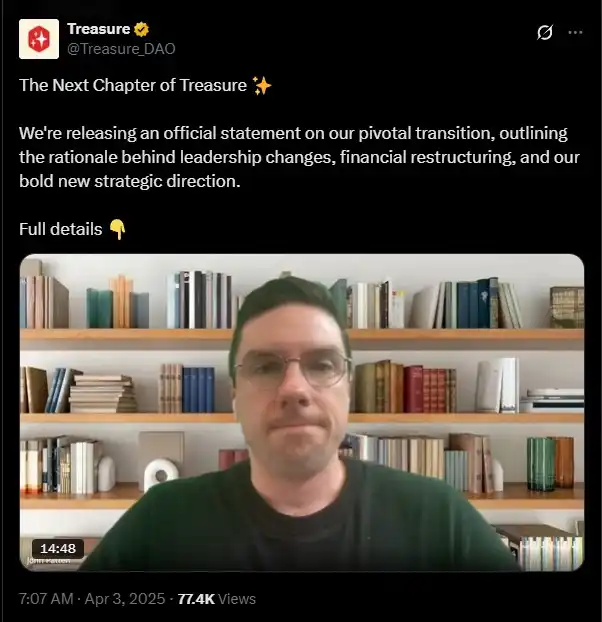
After waiting for 3 years, they never truly achieved their own "Nintendo". How did TreasureDAO, once thriving, end up in such desolation?
Origin
Treasure was founded in September 2021 by John Patten (@smoldev__) and yyyy (@0xyyyy). It initially appeared as a derivative of the Loot project. Loot NFTs were generated with randomly named weapon equipment, such as the "Dragon's Crown" and "Silver Ring" shown in the image below.
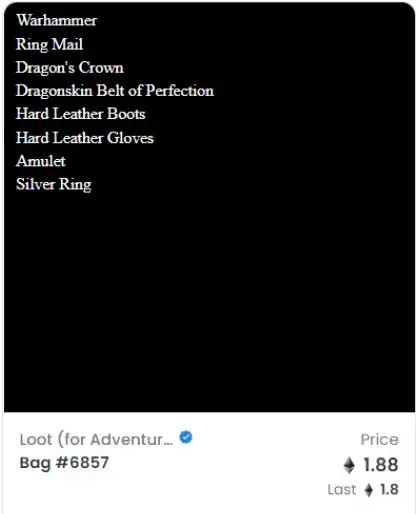
The once unintelligible Loot NFTs made people wonder, "Is this English word made of gold?"
Inspired by Loot, John Patten and yyyy believed that since randomly generating NFTs with weapon equipment names was a brilliant idea, wouldn't it be interesting to randomly generate NFTs with names of common RPG game treasures like "Diamond" and "Jade"? Hence, the following "Treasure Bag" was created.

Soon, they established a staking website where users could stake NFTs including $AGLD, Loot, Treasure, and other projects to receive $MAGIC tokens and Legion NFTs from the Bridgeworld game.
According to a tweet by @arius_xyz published on September 8, 2021, staking a "Treasure Bag" NFT would allow you to receive 3600 $MAGIC within 30 days. The highest historical price of $MAGIC was $6, meaning that staking a "Treasure Bag" NFT at that time for 30 days would turn into $21,600 six months later.
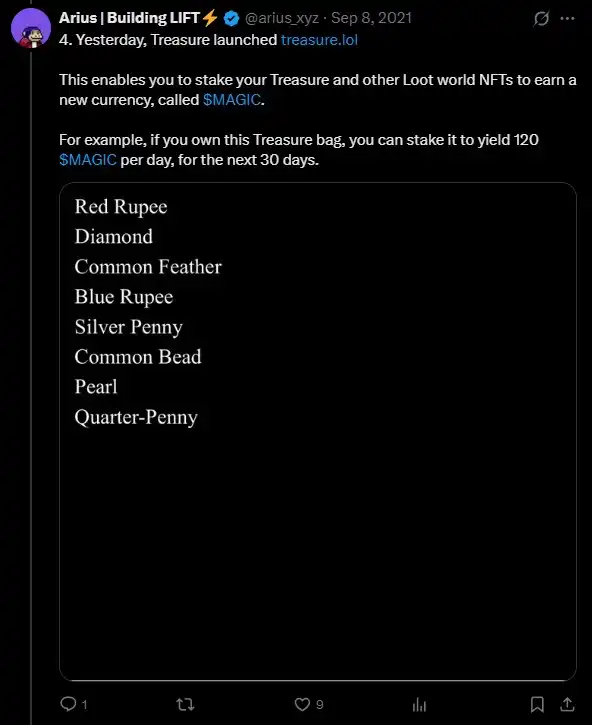
Aligned with Loot's vision at the time, Treasure aimed to build a bottom-up on-chain gaming world. As each of the 8 assets in each "Treasure Bag" was further broken down into NFTs, the number of staking transactions surged, and the congested Ethereum mainnet made the gas fees for these operations unbearable. Considering the poor player experience and the anticipated high volume of transactions once the game was released, Treasure made the decision to migrate to Arbitrum. TreasureDAO was also formally established to drive this grand vision.
At that time, there was no NFT marketplace supporting Arbitrum, as Arbitrum itself was also nascent. Consequently, TreasureDAO's NFT marketplace was also launched. This NFT marketplace later evolved into Trove, and for a considerable period, it stood as the undisputed representative of Arbitrum NFTs.
Brilliance
Back then, the Treasure team's understanding of leveraging NFTs and gamification to create the latest DeFi narrative was cutting-edge. Even now, if you revisit TreasureDAO's Medium, I bet you will marvel at how well they can tell a story. "Liquidity is weather, liquidity is time, liquidity is a measure of spatial scope" — this metaphor will forever remain on my CoinDesk President Mount Rushmore of Quotes.
They not only talk the talk but also walk the walk. The speed at which TreasureDAO was progressing at the time was not only remarkable within the Loot ecosystem but also across the entire crypto space. Within just one month of the project launch, they had completed asset breakdowns, asset animation production, cross-chain asset operations, and notably announced the integration of a new game called "Life." This was the first community-led project within the Treasure ecosystem but not developed by the team. The gaming concept at the time led me to unhesitatingly join the Chinese whitepaper translation work organized by @GavinGPT, who even personally funded rewards for all translators.
Throughout evolution, individuals exhibit new traits and undergo age-related changes. They go to school, fall in love, pursue careers, experience many uniquely personal successes and disappointments, and eventually die.
Life is a long, experiential board game. It was meant to be an emotional experience. NFTs breed like people, not like hamsters. Their lifespans are limited but extraordinary, just like our own.
Co-founder John Patten said when he wanted to create an NFT project called Smol Brains, many people didn't understand and thought it would dilute the value of $MAGIC. However, Smol Brains later became the flagship NFT series on Arbitrum. It was the most successful narrative GameFi series at the time. What struck me the most was when the storyline progressed to the point where the island where the Smol Brains lived was about to sink, the Smol Brains holders had to decide whether to board a rocket to the moon for survival. To build a rocket, Smol Brains had to achieve a certain IQ value through staking. At that time, Smol Brains were already priced out of my range, but I watched closely every day—what would happen to the Smol Brains with insufficient IQ? Would they be destroyed?
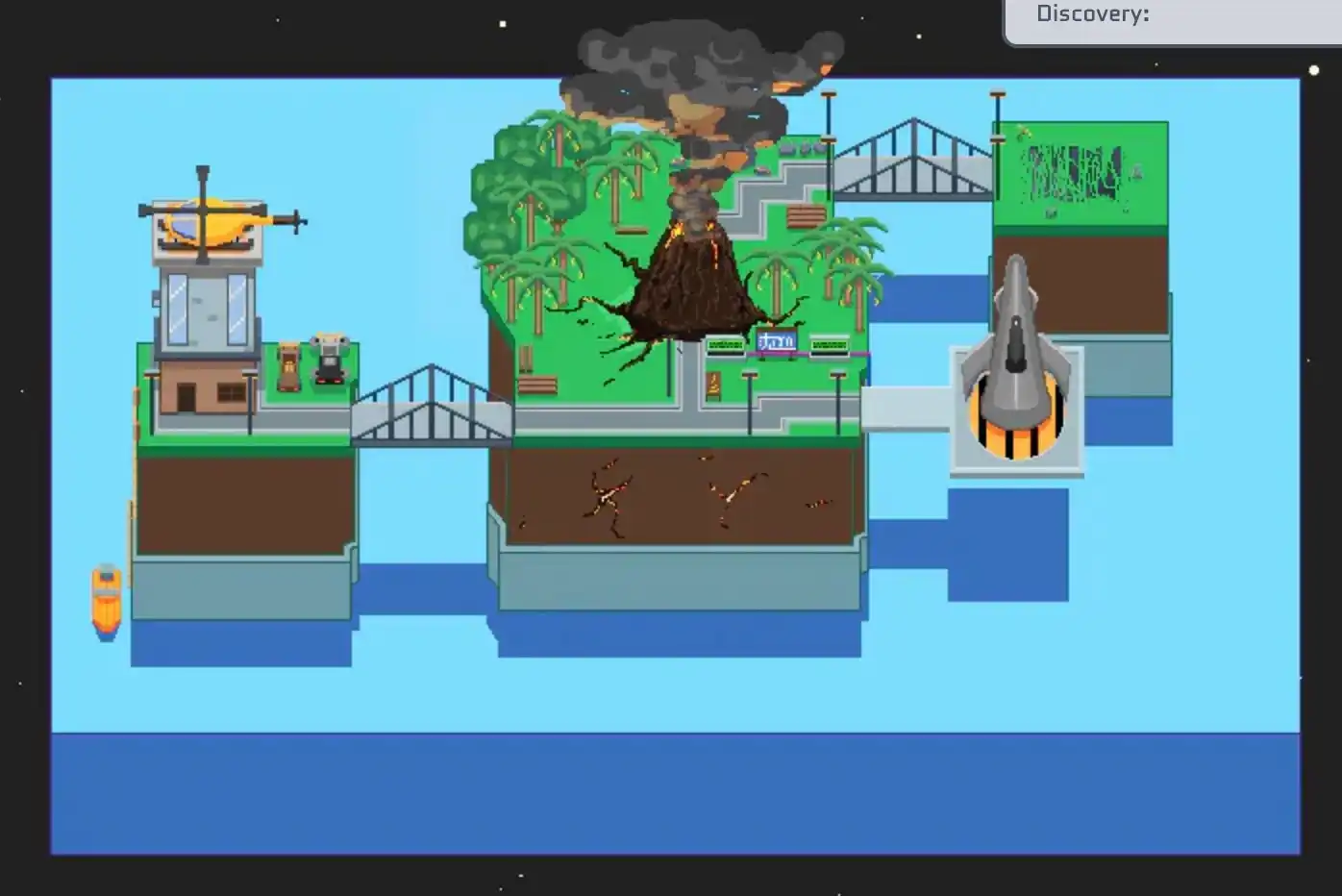
Smol Brain was a Free Mint project. At its price peak, holding a Smol Brains from start to finish could earn you $100,000 when converted to $MAGIC. On the other hand, the flagship project of the TreasureDAO ecosystem, Bridgeworld's Legion NFT, had a floor price of 20 ETH at its peak, during the era when ETH had proud diamond hands.
Prior to Treasure, Arbitrum's daily NFT trading volume was less than 1 ETH. Since the launch of the NFT marketplace on November 13, 2021, in just 7 months, it has achieved a trading volume of over $285 million. At the beginning of 2022, Treasure's marketplace was the second-highest-grossing NFT marketplace globally, with just the Bridgeworld and Smol Brains series accounting for 10% of the total OpenSea trading volume.
By the end of February 2022, $MAGIC's price reached a historical high of $6.
Twilight
All good things must come to an end. After reaching a peak of $6, the price of $MAGIC has been on a steady decline. By May 2022, $MAGIC's price had dropped below $1, reaching a low of under $0.3. Although there was a rebound to around $2 in early 2023, $MAGIC has never returned to even half of its previous all-time high since the peak.
Nevertheless, games within the ecosystem have been steadily advancing, with an increasing number of games choosing to join the TreasureDAO ecosystem. The most famous among them is "The Beacon," which surged in popularity towards the end of 2022, marking what I see as the final glory of TreasureDAO.
Due to the long development time and high difficulty of game development, a significant portion of games within the ecosystem ended up abandoned, such as the previously mentioned "Life," and "Battlefly," which was once an NFT selling for a four-digit USD price.
Apart from the market attention sparked by this significant shift in development direction, the last time TreasureDAO was in the spotlight was when Shaw's AI concept gained fame. Shaw was originally a developer within the TreasureDAO ecosystem, responsible for the AI game project "Smol World" under Smol Brains. The vision of Smol World was for each Smol Brains to act as an AI Agent in an on-chain game, where they could steal each other's assets through PvP, all while integrating the game itself with the Eliza framework. Back then, buoyed by this positive development, Smol Brains surged fourfold in value.
Questioning
Such a major strategic development shift announced abruptly in such a weak market environment naturally raised numerous questions.
Chinese community influencer BlueFox, who was once a supporter of TreasureDAO, commented on John Patten's tweet, asking, "Why now? Why not earlier?"
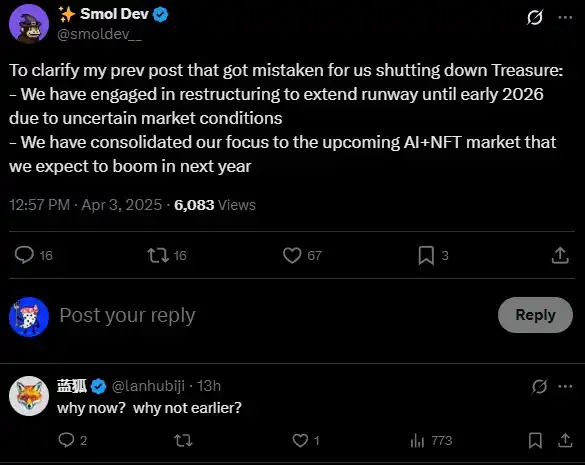
This is also my question. When the AI concept was at its peak hype last year, TreasureDAO did receive market attention. Why did they not pivot at that time and instead wait until now?
In a video, John Patten mentioned, "This transformation is not by choice but out of necessity for survival. Even with financial health, this is the most sensible choice." According to his disclosure, considering expenditure based on the USDC rate and the stablecoins held, the remaining operational funds of TreasureDAO can only sustain operations until July 2025.
Currently, the TreasureDAO treasury holds $2.4 million in stablecoins to support infrastructure and Bridgeworld game development. Additionally, Flowdesk (TreasureDAO's liquidity provider) holds around $1.49 million in assets, with $0.786 million of assets idle and available for withdrawal. If the DAO agrees to a proposal to withdraw this portion of the funds, the stablecoin assets will increase to $3.2 million.
The treasury also holds 22.3 million MAGIC tokens, currently valued at around $2.3 million. Grants distributed to ecosystem game projects are priced in USD but actually paid out in $MAGIC, calculated based on the average price at the time of distribution. With the devaluation of $MAGIC, the actual amount of $MAGIC required has significantly increased, greatly reducing TreasureDAO's ability to fulfill.
Well, for this nail-biting situation, it seems it can also be explained by "decision-making errors and failure to pivot in time." However, the financial expenditure of TreasureDAO has also left some players puzzled—after all, isn't the developed game a AAA title? Is it really necessary to burn through so much money?
Still based on John Patten's disclosure, TreasureDAO's annual personnel expenses are around $6.1 million, with annual operating costs of around $3 million, and the team size once approached 40 people. When I asked ChatGPT to help me find a traditional game company with annual operating costs of around $10 million, the answer ChatGPT provided was an American game company, Telltale Games, which had once produced "The Walking Dead" and had an employee count of about 90 people.
Arbitrum official Nina Rong also commented on TreasureDAO's financial difficulties:
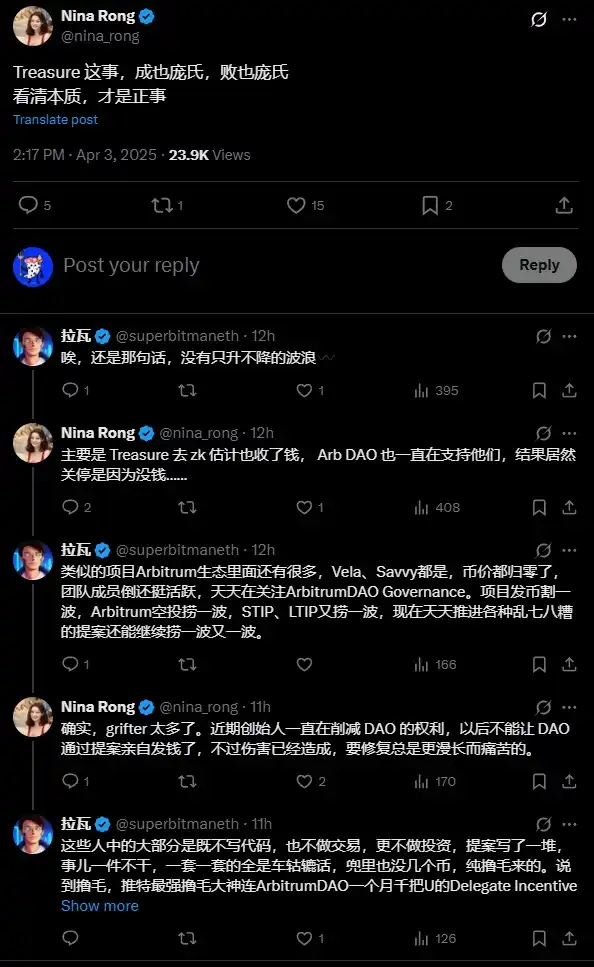
Has TreasureDAO moved funds to zkSync? Yes, they have, but they are also burning through them. A grant from Zk Foundation totaling about $1.1 million, half of which has been committed to the game project and will unlock over two years. The fixed annual operating cost of running the Treasure Chain is $0.45 million (priced in USDC), and even with the planned unlocks, Treasure Chain would still lose $0.175 million annually.
Conclusion
The dilemma faced by TreasureDAO may be the same dilemma faced by all projects in the crypto space. It's difficult to blame them for expanding outward when they had surplus at home, but they tightened their belts way too late. This unexpected announcement caused a drop in $MAGIC's price, undoubtedly making a bad situation worse.
Currently, TreasureDAO has laid off 15 employees, completely terminated its game publishing stack and game distribution, communicated with game partners to cancel remaining grants, reduced its annual spending from $7.5 million to $3.8 million, and plans to further reduce it to $3 million in the next few months.
However, John Patten also emphasized that if $MAGIC experiences a significant devaluation after the announcement and fails to recover, TreasureDAO will struggle to survive until 2026.
He proposed that TreasureDAO undergo strategic contraction, focusing on four areas: the NFT market, Bridgeworld, Smol World, and AI Agent. Multiple governance proposals are also forthcoming, including allocating a liquidation fee, withdrawing idle assets from the liquidity provider Flowdesk, confirming new product directions, and shutting down Treasure Chain.
TreasureDAO will still create games, but the vision of being the "Web3 Nintendo" has been completely erased. Facing survival, they are no longer able to pursue their former ideals.
This ideal was not only theirs, but once belonged to the entire Web3 community. Whether as project leaders like them or as Web3 users like us, perhaps we have never lost our ideals, but maybe we all feel the melancholy of shattered ideals.
An era has come to an end.
You may also like

Morning Report | BitMine increased its holdings by 126,971 ETH last week; trader Eugene announced his exit from the crypto market

Wang Chuan: How can one not feel anxious after the neighbor Old Wang made thirty times profit by investing in storage stocks? (Seven) - A quarter-century cycle

Cryptocurrency CEXs are flocking to sell US stocks, and traditional brokerages are facing an "uninvited guest."

$75 billion in foreign capital has fled, and South Korean retail investors have absorbed it all using leverage

Japan’s Three Megabanks Plan Joint Stablecoin Issuance in Fiscal 2026
MUFG, SMBC, and Mizuho reportedly plan to jointly issue fiat-pegged stablecoins in fiscal 2026, signaling Japan’s growing push into bank-led digital payment infrastructure.

Humanity Discloses H Token Dual-Chain Attack Details, With Losses on Ethereum and BSC Exceeding $36 Million
Humanity said the H token attack across Ethereum and BSC caused more than $36 million in losses after leaked ProxyAdmin keys enabled malicious contract upgrades and token minting.
White House Discusses CLARITY Act With Law Enforcement Ahead of Senate Vote
The White House discussed the CLARITY Act with law enforcement ahead of a Senate vote, focusing on illicit finance risks and developer protections.

Bitcoin Trading Guide 2026: Strategies for Experienced Traders

What Is XAUT and PAXG? Why Tokenized Gold Is Booming in 2026

Will the SpaceX IPO Hurt Bitcoin? Here's What Traders Are Watching

Foreign selling in the South Korean stock market accelerates, with cumulative net sales reportedly reaching $75 billion this year
On June 9, The Kobeissi Letter, citing Goldman Sachs data, reported that global investors are selling South Korean stocks at an unusually rapid pace. In the latest trading session, foreign investors sold about $801 million worth of Kospi constituent stocks again; total foreign outflows last week reached about $10 billion, and the market has been in net foreign selling on nearly every trading day over the past month. According to the data cited in the report, foreign investors have sold about $75 billion worth of South Korean stocks so far this year. Meanwhile, South Korean retail and institutional investors together recorded roughly $69 billion in net buying over the same period, suggesting that the market’s main buying support has come from domestic capital rather than returning overseas funds. The information currently disclosed still mainly comes from The Kobeissi Letter’s retelling and Goldman Sachs data summaries, while public details on the statistical period and the specific definition of “selling” remain relatively limited.

Fortune Warns of Strategy’s Financing Structure Risks as Bitcoin Premium Narrows
Fortune warned that Strategy’s Bitcoin treasury model faces growing financing risks as MSTR’s net asset premium narrows and preferred stock dividend pressure increases.

Ferrari Challenge Le Mans: Carl Moon to Dominate in WEEX Livery

Sahara AI Responds to SAHARA’s Sharp Drop: No Contract or Product Security Issues Found, Internal Investigation Underway
Sahara AI responded to SAHARA’s 60% price drop, saying no token contract or product security issues have been found and an internal investigation is underway.

WEEX Deposit/Withdrawal Dynamic Island: Your Asset Status, Always in Sight
Scaling Crypto Derivatives: The Digital Asset Infrastructure Behind High-Volume Trading
In the fast-moving digital asset ecosystem, derivatives platforms face an extreme architectural test. High-leverage futures markets demand more than just standard security—they require absolute operational precision, zero-latency matching engines, and ironclad structural scalability, all while navigating intense market volatility.
As global platforms scale to meet these demands, the industry is shifting away from rigid, monolithic setups toward a more agile, "decoupled" infrastructure philosophy.
The Blueprint for High-Volume Copy TradingFor elite global exchanges like WEEX (founded in 2018), this architectural choice becomes critical when scaling high-volume retail features like social copy trading. When thousands of users automatically mirror the real-time strategies of elite traders simultaneously, it triggers sudden, monumental spikes in concurrent transactional volume.
To prevent execution latency or settlement bottlenecks during these peak volatility events, a platform's primary engine must remain entirely dedicated to risk management, copy-trade synchronization, and order matching.
The Architectural Rule: New-generation platforms must separate front-end user execution engines from heavy backend infrastructural overhead to eliminate operational friction.
By separating these layers, platforms can maintain complete sovereignty over their trading environments and user experiences while strategically aligning with institutional-grade infrastructure ecosystems. This strategic framework allows modern exchanges to leverage advanced Digital Asset Custody infrastructure such as Cobo’s behind the scenes, ensuring that backend wallet management scales elastically alongside trading spikes.
Capitalizing on Market Momentum and 400× LeverageIn a derivatives arena where platforms offer up to 400× leverage on perpetual contracts, capital efficiency and market agility are core business metrics. To capture market momentum, an exchange needs the ability to rapidly expand its asset offerings, supporting everything from legacy crypto assets to sudden, trending altcoins across a massive library of trading pairs.
Adopting a flexible, scalable Wallet-as-a-Service (WaaS) solution such as Cobo’s could completely rewrite the development timeline for high-growth exchanges. Instead of spending months of engineering capital building out custom backend wallet architectures for every new blockchain network, platforms can deploy localized infrastructure in days.
This agility allows platforms to instantly scale their listings to over a thousand trading pairs without compromising security or delaying time-to-market. It mirrors the exact operational advantages seen during high-velocity market events, similar to how advanced wallet infrastructure empowers platforms during sudden asset surges; allowing exchanges to pass that speed and liquidity directly to their global user base.
A Mature Foundation for GrowthThe synergy between trusted infrastructure ecosystems and global trading platforms represents the natural evolution of a maturing crypto market. As WEEX continues to scale its global spot and derivatives offerings for over 6 million users, adopting robust backend paradigms proves that platforms no longer have to compromise between cutting-edge trading velocity and uncompromised structural security.

Get Paid to Onboard? Try WEEX’s New Homepage with Rewards for Registration, Deposit & Trade
WEEX Custom Layout: Build Your Perfect Trading Workspace in Seconds
Morning Report | BitMine increased its holdings by 126,971 ETH last week; trader Eugene announced his exit from the crypto market
Wang Chuan: How can one not feel anxious after the neighbor Old Wang made thirty times profit by investing in storage stocks? (Seven) - A quarter-century cycle
Cryptocurrency CEXs are flocking to sell US stocks, and traditional brokerages are facing an "uninvited guest."
$75 billion in foreign capital has fled, and South Korean retail investors have absorbed it all using leverage
Japan’s Three Megabanks Plan Joint Stablecoin Issuance in Fiscal 2026
MUFG, SMBC, and Mizuho reportedly plan to jointly issue fiat-pegged stablecoins in fiscal 2026, signaling Japan’s growing push into bank-led digital payment infrastructure.
Humanity Discloses H Token Dual-Chain Attack Details, With Losses on Ethereum and BSC Exceeding $36 Million
Humanity said the H token attack across Ethereum and BSC caused more than $36 million in losses after leaked ProxyAdmin keys enabled malicious contract upgrades and token minting.


