
Huma Finance 2.0 Officially Launches on Solana, Bringing Composable Yield to DeFi Users

Source: Huma Finance
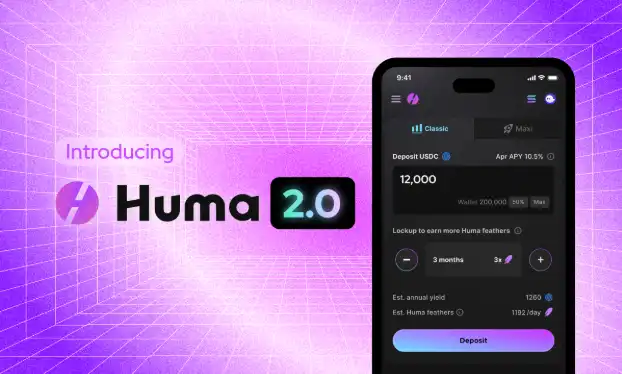
The first Payment Financial Network, Huma Finance, today announced the launch of Huma 2.0, a permissionless, compliant, and composable yield platform built on Solana. This platform opens up stable real yield generated from global payment financing derived from everyday commercial trading activities to users worldwide, marking a significant advancement where the previously elusive double-digit stable yield category, outside the realm of institutional finance, is now widely accessible to individual users. The existing permissioned service has been concurrently rebranded as Huma Institutional, continuing to serve institutions and accredited investors. Users can immediately start depositing on the brand-new Huma 2.0 platform.
Huma 2.0 provides users with diversified liquidity provision participation modes, launching two primary modes to cater to different needs: Classic Mode is designed for users seeking a stable double-digit USDC yield (currently at 10.5% APY, updated monthly) while offering a base reward called Huma Feathers; Maxi Mode is suited for users looking to maximize their accumulation of Huma Feathers, offering a 5x baseline reward rate (but without receiving USDC yield). Users can switch the mode of their existing positions at any time.
DeFi composability is a core feature of Huma 2.0 achieved through the PayFi Strategy Token (PST). This liquid interest LP token enables holders to integrate their Huma positions with leading Solana ecosystem protocols. At launch, users can swap PST for USDC through the aggregator Jupiter, marking the initial step of the integration plan with top Solana DeFi platforms. Subsequently, support will quickly follow on Kamino to use $PST as collateral and to trade future yields via RateX. Participation does not require locking, but users can opt for a 3-month or 6-month term that significantly boosts Huma Feather rewards through a multiplier. It is noteworthy that in the early stages of launch, these reward multipliers will see a substantial increase as part of a limited-time promotion, with particularly attractive bonuses in the Maxi Mode. These features provide users with enhanced flexibility and choice in managing their positions.
In just two years, Huma Finance's Payment Financial Network has rapidly scaled, processing over $3.8 billion in transactions, generating $8 million in annualized revenue. Huma assists partners in earning revenue from its payment finance business. Unlike DeFi yields relying on token incentives, market speculation, or traditional finance's low rates, payment finance yield directly stems from the fees paid by enterprise usage of the network for payment financing and settlement liquidity. Funds typically circulate rapidly within a few days, compounding continuously from fees generated by real-world economic activities. This mechanism enables Huma to consistently offer a stable double-digit USDC yield. Its sustainable model has garnered endorsements from top investors and been recognized by industry analysts such as Messari—payment finance is poised to leverage a $30 trillion market scale.
"Huma 2.0 is not just another yield product—it represents a structural shift." Huma Finance Co-Founder Erbil Karaman stated, "By providing payment institutions with a 24/7 operational and remarkably capital-efficient novel liquidity source, we are creating a new form of yield rooted in real economic activity, with composability and transparency. It finally allows DeFi to tap into a long-standing institutional-exclusive yield source without compromising DeFi's core strengths."
The launch of Huma 2.0 comes at a significant transformation period for the global financial and DeFi ecosystem. As traditional payment infrastructures like SWIFT face challenges in speed and transparency, with trillions of dollars still inefficiently deployed, the demand for blockchain-based modern solutions is increasingly evident—reportedly, stablecoin annual transaction volumes have surpassed $35 trillion. Seizing the opportunity, Huma 2.0 provides efficient settlement liquidity, enabling individuals worldwide to benefit from foundational financial activities—a realm previously dominated by institutions.
Crucially, the revenue generated by payment finance does not fluctuate with the crypto market cycle. Regardless of market boom or slump, underlying economic activities like payment and trade continue to operate, providing a stable source of revenue for Huma. This stability makes double-digit fixed income particularly valuable in bear markets, shining even brighter when speculative gains fade. As DeFi matures, the market is now prepared for such revenue rooted in real-world business (rather than token speculation). Payment finance as the foundational layer is fostering new DeFi strategies, such as Solmate, recently launched by Splyce—combining Huma's $PST yield with SOL liquidity staking, bridging DeFi and productive economic purposes.
Huma 2.0 marks a crucial step in building the new financial future, fundamentally expanding the scope of the financial revolution through an open and inclusive participation model. Early participants can enjoy various reward multipliers, including historical deposit user bonuses and promotion bonuses. As the platform expands more DeFi integrations and plans to become the launch platform's first major project for Jupiter's LFG 2.0—Huma continues to build a truly inclusive financial system.
To learn more about Huma 2.0 or get involved, please visit this link or follow @humafinance on X platform.
About Huma Finance
Huma is the first Payment Finance (PayFi) network, utilizing an open liquidity protocol stack, covering key areas such as cross-border payments, stablecoin debit cards, and trade financing applications. The network targets a market exceeding $30 trillion in total size, aiming to accelerate fund movement in an ever-active world.
This article is a contribution and does not represent the views of BlockBeats.
You may also like

Meet the new WEEX trial fund—your gateway to greater profits

WEEX Labs Lands at Dutch Blockchain Week: A Disruptive Crypto × AI Conversation Sets Sail in Amsterdam

SK Hynix Reportedly Plans U.S. ADR Listing as Early as August, With SEC Approval Possible in Late June
SK Hynix may pursue a U.S. ADR listing as early as August, with SEC approval reportedly possible in late June amid strong AI chip supply chain demand.

SpaceX vs Tesla vs xAI: Which Elon Musk Trade Has the Biggest Upside in 2026?
OpenAI Reveals It Has Confidentially Submitted an S-1 to the SEC, Keeping the Door Open for a Future IPO
On June 9, according to an OpenAI announcement, the company recently confidentially submitted a draft S-1 registration statement to the U.S. Securities and Exchange Commission (SEC), beginning the preliminary compliance process for a potential initial public offering. OpenAI said it chose to disclose this proactively because it expected the news might leak; however, the company has not yet set a specific listing timeline, and related arrangements may still take some time.

Latest research from 13 top universities including Cornell University: The current state, challenges, and misconceptions of the fusion of Crypto and AI
Deconstructing Anthropic: The Best AI Company, Possibly Also a Type of Organizational Invention
Apollo and Blackstone Reportedly Back $35 Billion Anthropic Chip Financing as Deal Details Remain Unclear
On June 9, according to currently available news alerts, Apollo and Blackstone Group participated in a $35 billion financing for an Anthropic “chip project.” Based on the original wording of the report, the funding has already been raised, but public information remains limited. The financing structure, use of proceeds, project entity, and whether Apollo and Blackstone participated through equity, debt, or project financing have not yet been disclosed.

Humanity Protocol Security Incident Escalates: More Than $31 Million Stolen From Related Addresses as Attacker Continues Selling H for ETH
On June 9, according to monitoring by Onchain Lens, more than $31 million has been stolen from addresses linked to Humanity Protocol, and the attack is still ongoing, with the hacker continuously swapping H tokens for ETH. Project founder Terence Kwok later confirmed the security incident on X, saying the issue involved a private key leak.

Bloomberg: As Bitcoin Weakens, Stablecoins and RWA Continue to Drive Expansion in Crypto Businesses
In June, Bloomberg reported that despite Bitcoin falling below $60,000 last week, wiping out about $235 billion in market value within seven days, and dropping close to 50% from last year’s peak, some core businesses in the crypto industry are still expanding, mainly in stablecoins, real-world asset tokenization (RWA), payments, and infrastructure. The report also noted that overall altcoin activity has contracted significantly: altcoin market capitalization has fallen from a peak of about $431 billion in November 2021 to around $170 billion, and among the tens of millions of tokens issued in recent years, fewer than 1,700 still maintain meaningful trading activity.

Galaxy Deep Research Report: How Hyperliquid's HIP-4 Upgrade Changes the Landscape of Prediction Markets?
Binance Research: RWA Market Expected to Expand Nearly 6x from Early 2025, with Public Equities and Onchain Payments Heating Up Together
In June, Binance Research said in its monthly market report that the real-world asset (RWA) market is expected to grow by about 589% from the beginning of 2025. Bond- and money market fund-related RWA expanded by about $6.5 billion, up 83% year over year, while publicly traded equity RWAs grew by about 422%. The report also noted that monthly crypto debit card transaction volume exceeded $747 million in May, up 48.6% year to date.

Japan to Assess a Framework for Yen Stablecoins and Crypto ETFs as Asia’s Compliant Payments Narrative Heats Up
Recently, according to the original report, Japan is considering the launch of yen stablecoins and cryptocurrency ETFs. Public information remains limited at this stage, and there is still no complete policy text, regulatory draft, or clear implementation timeline, so this is better characterized as a “policy discussion” rather than formal implementation. The original wording also noted that advancing stablecoin regulation in Asia is driving XRP usage and supporting growth in the XRPL ecosystem. However, based on currently available public information, there is not enough evidence to directly establish a clear causal relationship between this round of discussion in Japan and XRP or XRPL.

ZachXBT: Humanity private key leak and abnormal surge in H token should be viewed separately
On June 9, according to related disclosures, on-chain investigator ZachXBT posted an update on Humanity’s roughly $31 million security incident, saying that after further analyzing fund flows, he currently tends to believe the project team was not involved in an “inside job” or a self-staged attack. According to him, the official explanation about the private key leak was broadly accurate, but before the token unlock, the price of H had been artificially pushed higher, and the hacker later took advantage of that market environment; therefore, the private key leak and the earlier abnormal price pumping should be regarded as two separate and independent events. This reframing has shifted the market’s understanding of the nature of the incident. Earlier discussion around Humanity had focused on whether the team directly participated in the attack or used the security incident to cover up internal operations. ZachXBT’s latest remarks shift the focus from “whether it was self-theft” to “whether there were pre-unlock market structure issues.” He also questioned whether the team may have.

Morning Report | OpenAI has submitted an S-1 registration statement draft to the U.S. SEC; Morpho completes $175 million financing

Morning Report | BitMine increased its holdings by 126,971 ETH last week; trader Eugene announced his exit from the crypto market

Wang Chuan: How can one not feel anxious after the neighbor Old Wang made thirty times profit by investing in storage stocks? (Seven) - A quarter-century cycle
Cryptocurrency CEXs are flocking to sell US stocks, and traditional brokerages are facing an "uninvited guest."
Meet the new WEEX trial fund—your gateway to greater profits
WEEX Labs Lands at Dutch Blockchain Week: A Disruptive Crypto × AI Conversation Sets Sail in Amsterdam
SK Hynix Reportedly Plans U.S. ADR Listing as Early as August, With SEC Approval Possible in Late June
SK Hynix may pursue a U.S. ADR listing as early as August, with SEC approval reportedly possible in late June amid strong AI chip supply chain demand.
SpaceX vs Tesla vs xAI: Which Elon Musk Trade Has the Biggest Upside in 2026?
OpenAI Reveals It Has Confidentially Submitted an S-1 to the SEC, Keeping the Door Open for a Future IPO
On June 9, according to an OpenAI announcement, the company recently confidentially submitted a draft S-1 registration statement to the U.S. Securities and Exchange Commission (SEC), beginning the preliminary compliance process for a potential initial public offering. OpenAI said it chose to disclose this proactively because it expected the news might leak; however, the company has not yet set a specific listing timeline, and related arrangements may still take some time.
Latest research from 13 top universities including Cornell University: The current state, challenges, and misconceptions of the fusion of Crypto and AI


