
If there's no Compliance Coin, what's left for Coinbase?


Original Article Title: "Without Regulatory Benefits, What Is Left of Coinbase?"
Original Article Author: Fairy, ChainCatcher
Within the moat built on regulatory advantages, Coinbase is the "gold-letter signboard" in the compliance field. However, as the halo of compliance fades, its "noble indifference" is becoming increasingly dangerous.
Community feedback being ignored, slow customer service responses, high fees... These issues are making more and more users feel disappointed and dissatisfied. One pressing question is rising: Without regulatory benefits, what is left of Coinbase?
Where Have Individual Users Gone?
According to CryptoQuant data, Coinbase's retail investor dominance index is only 18.3%, far below Binance's 89.6% and Bitget's 50.1%. This index reflects the level of activity and influence of retail investors compared to institutional investors on the trading platform. A higher value indicates a higher proportion of individual investors in the user base.
Behind this data is the revelation that Coinbase has long focused on a compliant and institutionalized strategic direction, indicating that it is gradually drifting away from ordinary users. The platform's attractiveness and stickiness to the mass market are decreasing. This has been widely echoed in the community, with increasing negative comments about Coinbase, both in the Chinese and English communities, and users' voices are growing louder.
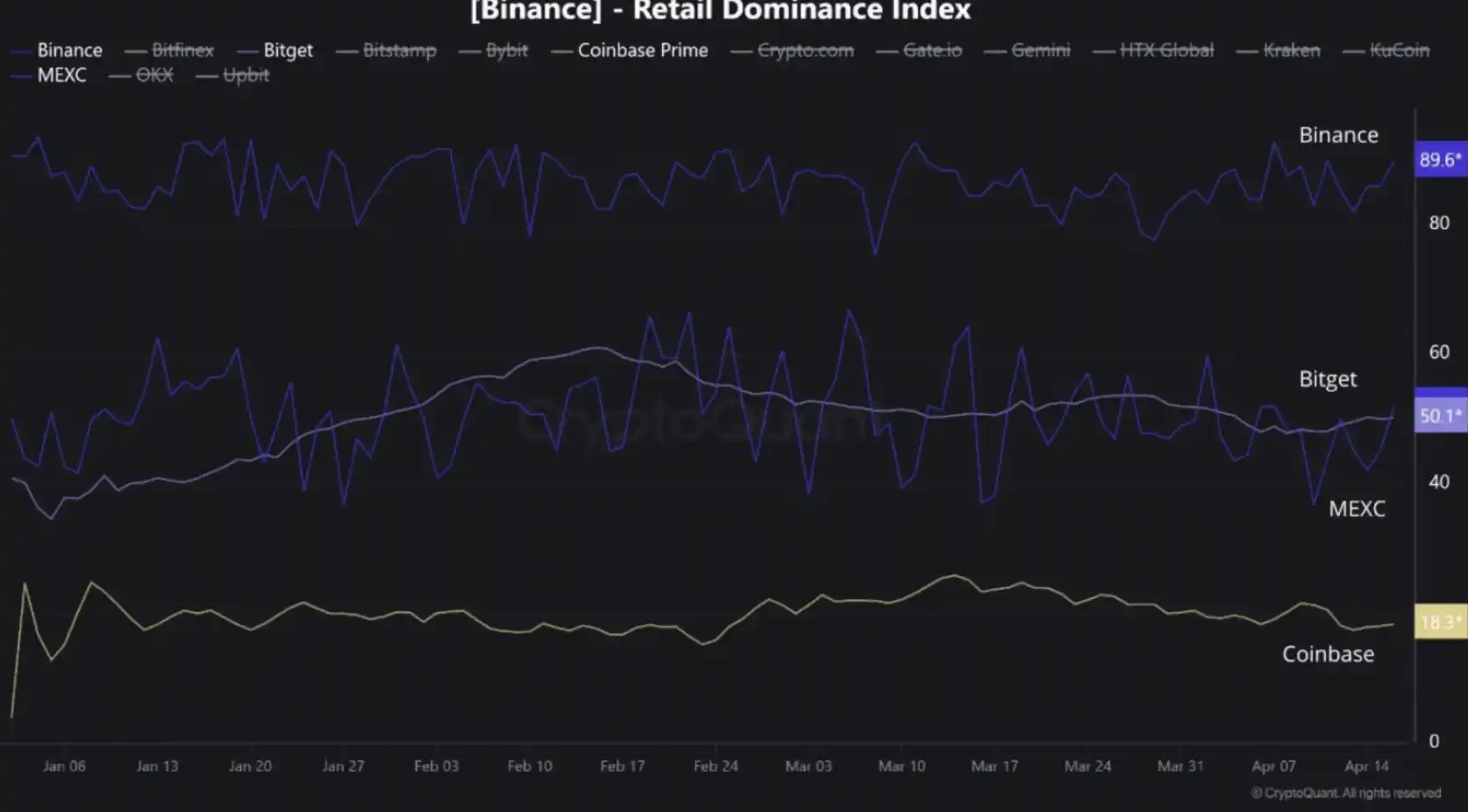
Image Source: CryptoQuant
Coinbase's "Mysterious Crediting"
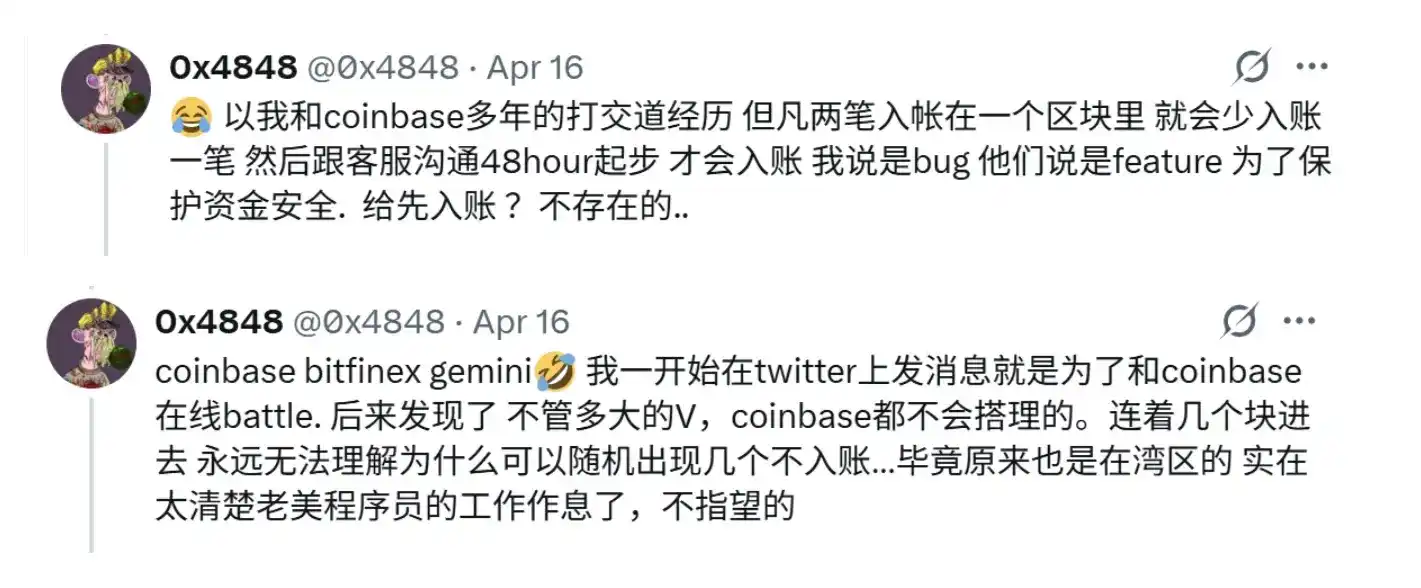
Some users have reported that when two transactions are processed in the same block, the Coinbase system may only credit one, while the other may take several days of back-and-forth with customer service to be restored. User @0x4848 said, "I said it was a bug, they said it was a feature, to protect the security of funds."
Issues of this kind, "in the name of security," can become an overdrawn of user patience and trust without an efficient and transparent resolution mechanism.
Customer Service: Slowness as the Norm
The customer support system of Coinbase has long been a "pain point hub." Many users have reported that Coinbase's chatbot is more of a hindrance than a help and cannot truly resolve issues.
Furthermore, once opting for human support, the nightmare of waiting truly begins. Human support agents have very limited authority and often can only "log the issue for further review." According to user feedback, receiving an initial response can take at least 48 hours, and fully resolving an issue may take a week or even longer.
Additionally, some users have described their support communication as chaotic and inefficient. "They keep going back and forth via email asking me for the same information, I provide it, then they say it's not enough," said user @MattLGov. "Dealing with Coinbase support is absolutely terrible."
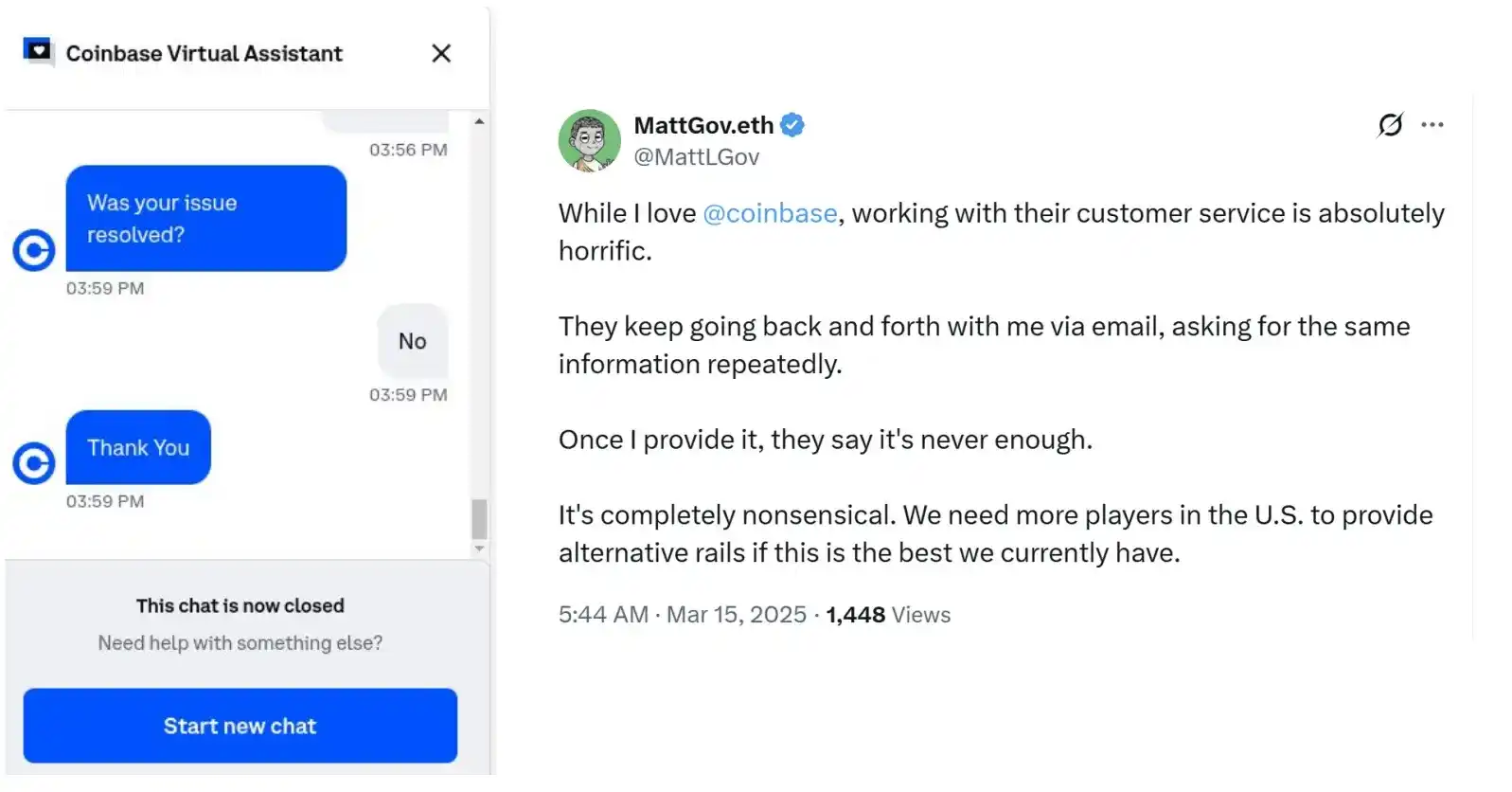
Image Source: @0x Ponga, @MattLGov
External Scams and Internal Breaches
Coinbase users are frequently targeted by scams. On-chain detective ZachXBT revealed that in just the past month, related incidents have caused up to $46 million in fund losses.
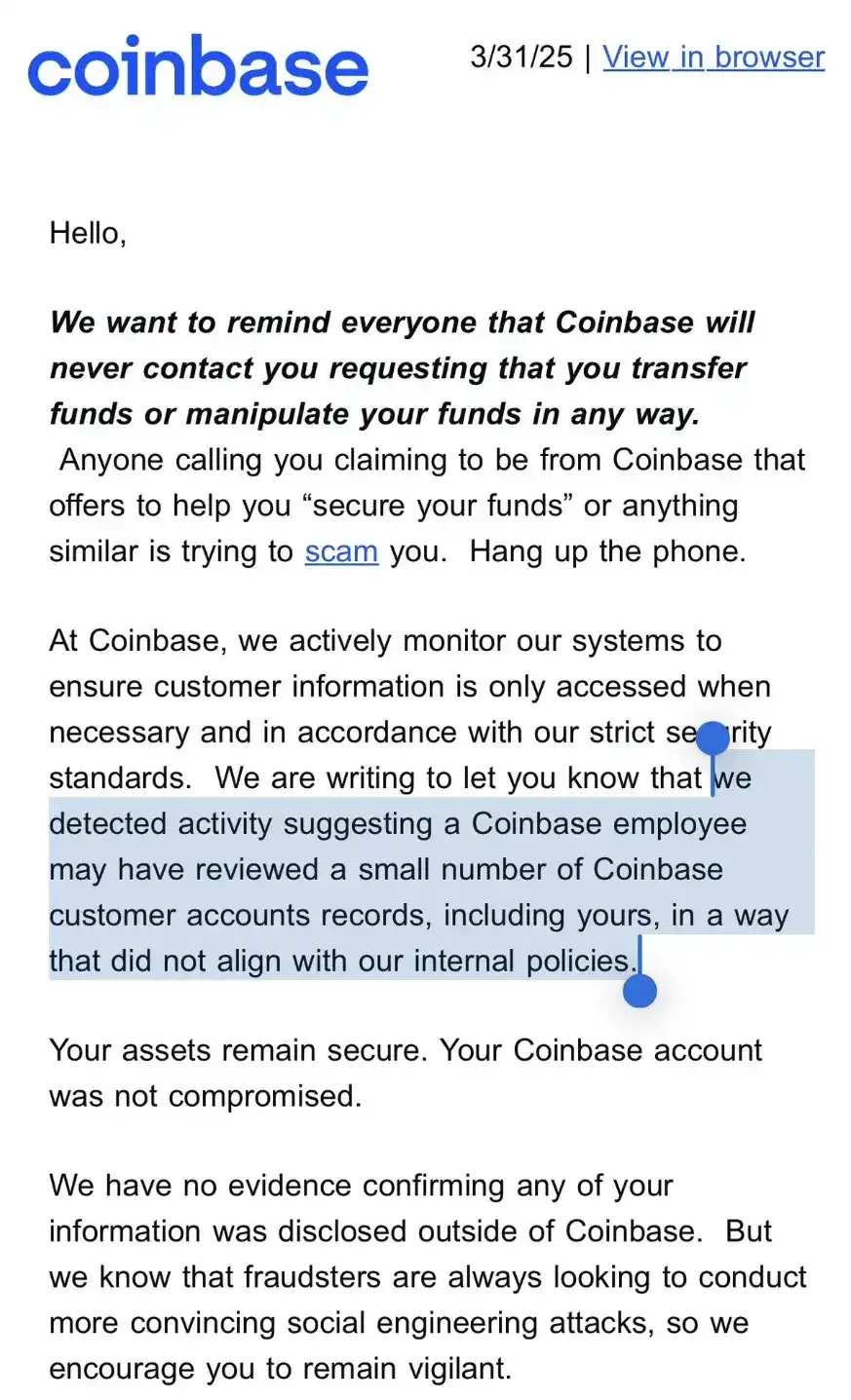
Meanwhile, internal data security issues have also surfaced at Coinbase. Mike Dudas, co-founder of The Block, shared on X platform that he received an official email indicating that an employee may have inappropriately accessed some user account data, including his own. The email stated: "We detected indications that an employee may have viewed a small number of customer account records in a way that may not be consistent with our internal policies." (Related Reading: Losing $300 million in a year, Coinbase users frequently targeted by precise scams, with an "insider" leaking information behind the scenes?)
"Read and Ignored" Coldness
When it comes to user communication, Coinbase's presence is almost non-existent. It does not cater to retail users and has not established an effective user feedback channel. Neither the CEO nor the executive team rarely publicly respond to user issues on social media. Even in the face of numerous complaints and doubts, their appearances to clarify or explain are extremely rare.
Behind this "silence," there may be cultural and regulatory considerations, but the result is that users' voices are hardly heard.
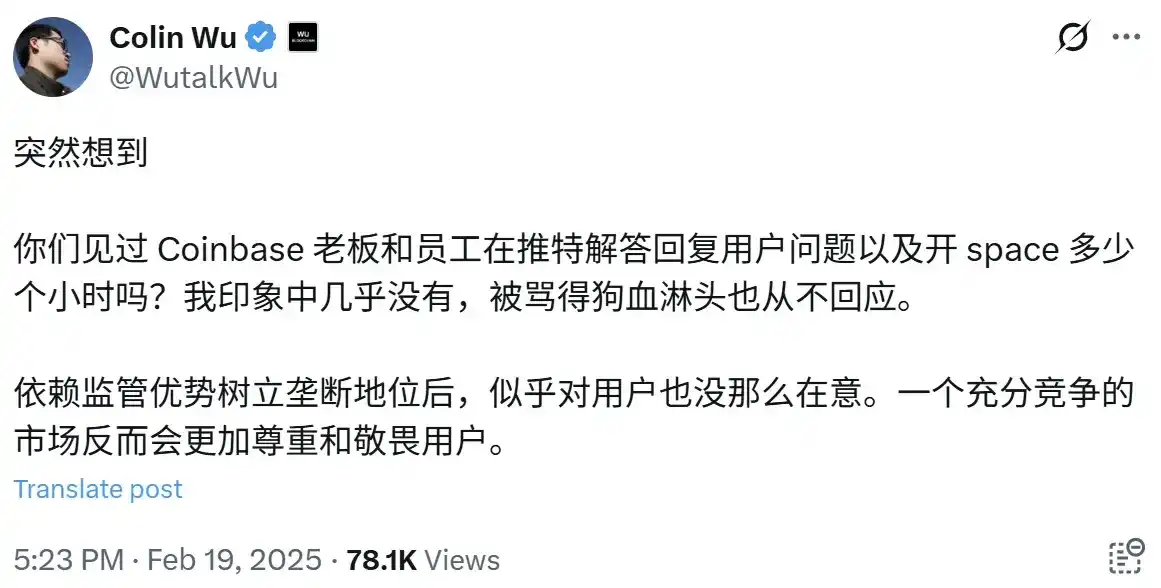
Image Source: @WutalkWu
「Noble Class」 Fee
User @hyperunit compiled the cost of purchasing 1 BTC spot price on mainstream trading platforms based on the initial fee level, showing that Coinbase's fee reached $329.68, ranking at a relatively high level. In addition, community user @Tmzhao 1 pointed out that in order to obtain the same fee level as a regular user on Binance on Coinbase, users need to start from VIP 0, complete approximately $250 million in trading volume, and pay over $300,000 in cumulative fees.
Although Coinbase Pro (now Advanced Trade) offers lower fee options, its interface is relatively complex, and many regular users are not familiar with it or find it easy to use.
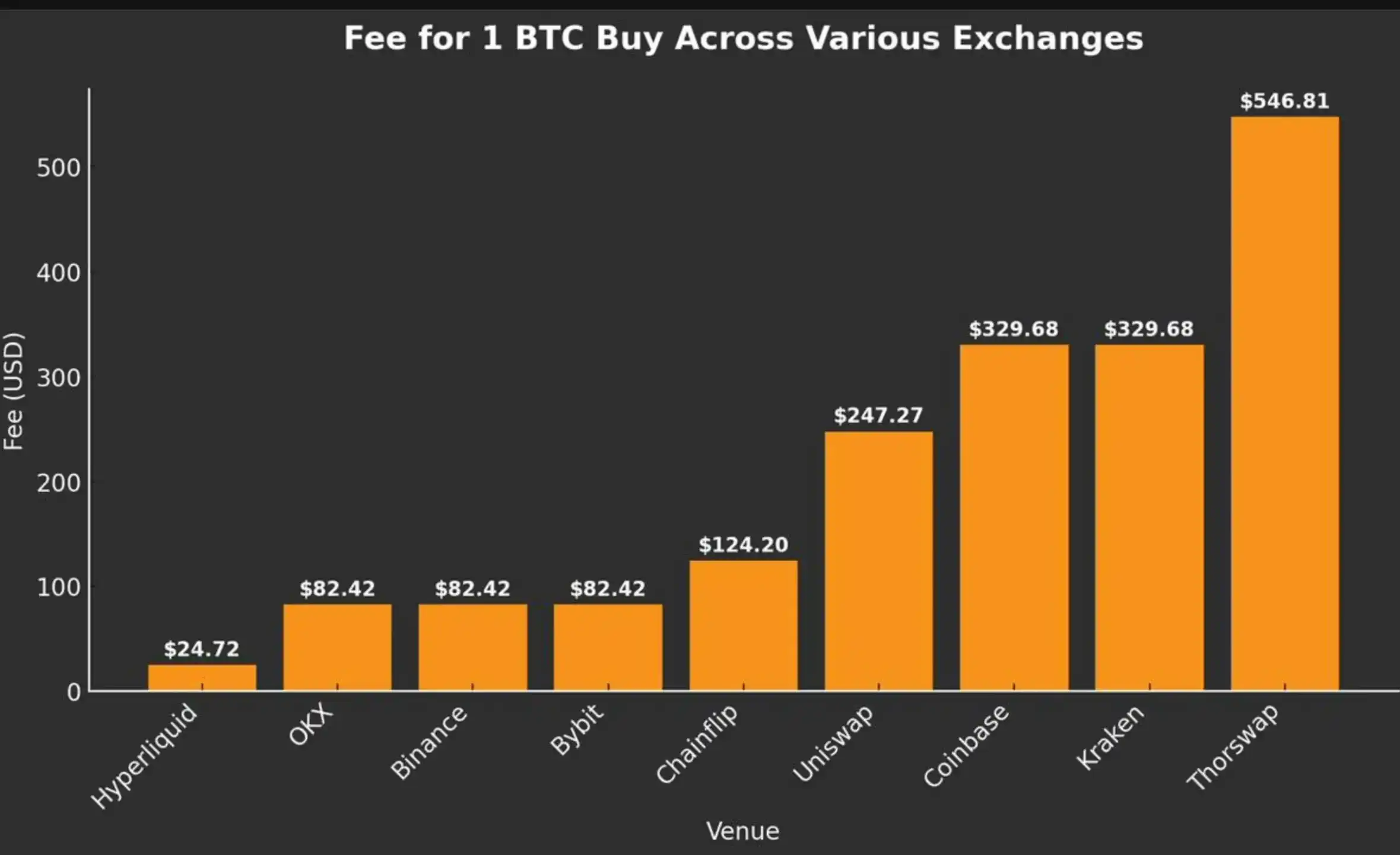
Image Source: @hyperunit
Undoubtedly, Coinbase's compliance halo is the cornerstone of its strong position in the U.S. market. However, as it continues to increase its reliance on institutions, it seems to gradually diminish its connection with ordinary users. On this path of pursuing compliance and security, Coinbase is quietly sacrificing user experience, giving up the meticulous polishing of platform operation and services.
Behind this advancing giant ship, there are scattered whispers and expectations of countless users, whose voices are gradually being drowned out in cumbersome processes and indifferent mechanisms.
You may also like

Galaxy in-depth report: Is Solana still worth paying attention to?

Young people in South Korea make a "final effort" in the epic bull market

Dialogue with OmenX Founder: Why does the prediction market need an evolution from "spot" to "derivatives"?
When the P2P illicit funds from ten years ago turned into 60,000 bitcoins

Morning News | CME Group launches Nasdaq Cryptocurrency Index futures; Asset management giant Janus Henderson strategically invests in Ethena

Why did Oracle deliver the strongest financial report in history, yet its stock price fell?

Bitcoin Layer 2 Network Botanix: Why Did We Choose to Dissolve?

Morning Report | OpenAI has submitted an S-1 registration statement draft to the U.S. SEC; Morpho completes $175 million financing

Galaxy Deep Research Report: How Hyperliquid's HIP-4 Upgrade Changes the Landscape of Prediction Markets?

Latest research from 13 top universities including Cornell University: The current state, challenges, and misconceptions of the fusion of Crypto and AI
Deconstructing Anthropic: The Best AI Company, Possibly Also a Type of Organizational Invention

Every exchange is a "Universal Exchange."

The counterattack of traditional finance: Alliance chains are quietly reviving
Pantera Capital Partner: How Tokenization is Restructuring the Private Equity and Early Investment Ecosystem?

Mastercard Launches Agent Pay for AI, Plans to Record AI Agent Payment Authorizations on Polygon
Mastercard launched Agent Pay for AI, a new payment protocol designed to help AI agents make small payments such as pay-per-use access to data and APIs. The system plans to record human-granted AI agent permissions on Polygon, focusing on verifiable authorization, identity, and payment controls.

Curve Deploys Llamalend v2 on Optimism With 250,000 OP Incentives
Curve launched Llamalend v2 on Optimism with 250,000 OP incentives from the Optimism Foundation. The upgrade expands Llamalend beyond its earlier crvUSD-focused model, adding broader collateral support, LlamaRisk market reviews, and the ability to use Curve LP tokens as collateral.

Raydium Old Liquidity Pool Reportedly Exploited, With $1.34 Million Moved to Ethereum and Tornado Cash
An old Raydium liquidity pool was reportedly exploited for around $1.34 million in USDC, RAY, and wSOL, with the stolen funds bridged to Ethereum and deposited into Tornado Cash. The incident highlights the tail risks of legacy DeFi pools, old contracts, and cross-chain fund laundering paths.
Kalshi Executive Challenges “SBF Backed AI Unicorns” Narrative, Says Leopold Aschenbrenner Was Key Figure
Kalshi executive John Wang questioned the “SBF backed AI unicorns” narrative, saying Leopold Aschenbrenner was the key figure behind major AI investment decisions.
Galaxy in-depth report: Is Solana still worth paying attention to?
Young people in South Korea make a "final effort" in the epic bull market
Dialogue with OmenX Founder: Why does the prediction market need an evolution from "spot" to "derivatives"?
When the P2P illicit funds from ten years ago turned into 60,000 bitcoins
Morning News | CME Group launches Nasdaq Cryptocurrency Index futures; Asset management giant Janus Henderson strategically invests in Ethena
Why did Oracle deliver the strongest financial report in history, yet its stock price fell?


