
In just 70 days, Polymarket easily raked in tens of millions in fees

Original Title: "In Just 70 Days, Polymarket Easily Takes Away Millions of Dollars in Fees"
Original Author: Azuma, Odaily Planet Daily
On January 6th this year, Polymarket officially bid farewell to the "zero fee" model, starting to charge transaction fees from the "15-minute cryptocurrency price change" market. The specific fee rate will vary with real-time market odds— the closer the odds are to 0% or 100%, the lower the fee; conversely, the closer the odds are to 50%, the higher the fee, reaching a maximum of 1.56%.
Later, on January 28th, about three weeks after the fee implementation, we published an article titled "Data Calculation: Polymarket's Annual Revenue Easily Exceeds $100 Million, Assuming...". The article made a static estimate based on Polymarket's trading volume and trading activity structure at the time: in the most conservative scenario, assuming the fee-charging market remains the same, it is estimated that Polymarket could generate approximately $38 million in revenue per year; and in the most aggressive scenario, if Polymarket expands fees to all markets, an estimated annual fee income of $418 million.
In our previous revenue estimate for Polymarket, we were frustrated by the short observation period and too few calculable samples. Now, two months later, we have re-estimated Polymarket's revenue expectations with richer data. The results show that the so-called "conservative" estimate is indeed too conservative, and the so-called "aggressive" expectation is not overly exaggerated.
Revenue Data Changes
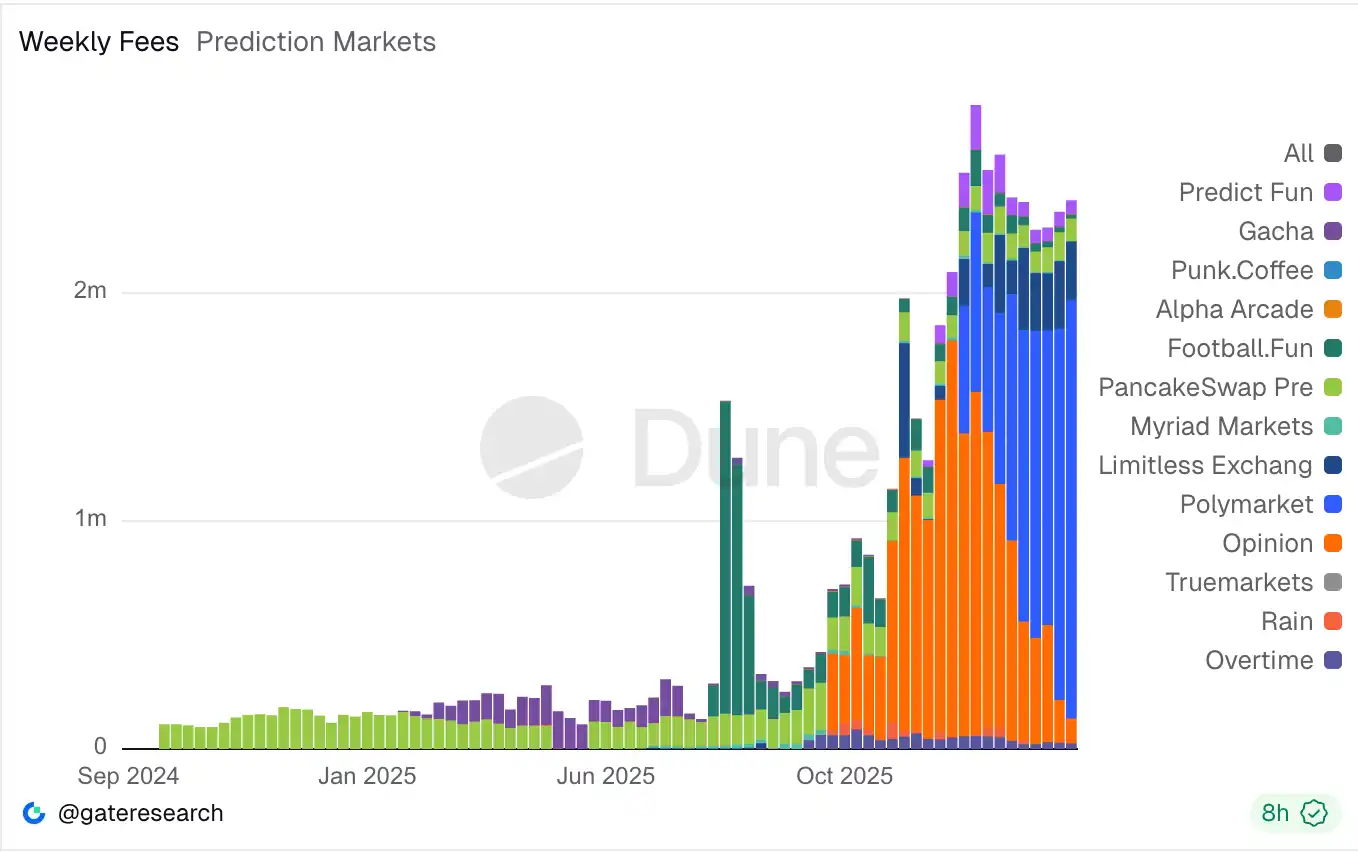
According to data compiled by Gate Research on Dune, since the introduction of transaction fees on January 6th, Polymarket has accumulated over $11.2 million in fee revenue.
By once again making a static estimate in the most conservative manner, assuming that market trading volume and activity structure remain unchanged, it is projected that Polymarket could generate approximately $58.4 million in revenue annually.
However, this estimation method does not accurately reflect Polymarket's revenue capabilities.
The reason is that Polymarket's revenue data is visibly growing— in the past 10 weeks, the platform's fee revenue has been $560,000, $786,000, $633,000, $749,000, $1.08 million, $1.28 million, $1.35 million, $1.29 million, $1.63 million, $1.84 million... almost showing significant growth every week.
Reasons for Revenue Growth
The growth in Polymarket's fee revenue can be attributed to two main factors. First, Polymarket has expanded the scope of fee-charging markets. Second, both Polymarket's overall trading volume and fee-charging market volume have continued to grow.
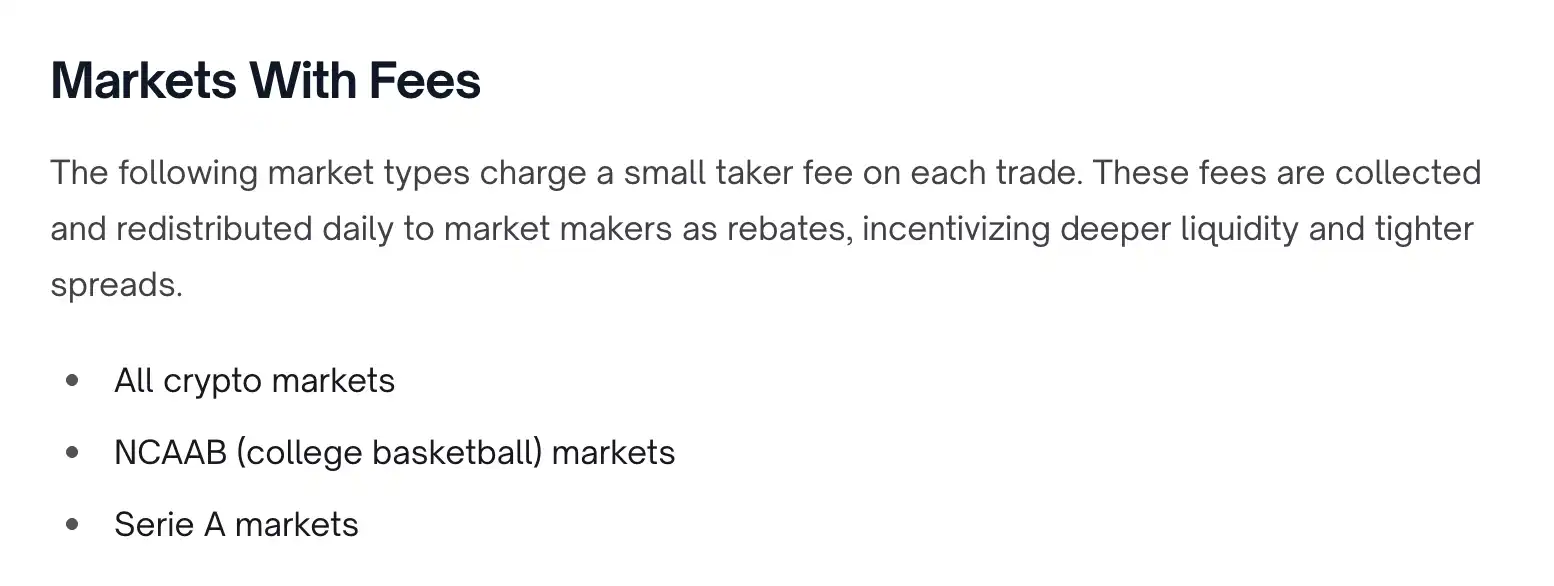
Regarding the scope of fee-charging markets, on March 6, Polymarket expanded its fee mechanism to all cryptocurrency-related markets. Additionally, earlier trials of fee collection were conducted in sports markets such as NCAA and Serie A, but the former (cryptocurrency-related markets) currently remains the main source of fee revenue.
With respect to trading volume, the data dashboard below, created by Data Dashboards on Dune, shows that Polymarket's overall weekly trading volume, including the cryptocurrency market (bottommost purple bar), has been steadily increasing.
Future Revenue Forecast
The last time we estimated Polymarket's revenue, we had to manually calculate the percentage of "15-Minute Cryptocurrency Price Change" related markets as a share of all cryptocurrency-related market volume. However, Polymarket has now expanded fees to all cryptocurrency-related markets as of March 6, making this estimation much more convenient. As for NCAA and Serie A, either because the former has not yet entered the "March Madness" formal tournament stage or the latter does not attract much attention in American culture, the trading volume of related markets is significantly lower compared to cryptocurrency, so we will temporarily ignore them.
Using the data from the first complete week after March 6 (3.9-3.15), the share of cryptocurrency-related event trading volume in Polymarket's total platform volume was 26.7% for that week. In the same week, Polymarket's fee revenue was approximately $1.84 million. Based on this static proportion, at the current level of trading volume and transaction structure, if Polymarket introduces a similar fee model to all markets, it is estimated that this platform could generate $360 million in annual revenue.
The Money Printer Is Running
It is worth noting that as a key initiative to enhance liquidity on Polymarket, the platform has distributed a total of $13.41 million in subsidies to liquidity providers (LPs) to date. As a comparison, if the data for the remaining days of March maintains the performance of the first half of the month, the fee revenue from Polymarket this month would be sufficient to cover the total expenditure on liquidity subsidies.

Polymarket has already essentially proven the revenue potential of this new format of prediction markets, and future revenue growth will largely depend on two variables - how much further trading volume can grow, and whether fees can be further extended to more markets.
If these two variables continue to rise, prediction markets could perhaps become the simplest, most straightforward “money printer” in the cryptocurrency industry.
You may also like

Strategy Founder: The Next 10 Years of Bitcoin
Forbes Special Report: Stablecoin cross-border payments are faster now, but not cheaper yet
Li Feifei's latest long article: When video generation, robots, and NVIDIA all claim to be world models, we need a taxonomy
Blaming the desolation of the cryptocurrency world on the rise of AI is a form of intellectual laziness
The impact of OUSD on Circle, Tether, and Paxos: not a single negative factor, but a more complex reshaping of competition
A valuation of 8 billion dollars, doubling in 8 months! What makes the crypto-friendly bank Erebor Bank stand out?
340 billion valuation: Li Yanhong's largest IPO, a seat in Kunlunxin's shares is hard to come by
Stablecoins are the "royalists" of the crypto world: Open USD brings the old currency system into play
Cape Verde 2-3 Argentina: The Underdog Team That Stunned the World in Defeat
Cape Verde's run ended in a 3-2 defeat to Argentina, but their journey — three unbeaten draws, one heroic goalkeeper, and a fight that pushed the defending champions to the brink — is the kind of story markets recognize too: small caps can rattle blue chips long before anyone expects it.
Semiconductor stocks plummet, yet Anthropic wants to create a 2nm chip
Where is Zhao Changpeng's billion-dollar investment going? YZi Labs' investment landscape fully revealed
Ethereum Foundation Report: A Basic Guide to Ethereum for Governments and Financial Institutions
A pre-announced harvesting case: After the cryptocurrency price dropped by 99%, the public chain Saga exited to transform into AI
When American giants collectively "defect" from Chinese AI models
BIS Report Compliance Observation: The Real Risks of Stablecoins, Not Just "Depegging"
Portugal 2-1 Croatia: Ronaldo's 20-Year Knockout-Stage Drought Ends With a Debt Finally Collected
Portugal beat Croatia 2-1 in the 2026 global football championship's knockout rounds as Ronaldo scored his first-ever knockout-stage goal, Gonçalo Ramos struck a stoppage-time winner, and VAR ruled out a late equalizer for offside.
Bitcoin Price Prediction July 2026: Will BTC Recover to $70K or Drop Below $55K?
A South Korean company that learned the strategy of hoarding coins, from a bull market to delisting?
Strategy Founder: The Next 10 Years of Bitcoin
Forbes Special Report: Stablecoin cross-border payments are faster now, but not cheaper yet
Li Feifei's latest long article: When video generation, robots, and NVIDIA all claim to be world models, we need a taxonomy
Blaming the desolation of the cryptocurrency world on the rise of AI is a form of intellectual laziness
The impact of OUSD on Circle, Tether, and Paxos: not a single negative factor, but a more complex reshaping of competition
A valuation of 8 billion dollars, doubling in 8 months! What makes the crypto-friendly bank Erebor Bank stand out?