
Interpreting Binance Launchpool's New Project GUNZ: Team Secures Over $100 Million in Funding, Is the Metaverse Gaming Sector Heating Up Again?


Original Title: "Chain Game Back on Track? Preview of the First Battle Royale Game Off The Grid to Simultaneously Launch on PC and Console"
Original Source: DeepTech TechFlow
Editor's Note: On March 27th, Binance Launchpool launched the 66th project GUNZ (GUN), which is the AAA game "Off The Grid" L1 public chain developed by the game developer Gunzilla Games. GUN has a total supply of 10 billion tokens, with an initial circulation of 645 million tokens (6.05% of the total token supply), and the Launchpool allocation is 400 million tokens (4% of the total token supply). The GUN token serves as the native token of the game and the core of the OTG economic system. This article provides a detailed introduction to the game's background, gameplay, economic system, etc. Can the previously struggling chain game sector regain market attention due to the listing on Binance?
This article was first released on October 25, 2024, and some data may have changed. For the latest project updates, please visit the official website. The full text is reprinted by BlockBeats below.
Chain games have been struggling and have become a tacit consensus of the previous bear market, with most game projects quietly disappearing.
However, not all practitioners are bearish on the game sector.
For example, Delphi Ventures partner Piers Kicks recently posted to cheer for the game developer Gunzilla Games and its upcoming flagship game Off The Grid.
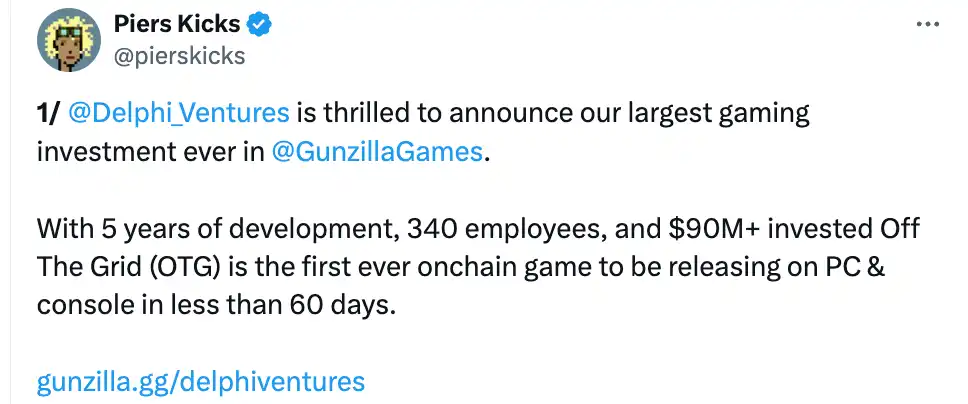
According to Piers' post, Delphi Ventures has placed a heavy bet on Off The Grid, making it the largest investment in the gaming sector. The game has also gone through 5 years of development by a team of 300 people, with a total investment in the game reaching $90 million.
On a side note, the estimated cost of Black Myth Wukong was previously revealed to be around 300-400 million RMB, roughly making the investment cost of Off The Grid even higher than Black Myth.
But as the old saying goes, after the whale falls, all things are born. In the chain game sector, it may be that when all things fall, only then does the whale rise.
In the context of numerous blockchain gaming projects failing one after another, what sets Off The Grid apart?
It is reported that Off The Grid plans to simultaneously launch on PC and console platforms (PS5/XBOX) within the next 60 days, marking the first time a blockchain game has launched on multiple platforms at the same time.
Moreover, let's not forget that PC and console players are often hardcore gamers who despise any pay-to-win elements and the smell of on-chain grind. For a blockchain game to succeed, it must strike a delicate balance in gameplay, graphics, on-chain economy, and marketing targeting this player base.
In an environment where blockchain games are generally looked down upon, can Off The Grid truly set an example for a "good game"?
Inviting Industry Leaders for Scriptwriting and Special Effects to Attract VC Investments
In the gaming industry, a successful title typically relies on two key elements: people and money.
The former refers to the development team, and the latter refers to financial support.
What does Gunzilla Games, the developer behind Off The Grid, bring to the table?
Established in 2020, Gunzilla Games is a relatively young company, but it boasts a solid team lineup and size. Currently, the company has around 340 employees, including many veterans from the gaming industry.
The core development team of the company mainly comes from the former Crytek Kyiv studio. This team was involved in the development of the popular online shooter game Warface, which attracted over 140 million players and generated over $1 billion in revenue. Additionally, team members have worked on renowned game series such as Far Cry and Crysis, as well as the development of the CRYENGINE game engine. At its peak, CRYENGINE drove cutting-edge graphics in games and provided technical support for many major titles.
Interestingly, the company has also enlisted Neill Blomkamp as a co-founder and Chief Creative Officer. Blomkamp has directed sci-fi blockbusters like District 9 and Elysium, bringing top-tier visual and narrative design to Off The Grid with his unique visual style and profound social insights.
Simultaneously, the game's 60-hour campaign storyline is penned by renowned sci-fi author Richard Morgan. Morgan is the author of best-selling novels like Altered Carbon, which have been adapted into popular Netflix series.
This is a bit different from the blockchain games we've seen before. They seem to have put a lot of effort into the script and special effects, aiming more towards a premium single-player game.
However, we'll have to wait for the official release to see the actual quality. After all, we can't be sure if this is just a big name endorsing the game or if they actually participated in its production.
Speaking of the financial side, the article mentioned that Delphi Ventures invested $6 million to become the largest validator and node operator on Gunzilla's GUNZ blockchain platform (source of funding: Coindesk).
In March this year, Gunzilla Games completed a $30 million funding round. This round was led by CoinFund and Avalanche's Avalanche Fund, with participation from renowned institutions such as Republic Capital and Morningstar Ventures.
With ample funding available, how polished will this game be?
Cyberpunk Battle Royale, Battle Royale Gameplay + On-Chain Items
The core gameplay of Off The Grid is actually Battle Royale, the classic mode seen in games like PUBG. A group of players competes for resources on a carefully designed map, aiming to be the last one standing.
However, this game incorporates more sci-fi and cyberpunk elements.
The game is set in a dystopian future, where on a massive battlefield called "Teardrop Island," participants from around the world engage in a ruthless "reality show" for a huge prize pool.
In the game's setting, all participants must amputate their limbs to use advanced prosthetic technology on Teardrop Island. This is not just a unique setting but also a core game mechanic. Players can gain various special abilities by swapping different prosthetics, such as a grappling hook, reconnaissance drones, or a quick dash. This design brings unprecedented tactical depth and flexibility to the game.
In terms of map design, OTG has created the largest Battle Royale map to date. Players can navigate between towering skyscrapers using their character's jetpack and prosthetic special abilities, enabling fast aerial movements. This highly flexible movement system not only increases the game's excitement but also encourages a more aggressive playstyle.
But how does this relate to on-chain activities?
OTG has introduced a mode called Extraction Royale. Players collect HEX cubes on the map, which represent blueprints for weapons, attachments, or prosthetics.
Players need to take these cubes to specific extraction points for decoding, while also defending against other players who covet your loot. After successful extraction, these items will be "3D printed" into the player's inventory, effectively minting the assets on the blockchain in the background.
To put it simply, this gameplay is a mix of off-chain battle royale and on-chain loot box mechanics.
The main gameplay involves battling to win loot boxes, which can then be opened. The items inside are turned into assets such as NFTs on the blockchain, with the player's account linked and a transaction logic set up.
The game does not have a traditional in-game store; all items entering the economic system and peer-to-peer market are obtained by players through an in-game extraction mechanism and minted on the blockchain.
This design ensures not only the scarcity and true ownership of items but also brings more dynamism to the game economy and player engagement.
It is worth mentioning that OTG has adopted a seamless integration approach to deal with on-chain issues. The parts of the game involving cryptography have become optional rather than mandatory, gradually attracting players to the blockchain in a completely optional manner.
Although the finished game product has not been seen yet, features like social login, built-in wallet, hidden entry and exit points, and gas fee abstraction are likely not to be missing.
On-Chain Economic System Outlook
In OTG, players obtain in-game item NFTs through the extraction of HEX cubes as described above. This process cleverly combines game mechanics with blockchain technology, making asset minting a natural extension of the gaming experience rather than a somewhat detached external operation.
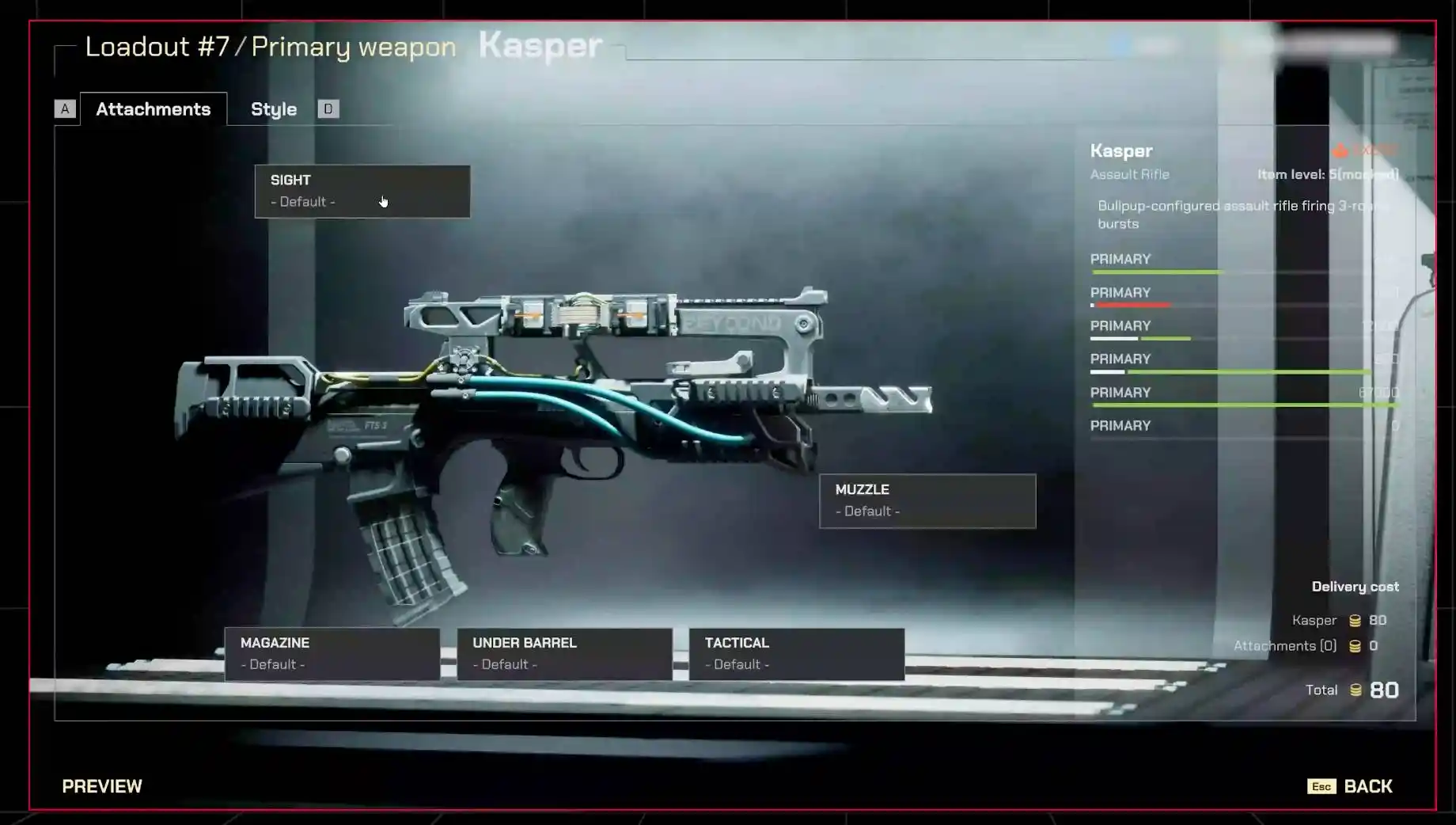
At the same time, the GUN token is the core of the OTG economic system. As the game's native token, GUN plays multiple roles in the game ecosystem:
a) Medium of Exchange: Players can use GUN to buy, sell, or trade NFT items on the in-game market.
b) Governance: Players holding GUN tokens can participate in critical game decisions, such as voting on new features or adjusting economic parameters.
c) Staking Rewards: Players can stake GUN tokens to receive additional in-game rewards or privileges.
d) Creator Incentives: Content creators can earn GUN tokens by creating game content such as custom skins or maps.
e) In-Game Fees: Certain advanced features or services may require payment in GUN tokens, such as speeding up manufacturing processes or unlocking special areas.
It is worth noting that the game has its own blockchain network called GUNZ, which is essentially an Avalanche-based subnet. By establishing a dedicated subnet to ensure fast and low-cost transactions, there is ample room for future expansion and optimization.
Public data shows that the GUNZ testnet has been running for nearly a year, processing 27 million transactions and accumulating over 220,000 registered wallets.
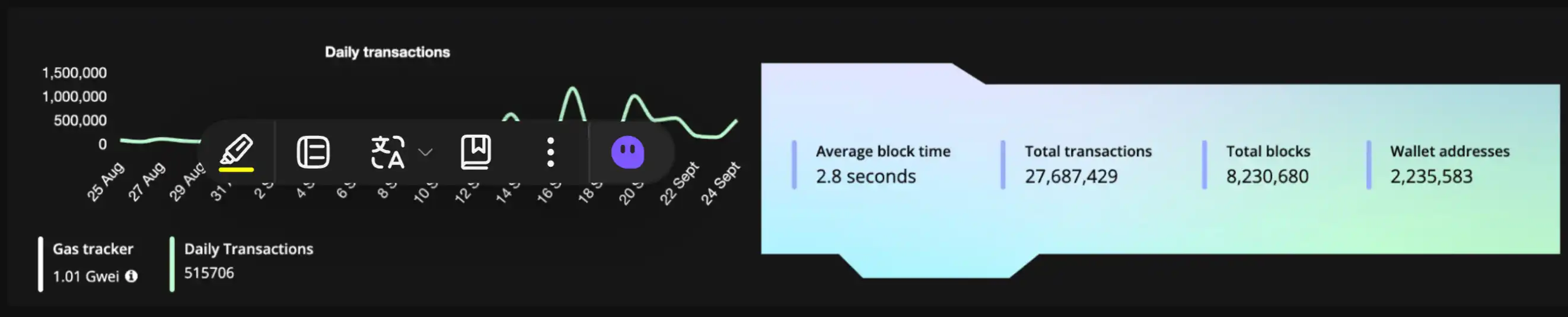
In the GUNZ subnet, validator nodes play a crucial role. They are not only responsible for validating and confirming all in-game transactions but also collectively maintain the security and stability of the entire network, with specific functions as follows:
a) Transaction Validation: Nodes are responsible for validating and confirming all in-game transactions, ensuring the security and reliability of the economic system.
b) Network Maintenance: Nodes collectively maintain the operation of the GUNZ network, ensuring the continuous and stable operation of the in-game economy.
c) Participation in Governance: Some nodes may have voting rights to participate in important network decisions.
d) Reward Mechanism: Participants running nodes may receive GUN tokens as a reward, further incentivizing community participation in network maintenance.
In the current design, the core of the ecosystem is 10,000 validators, which are responsible for processing transactions and minting all in-game items. From an investment perspective, these validator nodes are attractive because players must pay them USD-denominated in-game item minting fees; additionally, validators also collect commissions from all transactions of their minted items in the secondary market.
Supporting Off The Grid game is the full suite of Gunzilla ecosystem tools, including wallets (running on iOS and Android), marketplace, and blockchain explorer. Interested players can check real-time data displayed by the GUNZ testnet explorer here.
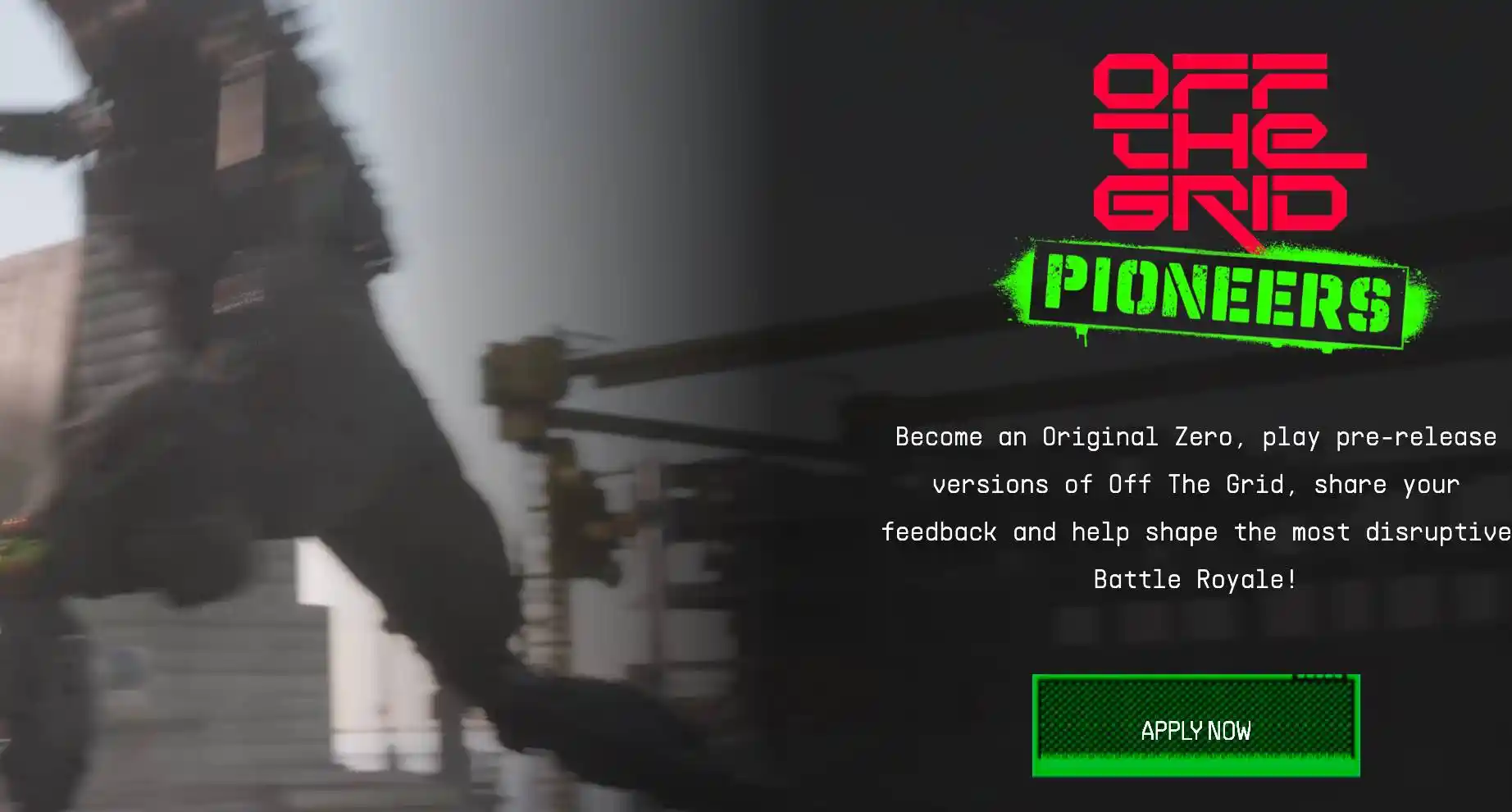
Currently, if you want to playtest the game early, you can only do so by filling out a form and answering questions on the official website's "Pioneer Program," selecting your gaming platform (console or PC), and then waiting for the game's official selection before receiving a playtest invitation.
Finally, it is important to emphasize that until the game is seen as a finished product, it cannot be said to have moved away from the "low-level fun" of gold farming and achieved pure gameplay.
In fact, the crypto world may not even need pure gameplay; but if the on-chain economic system can become a mature carrier of the "loot box model" without overshadowing everything else, then this game Off the Grid can still be looked forward to a little.
After all, with a free game available on PC and PS5/XBOX, there are still those who like to try their hand at freeloading.
You may also like

Bitcoin Trading Guide 2026: Strategies for Experienced Traders

What Is XAUT and PAXG? Why Tokenized Gold Is Booming in 2026

Cryptocurrency CEXs are flocking to sell US stocks, and traditional brokerages are facing an "uninvited guest."

Will the SpaceX IPO Hurt Bitcoin? Here's What Traders Are Watching
Foreign selling in the South Korean stock market accelerates, with cumulative net sales reportedly reaching $75 billion this year
On June 9, The Kobeissi Letter, citing Goldman Sachs data, reported that global investors are selling South Korean stocks at an unusually rapid pace. In the latest trading session, foreign investors sold about $801 million worth of Kospi constituent stocks again; total foreign outflows last week reached about $10 billion, and the market has been in net foreign selling on nearly every trading day over the past month. According to the data cited in the report, foreign investors have sold about $75 billion worth of South Korean stocks so far this year. Meanwhile, South Korean retail and institutional investors together recorded roughly $69 billion in net buying over the same period, suggesting that the market’s main buying support has come from domestic capital rather than returning overseas funds. The information currently disclosed still mainly comes from The Kobeissi Letter’s retelling and Goldman Sachs data summaries, while public details on the statistical period and the specific definition of “selling” remain relatively limited.

Fortune Warns of Strategy’s Financing Structure Risks as Bitcoin Premium Narrows
Fortune warned that Strategy’s Bitcoin treasury model faces growing financing risks as MSTR’s net asset premium narrows and preferred stock dividend pressure increases.

Ferrari Challenge Le Mans: Carl Moon to Dominate in WEEX Livery

Sahara AI Responds to SAHARA’s Sharp Drop: No Contract or Product Security Issues Found, Internal Investigation Underway
Sahara AI responded to SAHARA’s 60% price drop, saying no token contract or product security issues have been found and an internal investigation is underway.

WEEX Deposit/Withdrawal Dynamic Island: Your Asset Status, Always in Sight

Scaling Crypto Derivatives: The Digital Asset Infrastructure Behind High-Volume Trading
In the fast-moving digital asset ecosystem, derivatives platforms face an extreme architectural test. High-leverage futures markets demand more than just standard security—they require absolute operational precision, zero-latency matching engines, and ironclad structural scalability, all while navigating intense market volatility.
As global platforms scale to meet these demands, the industry is shifting away from rigid, monolithic setups toward a more agile, "decoupled" infrastructure philosophy.
The Blueprint for High-Volume Copy TradingFor elite global exchanges like WEEX (founded in 2018), this architectural choice becomes critical when scaling high-volume retail features like social copy trading. When thousands of users automatically mirror the real-time strategies of elite traders simultaneously, it triggers sudden, monumental spikes in concurrent transactional volume.
To prevent execution latency or settlement bottlenecks during these peak volatility events, a platform's primary engine must remain entirely dedicated to risk management, copy-trade synchronization, and order matching.
The Architectural Rule: New-generation platforms must separate front-end user execution engines from heavy backend infrastructural overhead to eliminate operational friction.
By separating these layers, platforms can maintain complete sovereignty over their trading environments and user experiences while strategically aligning with institutional-grade infrastructure ecosystems. This strategic framework allows modern exchanges to leverage advanced Digital Asset Custody infrastructure such as Cobo’s behind the scenes, ensuring that backend wallet management scales elastically alongside trading spikes.
Capitalizing on Market Momentum and 400× LeverageIn a derivatives arena where platforms offer up to 400× leverage on perpetual contracts, capital efficiency and market agility are core business metrics. To capture market momentum, an exchange needs the ability to rapidly expand its asset offerings, supporting everything from legacy crypto assets to sudden, trending altcoins across a massive library of trading pairs.
Adopting a flexible, scalable Wallet-as-a-Service (WaaS) solution such as Cobo’s could completely rewrite the development timeline for high-growth exchanges. Instead of spending months of engineering capital building out custom backend wallet architectures for every new blockchain network, platforms can deploy localized infrastructure in days.
This agility allows platforms to instantly scale their listings to over a thousand trading pairs without compromising security or delaying time-to-market. It mirrors the exact operational advantages seen during high-velocity market events, similar to how advanced wallet infrastructure empowers platforms during sudden asset surges; allowing exchanges to pass that speed and liquidity directly to their global user base.
A Mature Foundation for GrowthThe synergy between trusted infrastructure ecosystems and global trading platforms represents the natural evolution of a maturing crypto market. As WEEX continues to scale its global spot and derivatives offerings for over 6 million users, adopting robust backend paradigms proves that platforms no longer have to compromise between cutting-edge trading velocity and uncompromised structural security.

Morning Report | BitMine increased its holdings by 126,971 ETH last week; trader Eugene announced his exit from the crypto market

Wang Chuan: How can one not feel anxious after the neighbor Old Wang made thirty times profit by investing in storage stocks? (Seven) - A quarter-century cycle

Get Paid to Onboard? Try WEEX’s New Homepage with Rewards for Registration, Deposit & Trade

WEEX Custom Layout: Build Your Perfect Trading Workspace in Seconds

See “Buy Walls” & “Sell Walls” Instantly: WEEX Launches the Depth Chart for Smarter Trades

What Is Quick Trade on WEEX? 2 Ways WEEX Ends Chart-Panel Jumping
Morning News | Five major virtual asset platforms in South Korea have experienced 57 incidents of hacking and system failures in six years; Grayscale submits registration application for Canton ETF
Should we escape the peak? The principle of the tail-end market in the stock market
Bitcoin Trading Guide 2026: Strategies for Experienced Traders
What Is XAUT and PAXG? Why Tokenized Gold Is Booming in 2026
Cryptocurrency CEXs are flocking to sell US stocks, and traditional brokerages are facing an "uninvited guest."
Will the SpaceX IPO Hurt Bitcoin? Here's What Traders Are Watching
Foreign selling in the South Korean stock market accelerates, with cumulative net sales reportedly reaching $75 billion this year
On June 9, The Kobeissi Letter, citing Goldman Sachs data, reported that global investors are selling South Korean stocks at an unusually rapid pace. In the latest trading session, foreign investors sold about $801 million worth of Kospi constituent stocks again; total foreign outflows last week reached about $10 billion, and the market has been in net foreign selling on nearly every trading day over the past month. According to the data cited in the report, foreign investors have sold about $75 billion worth of South Korean stocks so far this year. Meanwhile, South Korean retail and institutional investors together recorded roughly $69 billion in net buying over the same period, suggesting that the market’s main buying support has come from domestic capital rather than returning overseas funds. The information currently disclosed still mainly comes from The Kobeissi Letter’s retelling and Goldman Sachs data summaries, while public details on the statistical period and the specific definition of “selling” remain relatively limited.
Fortune Warns of Strategy’s Financing Structure Risks as Bitcoin Premium Narrows
Fortune warned that Strategy’s Bitcoin treasury model faces growing financing risks as MSTR’s net asset premium narrows and preferred stock dividend pressure increases.


