
Is Solana About to Recover? Analyzing On-Chain MEME Whale Movement

Original Article Title: "Local Frenzy or Full Recovery? Data Analysis of Solana Chain MEME Whale Activity and Market Divergence"
Original Article Author: Frank, PANews
The MEME market seems to have heated up once again, starting in mid-March, with Fartcoin starting to rebound from its low, experiencing an approximately 349% increase over about a month, reaching a peak total market value of nearly 9.85 billion US dollars. At the same time, the on-chain activity of MEME whales has also attracted attention, with some whales investing millions of dollars in Fartcoin, RFC, and other MEME coins, leading to a rapid increase in related token market values.
Behind these movements, on April 11, the number of active addresses on the Solana chain once again surpassed 5.1 million, nearing the peak level seen in January.
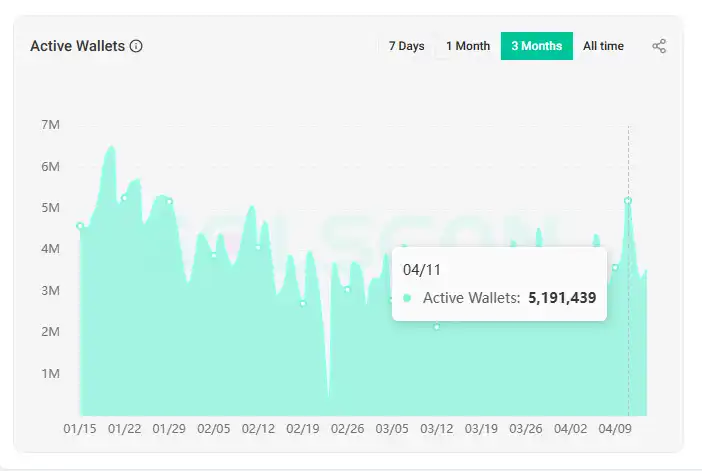
The minor outbreak of this MEME market rally, is it a return of the MEME bull market or a speculative resurgence in a boring market environment? PANews conducted data analysis on the large holder addresses of several recently surging MEME coins in hopes of finding some clues.
Fartcoin Analysis: Whale Entry in Mid-March, Average Cost Around $0.62
Firstly, after observing several previously high market cap tokens, PANews found that this round of MEME frenzy is not universal but rather concentrated in a few specific tokens. Most of the MEME tokens that previously had market caps over a billion (such as Trump, BONK, WIF, POPCAT) are still in a decline or bottoming phase. Among the tokens observed by PANews, except for Fartcoin, the other tokens are either new coins created in the past 1 to 2 months or tokens that have been lukewarm since their issuance. Here are several tokens observed by PANews: RFC, Fartcoin, ALCH, GOHOME, DARK, House, FAT.

The token selection criterion is a market cap ranging from 10 million to over 100 million US dollars, with tokens that have experienced significant increases or rebounds in the past 1 to 3 months. Among these, RFC has seen the largest increase, with a maximum increase of 54 times in the past month.
The leading token of this round is Fartcoin, which, after hitting a low on March 10, began a new upward trend. Its market cap once reached 9.48 billion US dollars, once again becoming the leader of the MEME trend.
Analysis of the first-time purchase time of whales reveals that the collective entry time of whales in this round started from mid-March and continued until April 10, with whale entry maintaining an upward trend.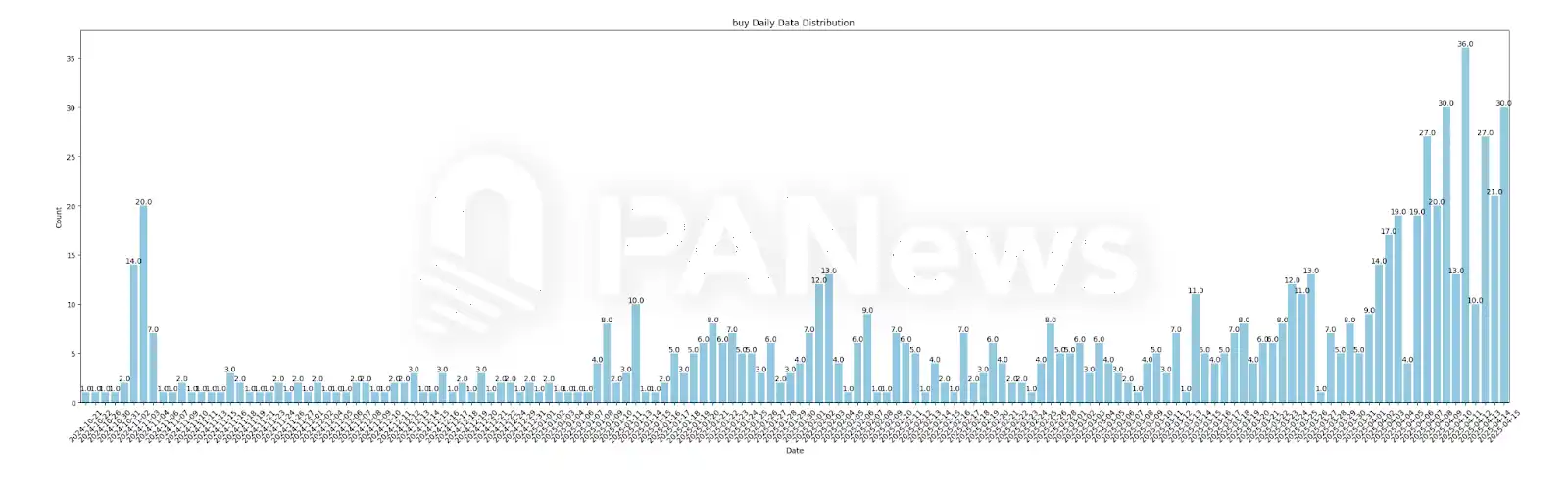
Fartcoin Whale Entry Time Distribution
In terms of cost, the initial purchases of the top 1000 whales are mostly concentrated between $0.2-$0.6 and $0.6-$0.9. Looking at the Fartcoin chart, the percentage of whales still trapped above $1 is relatively small. Overall analysis shows that the current holding whales mostly entered the market after the price low on March 12.
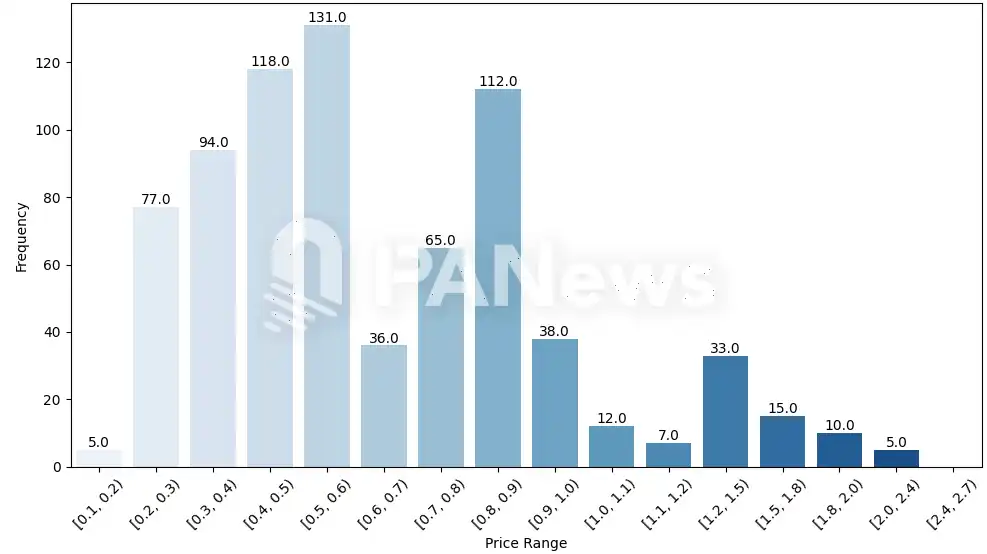
Fartcoin Whale Holding Cost Distribution
In total, the average holding cost of Fartcoin whales' initial purchases is about $0.62. Based on the current price of $0.844, these new whales have an average profit margin of about 36%.
23% of Addresses Have Cross-Asset Holdings, DARK and RFC Replay the Same Story
Looking at the overall picture, by comparing the top 1000 whale holders of these tokens, it is found that 23% of whale addresses hold at least 2 or more different tokens. Among them, the most held token by whales is DARK, a token with the shortest creation time, but 116 whales hold this token repeatedly.
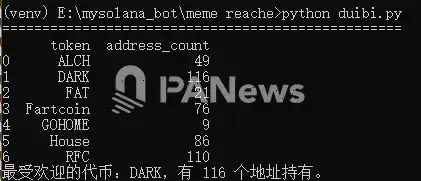
Next, RFC has the highest number of repeat occurrences, reaching 110 times. Fartcoin has recently received high market attention and also has the highest market value among the analyzed tokens, but it has only appeared 76 times in repetitions. However, according to PANews analysis, the reason for this may be that Fartcoin's market value has already risen to a relatively high level, and many large holders have exited or switched tokens. As specific historical information of whale holdings at a particular time cannot be tracked, we currently cannot provide a definitive answer.
However, from the analysis of RFC and DARK, it seems that these two tokens have a somewhat similar storyline.
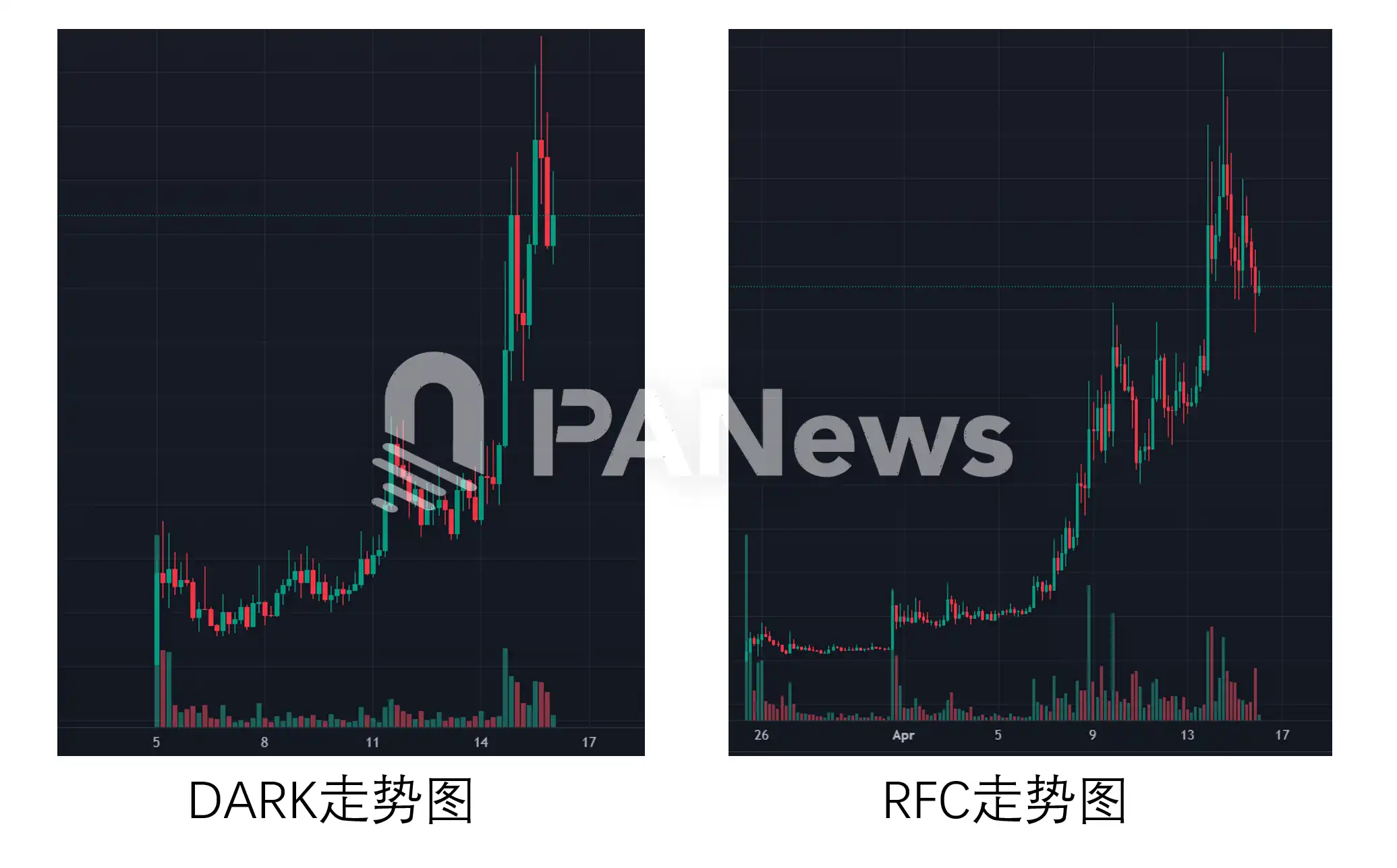
First of all, let's look at the candlestick chart trends of the two. Apart from the difference in creation time, the trends, including pullback patterns, tend to be similar.
Furthermore, the data on whale holdings of these two tokens are also quite similar, both being above 110. In a more detailed analysis, PANews observed that there are 75 addresses simultaneously holding the DARK and RFC tokens, which is the largest number in the whale holding combinations. The next is the Fartcoin and House combination, with 35 addresses simultaneously holding these two tokens.
Looking further into the timing of these addresses holding RFC and DARK simultaneously, most whale addresses initially bought these two tokens on April 13th and April 14th, respectively.
From the perspective of the candlestick chart trends, April 13th was precisely the date of RFC's rapid surge, with a one-day increase of 65% and a swing of 107%. On April 14th, DARK saw a similar market movement, with a one-day increase of 80% and a swing of 218%. This significant surge one after another appears to be a coordinated pumping action.
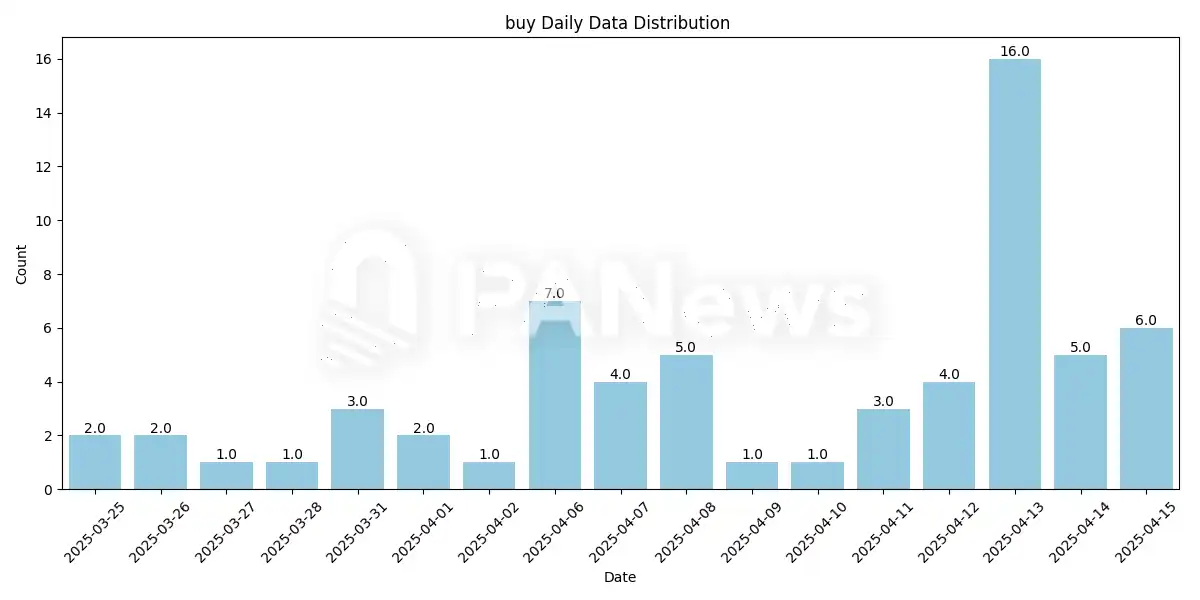
Whale First Purchase Distribution Date of RFC
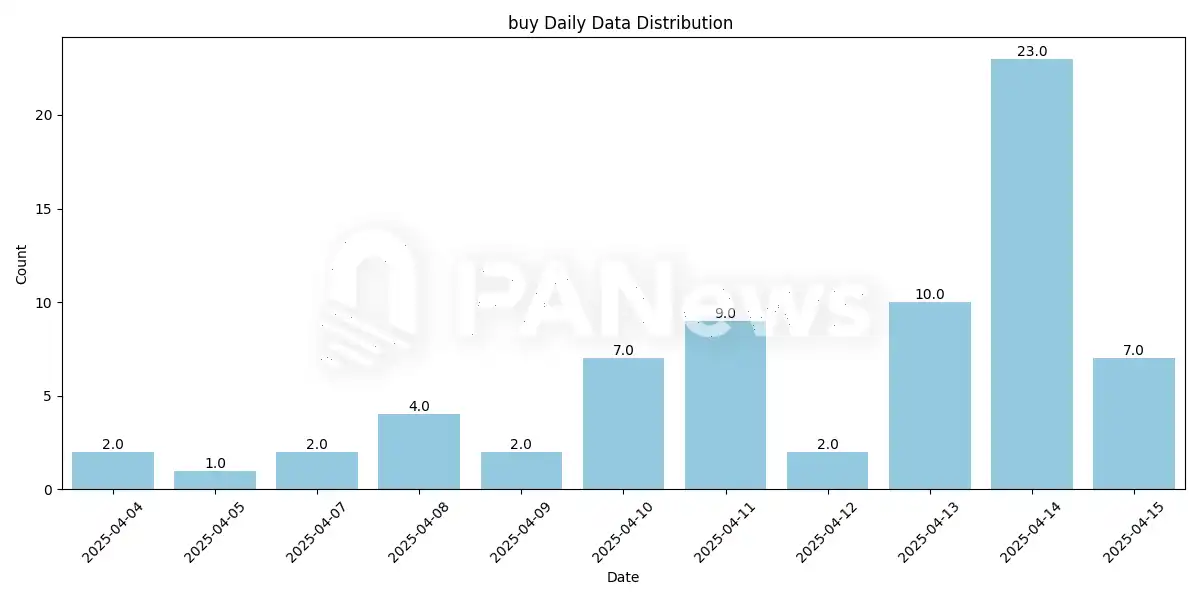
Whale First Purchase Distribution Date of DARK
Of course, it is worth noting that the market value of RFC reached as high as $138 million, while DARK's peak market value was only $23 million. It seems that the whales behind these tokens are not the absolute dominant force in the market, or the whales' expectations for these two tokens are not the same. Therefore, it cannot be assumed that DARK will replicate RFC's market value.
Additionally, tokens such as Fartcoin and House or DARK and House appear frequently in whale holdings.
“Artificial Bull” Embraces MEME Culture and AI
In the overall data, the total holding amount of these whale addresses with repeated holdings in these 7 tokens is approximately $100 million (excluding holdings by major exchanges such as Gate, Bitget, Raydium), accounting for 8.47% of the market value of these tokens.
As of early April 16, these tokens have also experienced a certain degree of pullback. Among them, FAT has retraced by 72.51% from its peak, House has retraced by 50%, with an overall average retracement of 37.12%. Among them, only ALCH has seen a smaller retracement, which, from its nature, is the only AI-related token with practical applications. However, from a cyclical perspective, ALCH may just happen to be in a phase of market rotation without entering a selling cycle.
Behind this MEME rotation surge, there seems to be some traces of an artificial MEME bull market. KOL @MasonCanoe stated on Twitter that the whale address responsible for the rise in RFC is associated with addresses that have engaged in market-making activities for previous tokens such as TRUMP, VIRTUAL, LIBRA, and is also associated with several addresses that were early stakeholders in RFC. Based on this, @MasonCanoe believes that the pump in RFC is by no means accidental and may be a signal of careful positioning by large funds.
From a data perspective, MEME on Solana's blockchain does seem to be once again capturing market attention under the impetus of some whales. However, since this driving effect cannot benefit all MEME tokens, it can only be judged by tracking the real-time dynamics of these main funds. Additionally, from the classification of several tokens, tokens with cat, dog, and frog themes seem to have not occupied a significant position in the recent surge, mainly with AI and MEME culture tokens showing outstanding performance.
Overall, this recent MEME craze on Solana's blockchain has not blossomed across the board but has been highly concentrated on a few specific tokens, with Fartcoin as the leader attracting a large number of new high-net-worth individuals who entered the market in mid-March. Of greater note is the fact that behind the trends of RFC and DARK, two highly similar tokens, there are numerous overlapping whale addresses holding both tokens, with their main buying times concentrated around the sharp surges on April 13 and 14, strongly implying possible coordinated actions or main fund rotation behavior. This surge seems to be not purely a result of organic market behavior but carries traces of an "artificial bull market," and whether this "artificial rain" can evolve into natural capital inflows is still to be observed.
You may also like

Mastercard Launches Agent Pay for AI, Plans to Record AI Agent Payment Authorizations on Polygon
Mastercard launched Agent Pay for AI, a new payment protocol designed to help AI agents make small payments such as pay-per-use access to data and APIs. The system plans to record human-granted AI agent permissions on Polygon, focusing on verifiable authorization, identity, and payment controls.

Curve Deploys Llamalend v2 on Optimism With 250,000 OP Incentives
Curve launched Llamalend v2 on Optimism with 250,000 OP incentives from the Optimism Foundation. The upgrade expands Llamalend beyond its earlier crvUSD-focused model, adding broader collateral support, LlamaRisk market reviews, and the ability to use Curve LP tokens as collateral.

Raydium Old Liquidity Pool Reportedly Exploited, With $1.34 Million Moved to Ethereum and Tornado Cash
An old Raydium liquidity pool was reportedly exploited for around $1.34 million in USDC, RAY, and wSOL, with the stolen funds bridged to Ethereum and deposited into Tornado Cash. The incident highlights the tail risks of legacy DeFi pools, old contracts, and cross-chain fund laundering paths.

Kalshi Executive Challenges “SBF Backed AI Unicorns” Narrative, Says Leopold Aschenbrenner Was Key Figure
Kalshi executive John Wang questioned the “SBF backed AI unicorns” narrative, saying Leopold Aschenbrenner was the key figure behind major AI investment decisions.

Pantera Capital Partner: How Tokenization is Restructuring the Private Equity and Early Investment Ecosystem?

New York Proposes Stricter Stablecoin Issuer Rules Aligned With Federal GENIUS Act
NYDFS proposed stricter stablecoin issuer rules aligned with the GENIUS Act, covering reserves, custody, redemption timelines, audits, and capital buffers.
Every exchange is a "Universal Exchange."

The counterattack of traditional finance: Alliance chains are quietly reviving

CryptoQuant Says Bitcoin Profitable Supply Is Near 45% Pressure Zone as On-Chain Data Points to Market Repricing
CryptoQuant said Bitcoin’s profitable supply is nearing the 45% pressure zone, signaling rising market stress, unrealized losses, and a possible on-chain repricing phase.

Bitcoin Falls Below 200-Week Moving Average as On-Chain Data Shows Over Half of Supply in Loss
Bitcoin dropped below its 200-week moving average as on-chain data showed over 50% of circulating supply is now in loss, signaling rising market stress.

CFTC Reportedly Plans New Prediction Market Rules Focused on Manipulation Risk and Public Interest Review
The CFTC is reportedly preparing new prediction market rules focused on manipulation risk, public interest review, and retail trader protections.

Meet the new WEEX trial fund—your gateway to greater profits

WEEX Labs Lands at Dutch Blockchain Week: A Disruptive Crypto × AI Conversation Sets Sail in Amsterdam
SK Hynix Reportedly Plans U.S. ADR Listing as Early as August, With SEC Approval Possible in Late June
SK Hynix may pursue a U.S. ADR listing as early as August, with SEC approval reportedly possible in late June amid strong AI chip supply chain demand.

SpaceX vs Tesla vs xAI: Which Elon Musk Trade Has the Biggest Upside in 2026?
OpenAI Reveals It Has Confidentially Submitted an S-1 to the SEC, Keeping the Door Open for a Future IPO
On June 9, according to an OpenAI announcement, the company recently confidentially submitted a draft S-1 registration statement to the U.S. Securities and Exchange Commission (SEC), beginning the preliminary compliance process for a potential initial public offering. OpenAI said it chose to disclose this proactively because it expected the news might leak; however, the company has not yet set a specific listing timeline, and related arrangements may still take some time.
Latest research from 13 top universities including Cornell University: The current state, challenges, and misconceptions of the fusion of Crypto and AI
Deconstructing Anthropic: The Best AI Company, Possibly Also a Type of Organizational Invention
Mastercard Launches Agent Pay for AI, Plans to Record AI Agent Payment Authorizations on Polygon
Mastercard launched Agent Pay for AI, a new payment protocol designed to help AI agents make small payments such as pay-per-use access to data and APIs. The system plans to record human-granted AI agent permissions on Polygon, focusing on verifiable authorization, identity, and payment controls.
Curve Deploys Llamalend v2 on Optimism With 250,000 OP Incentives
Curve launched Llamalend v2 on Optimism with 250,000 OP incentives from the Optimism Foundation. The upgrade expands Llamalend beyond its earlier crvUSD-focused model, adding broader collateral support, LlamaRisk market reviews, and the ability to use Curve LP tokens as collateral.
Raydium Old Liquidity Pool Reportedly Exploited, With $1.34 Million Moved to Ethereum and Tornado Cash
An old Raydium liquidity pool was reportedly exploited for around $1.34 million in USDC, RAY, and wSOL, with the stolen funds bridged to Ethereum and deposited into Tornado Cash. The incident highlights the tail risks of legacy DeFi pools, old contracts, and cross-chain fund laundering paths.
Kalshi Executive Challenges “SBF Backed AI Unicorns” Narrative, Says Leopold Aschenbrenner Was Key Figure
Kalshi executive John Wang questioned the “SBF backed AI unicorns” narrative, saying Leopold Aschenbrenner was the key figure behind major AI investment decisions.
Pantera Capital Partner: How Tokenization is Restructuring the Private Equity and Early Investment Ecosystem?
New York Proposes Stricter Stablecoin Issuer Rules Aligned With Federal GENIUS Act
NYDFS proposed stricter stablecoin issuer rules aligned with the GENIUS Act, covering reserves, custody, redemption timelines, audits, and capital buffers.

Popular coins
Latest Crypto News


