
New Chair Takes Over, SEC Now Dubbed "Crypto Dad" Within 48 Hours





On April 10, 2025, the SEC welcomed its new Chairman, Paul Atkins. Nominated by President Trump and confirmed by the Senate with a 52-44 vote, this leader took office and promptly announced that establishing a digital asset regulatory framework would be a "top priority," pledging to create a transparently operated SEC that extensively incorporates industry and consumer feedback, fundamentally changing the past closed, high-pressure regulatory style. Paul Atkins quickly became the focus of the crypto industry, and in his first 48 hours in office, a series of regulatory favorable factors emerged. Multiple crypto-related litigations during former SEC Chairman Gary Gensler's tenure were dropped, the SEC issued a statement urging detailed disclosures when issuing cryptocurrency, and personally intervened to guide project teams on coin issuance. Such intense actions have made people curious: Is Trump's SEC going to be the "daddy" of the crypto industry?
SEC's New Chairman's Arrival Brings Frequent Regulative Positives
Paul Atkins is not new to the SEC and is also a veteran in crypto. As early as 2002 to 2008, he served as an SEC Commissioner, accumulating rich regulatory experience. Subsequently, he founded Patomak Global Partners, providing compliance and risk strategy consulting to financial and digital asset companies, including crypto exchanges and DeFi platforms. He has also led the Token Alliance crypto advocacy group, openly supporting digital asset innovation. It was disclosed that he and his spouse hold up to $6 million in crypto-related assets.

On April 9, 2025, the Senate confirmed Atkins' nomination with full Republican support, marking a significant shift for the SEC from former Chairman Gary Gensler's enforcement-focused style to a pro-market orientation. During Gensler's tenure, he initiated over 100 crypto-related enforcement actions, emphasizing that most tokens fall under securities law jurisdiction and adopting a skeptical attitude towards the industry. In contrast, Atkins advocates providing clear and feasible rules for digital assets through a principle-based regulatory framework. During a Senate Banking Committee hearing on March 28, he explicitly stated that digital assets are the SEC's top priority this year, committing to cooperating with the Commodity Futures Trading Commission (CFTC) and Congress to fill regulatory gaps, unleash America's global competitiveness in Bitcoin and blockchain finance.
Atkins succeeded Mark Uyeda, who served as acting chairman after Gensler's resignation in January. Under the "crypto-friendly" Trump administration, Uyeda's brief tenure had already paved the way for the SEC's transformation, such as dismissing multiple crypto-related enforcement cases and abolishing the internal rule SAB 121 restricting public companies from holding crypto assets. Atkins' assumption of office accelerated the trend of regulatory relaxation, and his term will last until June 2026. In a period of over a year, he may advance significant changes to the crypto regulatory policy framework.
Atkins's "first blaze" ignited the financial market, with Atkins's pro-market stance injecting a dose of vitality into the financialization of crypto assets. On her first day in office, April 10th, the SEC approved options trading for a spot Ethereum ETF, a milestone that provided investors with more participation channels. Additionally, Atkins supported simplifying private market rules, proposing to define accredited investors based on financial sophistication rather than net worth, which may further lower the barrier to entry for crypto investments.
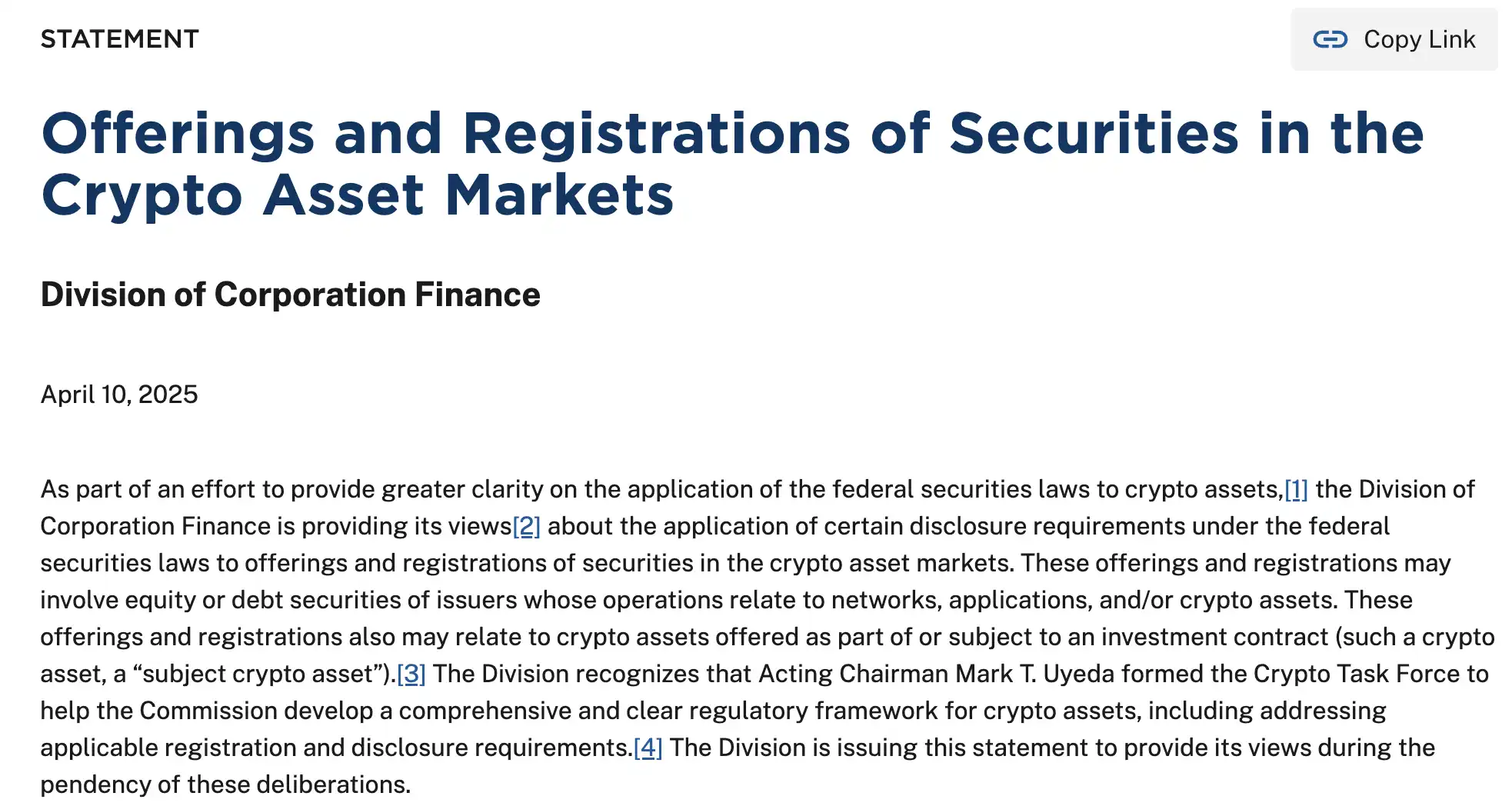
The "second blaze" provided future regulatory guidance. On her second day in office, the SEC issued a non-binding guidance statement, stating: "These issuances and registrations may involve issuers' equity or debt securities related to networks, applications, and/or crypto assets. These issuances and registrations may also involve crypto assets that are part of or subject to investment contracts (such crypto assets referred to as 'underlying crypto assets')." It urged companies issuing or handling tokens that could be considered securities to provide detailed disclosures, including business details, token roles, network development milestones, and token holder rights, among others. Although it is still not clear which cryptocurrencies fall under securities, it is based on the SEC's observation of existing company disclosure information, attempting to provide a more explicit reference framework for the industry. Such detailed "off-the-cuff guidance" also reflects the SEC's shift from "penalty over guidance" to "guidance over enforcement," hoping to reduce market uncertainty through communication and transparency, preventing the industry from teetering on the brink and only able to repeatedly probe.
The "third blaze" melted away the "cold cases" during Gary Gensler's tenure, as the SEC showed a more lenient attitude toward past crypto litigations. On April 11th, Helium network developer Nova Labs announced that the SEC had dismissed charges of selling unregistered securities against it. Previously, the SEC had filed lawsuits against Nova Labs for three tokens—HNT, MOBILE, and IoT. With Atkins taking office, this litigation quietly concluded, setting a positive precedent for similar projects. On the same day, the SEC reached a settlement with Ripple in the long-running litigation, with both parties filing a joint motion to stay the appeal, Ripple paying a $50 million fine, and the remaining $75 million to be refunded to the company.
In addition, to promote regulatory clarity, the SEC's Cryptocurrency Working Group plans to hold four public roundtable discussions from April to June 2025, covering topics such as crypto trading, custody, asset tokenization, and DeFi. Commissioner Hester Peirce referred to this as the "spring sprint toward crypto clarity," marking a shift for the SEC from confrontation to cooperation. The first meeting on April 11 will focus on "tailored regulation for crypto trading," with subsequent meetings exploring the integration of traditional finance and blockchain, as well as the intersection of DeFi and the American ethos.
What Other Moves Does the "Crypto Dad" Have?
Atkins' intensive actions following his appointment are closely tied to the overall policy context of the Trump administration, aligning well with crypto policy.
Upon Trump's return to the White House, policies saw significant relaxation. Firstly, there was notable progress in approving crypto ETFs. Previously stalled ETF applications for assets like XRP and Solana due to Gensler's tough stance are now undergoing more lenient reviews within the SEC, with industry insiders expecting multiple ETF approvals by 2025, significantly enhancing market liquidity. Secondly, market makers such as Citadel Securities and Wintermute have returned, promoting comprehensive improvements in market liquidity, trade efficiency, and regulatory compliance. Simultaneously, stablecoin legislation is rapidly advancing. Trump has publicly supported stablecoins multiple times to increase demand for U.S. Treasury bonds, bolster U.S. digital dollar hegemony, and solidify the dollar's global dominance. In April, the Senate Banking Committee approved the "GENIUS Act" proposed by Republican Senator Bill Hagerty, establishing licensing, reserve, and disclosure requirements for stablecoin issuance, providing a light-touch regulatory framework. Atkins stated that the SEC will coordinate with the CFTC to clarify stablecoins' security and commodity attributes, and support state-level regulatory exemptions for stablecoins with a market cap below $100 billion to encourage innovation.
Furthermore, just today, Trump signed a bill repealing the IRS broker rule for DeFi platforms, removing obstacles for DeFi development. This rule, introduced in 2024, classified DeFi platforms as brokers, requiring them to submit tax forms for users, sparking widespread industry dissatisfaction. Trump, upon signing the bill, stated that the rule "inhibited American innovation" and "invaded the privacy of ordinary Americans." This is the first cryptocurrency-related legislation signed by the Trump administration, once again demonstrating that from nominating a market-friendly SEC chairman to repealing restrictive rules, the Trump administration is actively working to create a relaxed environment for the digital asset industry, aiming to establish the U.S. as a global digital financial center.
Related Reading: "Senate Repeals 'DeFi Broker Rule,' Ushering in US Regulatory Lightning War on DeFi?"
Under the leadership of Trump, the federal government seems to be forming a more relaxed atmosphere for crypto policy, and the SEC also appears to be transitioning from a 'regulatory iron fist' to a 'crypto daddy.' With multiple crypto ETF approvals, dismissals of years-long lawsuits, the return of multiple market makers, and the abolition of the DeFi broker rule, the Trump administration is attempting to stimulate industry growth by reducing regulatory barriers. However, this policy shift has also raised some concerns. Senator Elizabeth Warren criticized Atkins' ties to Wall Street and FTX as advisors, believing that their background may compromise regulatory impartiality. Critics also argue that overly lax regulation could lead to market chaos and increase investor risk.
We must both strictly regulate market order and nurture industry innovation and growth. In the future, whether this 'crypto daddy' can find a balance between innovation and protection to achieve the global status of the US digital asset market remains to be seen. It is foreseeable that with the support of the Trump administration, the SEC's crypto policy will continue to be a focus of global attention, and the future of the US digital asset market may be starting a new chapter from here.
You may also like

Every exchange is a "Universal Exchange."

The counterattack of traditional finance: Alliance chains are quietly reviving

CryptoQuant Says Bitcoin Profitable Supply Is Near 45% Pressure Zone as On-Chain Data Points to Market Repricing
CryptoQuant said Bitcoin’s profitable supply is nearing the 45% pressure zone, signaling rising market stress, unrealized losses, and a possible on-chain repricing phase.

Bitcoin Falls Below 200-Week Moving Average as On-Chain Data Shows Over Half of Supply in Loss
Bitcoin dropped below its 200-week moving average as on-chain data showed over 50% of circulating supply is now in loss, signaling rising market stress.

CFTC Reportedly Plans New Prediction Market Rules Focused on Manipulation Risk and Public Interest Review
The CFTC is reportedly preparing new prediction market rules focused on manipulation risk, public interest review, and retail trader protections.

Meet the new WEEX trial fund—your gateway to greater profits

WEEX Labs Lands at Dutch Blockchain Week: A Disruptive Crypto × AI Conversation Sets Sail in Amsterdam

SK Hynix Reportedly Plans U.S. ADR Listing as Early as August, With SEC Approval Possible in Late June
SK Hynix may pursue a U.S. ADR listing as early as August, with SEC approval reportedly possible in late June amid strong AI chip supply chain demand.

SpaceX vs Tesla vs xAI: Which Elon Musk Trade Has the Biggest Upside in 2026?
OpenAI Reveals It Has Confidentially Submitted an S-1 to the SEC, Keeping the Door Open for a Future IPO
On June 9, according to an OpenAI announcement, the company recently confidentially submitted a draft S-1 registration statement to the U.S. Securities and Exchange Commission (SEC), beginning the preliminary compliance process for a potential initial public offering. OpenAI said it chose to disclose this proactively because it expected the news might leak; however, the company has not yet set a specific listing timeline, and related arrangements may still take some time.

Latest research from 13 top universities including Cornell University: The current state, challenges, and misconceptions of the fusion of Crypto and AI
Deconstructing Anthropic: The Best AI Company, Possibly Also a Type of Organizational Invention
Apollo and Blackstone Reportedly Back $35 Billion Anthropic Chip Financing as Deal Details Remain Unclear
On June 9, according to currently available news alerts, Apollo and Blackstone Group participated in a $35 billion financing for an Anthropic “chip project.” Based on the original wording of the report, the funding has already been raised, but public information remains limited. The financing structure, use of proceeds, project entity, and whether Apollo and Blackstone participated through equity, debt, or project financing have not yet been disclosed.

Humanity Protocol Security Incident Escalates: More Than $31 Million Stolen From Related Addresses as Attacker Continues Selling H for ETH
On June 9, according to monitoring by Onchain Lens, more than $31 million has been stolen from addresses linked to Humanity Protocol, and the attack is still ongoing, with the hacker continuously swapping H tokens for ETH. Project founder Terence Kwok later confirmed the security incident on X, saying the issue involved a private key leak.

Bloomberg: As Bitcoin Weakens, Stablecoins and RWA Continue to Drive Expansion in Crypto Businesses
In June, Bloomberg reported that despite Bitcoin falling below $60,000 last week, wiping out about $235 billion in market value within seven days, and dropping close to 50% from last year’s peak, some core businesses in the crypto industry are still expanding, mainly in stablecoins, real-world asset tokenization (RWA), payments, and infrastructure. The report also noted that overall altcoin activity has contracted significantly: altcoin market capitalization has fallen from a peak of about $431 billion in November 2021 to around $170 billion, and among the tens of millions of tokens issued in recent years, fewer than 1,700 still maintain meaningful trading activity.

Galaxy Deep Research Report: How Hyperliquid's HIP-4 Upgrade Changes the Landscape of Prediction Markets?
Binance Research: RWA Market Expected to Expand Nearly 6x from Early 2025, with Public Equities and Onchain Payments Heating Up Together
In June, Binance Research said in its monthly market report that the real-world asset (RWA) market is expected to grow by about 589% from the beginning of 2025. Bond- and money market fund-related RWA expanded by about $6.5 billion, up 83% year over year, while publicly traded equity RWAs grew by about 422%. The report also noted that monthly crypto debit card transaction volume exceeded $747 million in May, up 48.6% year to date.

Japan to Assess a Framework for Yen Stablecoins and Crypto ETFs as Asia’s Compliant Payments Narrative Heats Up
Recently, according to the original report, Japan is considering the launch of yen stablecoins and cryptocurrency ETFs. Public information remains limited at this stage, and there is still no complete policy text, regulatory draft, or clear implementation timeline, so this is better characterized as a “policy discussion” rather than formal implementation. The original wording also noted that advancing stablecoin regulation in Asia is driving XRP usage and supporting growth in the XRPL ecosystem. However, based on currently available public information, there is not enough evidence to directly establish a clear causal relationship between this round of discussion in Japan and XRP or XRPL.
Every exchange is a "Universal Exchange."
The counterattack of traditional finance: Alliance chains are quietly reviving
CryptoQuant Says Bitcoin Profitable Supply Is Near 45% Pressure Zone as On-Chain Data Points to Market Repricing
CryptoQuant said Bitcoin’s profitable supply is nearing the 45% pressure zone, signaling rising market stress, unrealized losses, and a possible on-chain repricing phase.
Bitcoin Falls Below 200-Week Moving Average as On-Chain Data Shows Over Half of Supply in Loss
Bitcoin dropped below its 200-week moving average as on-chain data showed over 50% of circulating supply is now in loss, signaling rising market stress.
CFTC Reportedly Plans New Prediction Market Rules Focused on Manipulation Risk and Public Interest Review
The CFTC is reportedly preparing new prediction market rules focused on manipulation risk, public interest review, and retail trader protections.
Meet the new WEEX trial fund—your gateway to greater profits


