
OpenLedger's OpenLoRA: Pioneering a New Paradigm for Decentralized AI Model Serving


In the rapidly evolving decentralized AI field, OpenLedger is redefining the construction, fine-tuning, and commercialization foundation of AI models as the next-generation blockchain network. With a vision to democratize artificial intelligence, OpenLedger is building a full-stack infrastructure that allows contributors to not only be passive participants in the ecosystem but also to become stakeholders in a value-distributing, transparent, scalable, and verifiable decentralized network. The project has secured top-tier funding from Polychain Capital, Borderless Capital, HashKey, as well as support from industry leaders such as Sreeram Kannan, Balaji Srinivasan, Sandeep Nailwal, and Kenny Li, quietly constructing the infrastructure layer that will take decentralized AI from concept to practicality.
Within its innovative technology matrix, OpenLoRA stands out as a breakthrough—this model serving framework redefines the efficiency, scalability, and cost-effectiveness of fine-tuning AI models. But to understand the significance of OpenLoRA, we first need to examine the systemic flaws in current AI infrastructure.
Core Issue: Centralized AI and Inference Bottleneck
Despite AI applications accelerating across industries, the vast majority of innovation remains centralized. AI models are typically trained and deployed by tech giants, locked behind private APIs, with opaque training datasets and untraceable value attribution mechanisms.
More importantly, as fine-tuning AI models (especially in vertical domain-specific applications) becomes increasingly common, a key bottleneck has emerged: model serving.
Core Challenge of Model Deployment:
• High GPU Costs: Each fine-tuned model typically requires a separate instance, leading to exponential scaling costs
• Latency-Throughput Tradeoff: High concurrency often results in response delays or model accuracy degradation
• Memory Constraints: Traditional deployment frameworks preload multiple models, leading to very low memory utilization
• Rigid Personalized Services: Large-scale deployment of user-specific models faces both technical and economic feasibility barriers
The market urgently needs a model serving solution that can cater to large-scale personalization, low cost, high efficiency, and native decentralization.
OpenLoRA: A Paradigm Shift in Model Serving
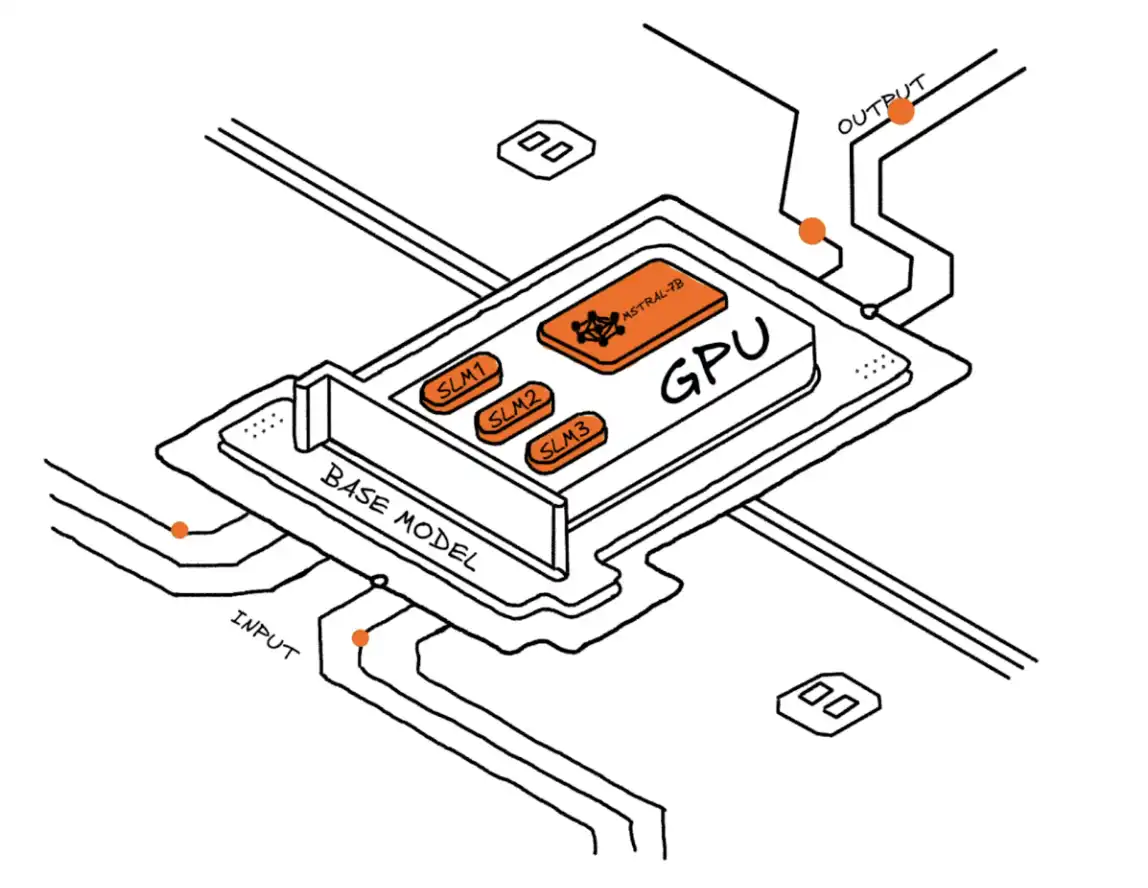
OpenLoRA is the solution provided by OpenLedger. This high-performance, scalable framework can parallelly serve thousands of LoRA (Low-Rank Adaptive) models on a single GPU block, significantly reducing operational costs and unlocking possibilities for the next generation of AI applications.
Breakthrough Features of OpenLoRA:
• Dynamic Adapter Loading: Adopt instant loading mechanism to replace full preloading, freeing up GPU memory
• Real-time Model Fusion: Support runtime multi-adapter merging, achieving integrated inference
• Streaming Quantization Processing: Support token streaming and 4-bit quantization, achieving ultra-low latency real-time inference
• High-Performance Metrics:
Token Generation Speed: 2000+/sec
Latency: 20-50ms
Memory Footprint: <12GB (traditional frameworks require 40-50GB)
• Developer Friendly: Achieve adapter loading, merging, running, and unloading through a simple API, perfectly suited for productization scenarios
Benchmarking: Quantifying the OpenLoRA Advantage
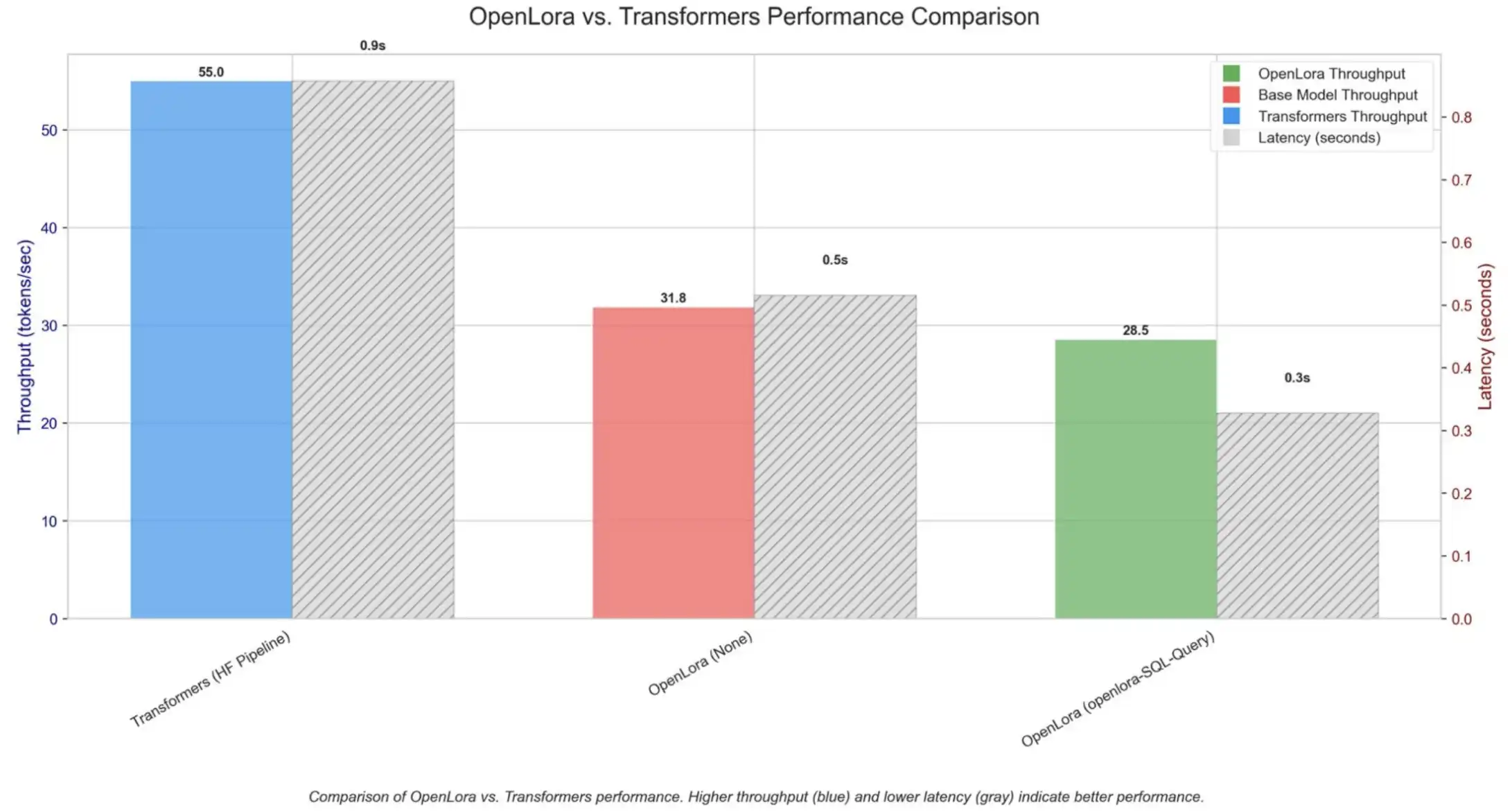
The latest performance tests confirm OpenLoRA's comprehensive superiority over traditional model serving frameworks.
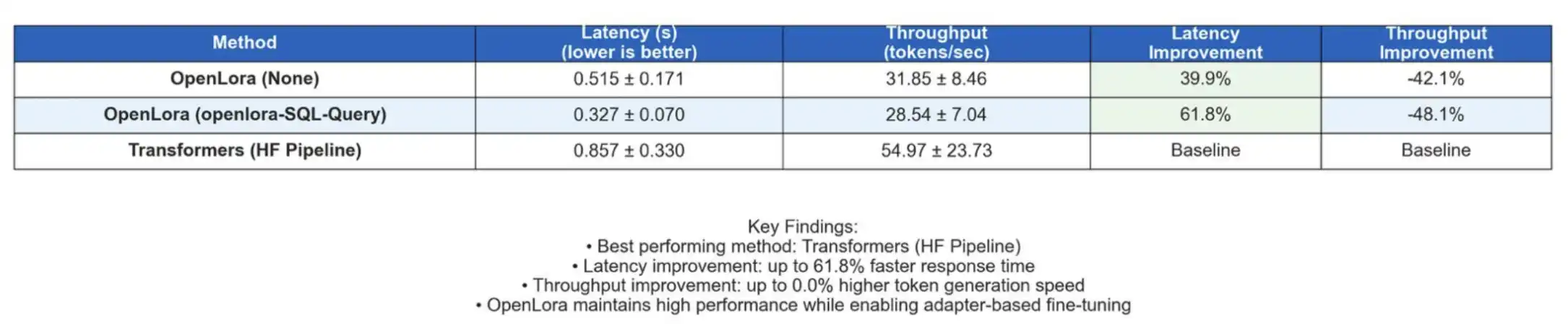
In comparative tests, OpenLoRA's token generation speed exceeds that of traditional solutions by over 4 times, with significantly reduced memory usage. Even under high-concurrency loads, it can maintain a 20ms ultra-low latency while serving thousands of LoRA adapters with less than 12GB of VRAM. These metrics have been validated across multiple hardware environments, demonstrating that OpenLoRA consistently outperforms traditional architectures in throughput and efficiency. This performance leap establishes OpenLoRA as the preferred infrastructure for scalable real-time AI deployments in decentralized environments.
For developers looking to deploy personalized assistants, multi-domain intelligent agents, or build real-time AI services, the OpenLoRA architecture completely eliminates the GPU resource burden.
Built on the Native AI Blockchain Infrastructure of OpenLedger
OpenLoRA is not a standalone service but deeply integrated into the OpenLedger blockchain network designed specifically for AI applications. This infrastructure includes:
• ModelFactory: GUI-based LoRA/QLoRA model fine-tuning engine
• Proof of Attribution: Ensures data integrity and aligns incentives with contributors through cryptographic proof
• Datanets: Decentralized data networks providing high-quality domain-specific training data
These layers together form the cornerstone of "Payable AI," where models not only achieve decentralization and transparency but also enable value distribution based on user contributions. By addressing the final barrier of this technology stack — large-scale, cost-effective model deployment for real-world applications — OpenLoRA further advances this mission.
Testnet Progress
To prepare for the mainnet launch, OpenLedger has initiated a public testnet, creating an openly accessible decentralized ecosystem. Participants can earn points through:
• Running testnet nodes
• Completing tasks in various Datanets
• Contributing high-quality data
• Inviting new users
These points will tie into OpenLedger's tiered rewards mechanism, where early contributors will receive launch incentives upon the mainnet release. Of particular note is its extremely low barrier to entry:
• Mobile (Android) and browser extension nodes can be deployed within 30 seconds
• No technical background required as the participation process is designed for scalability
A notable development is that China has emerged as one of the most active participating regions, with testnet traffic ranking among the highest globally. Of the 24.8 million requests recorded on the platform, China leads in contribution.
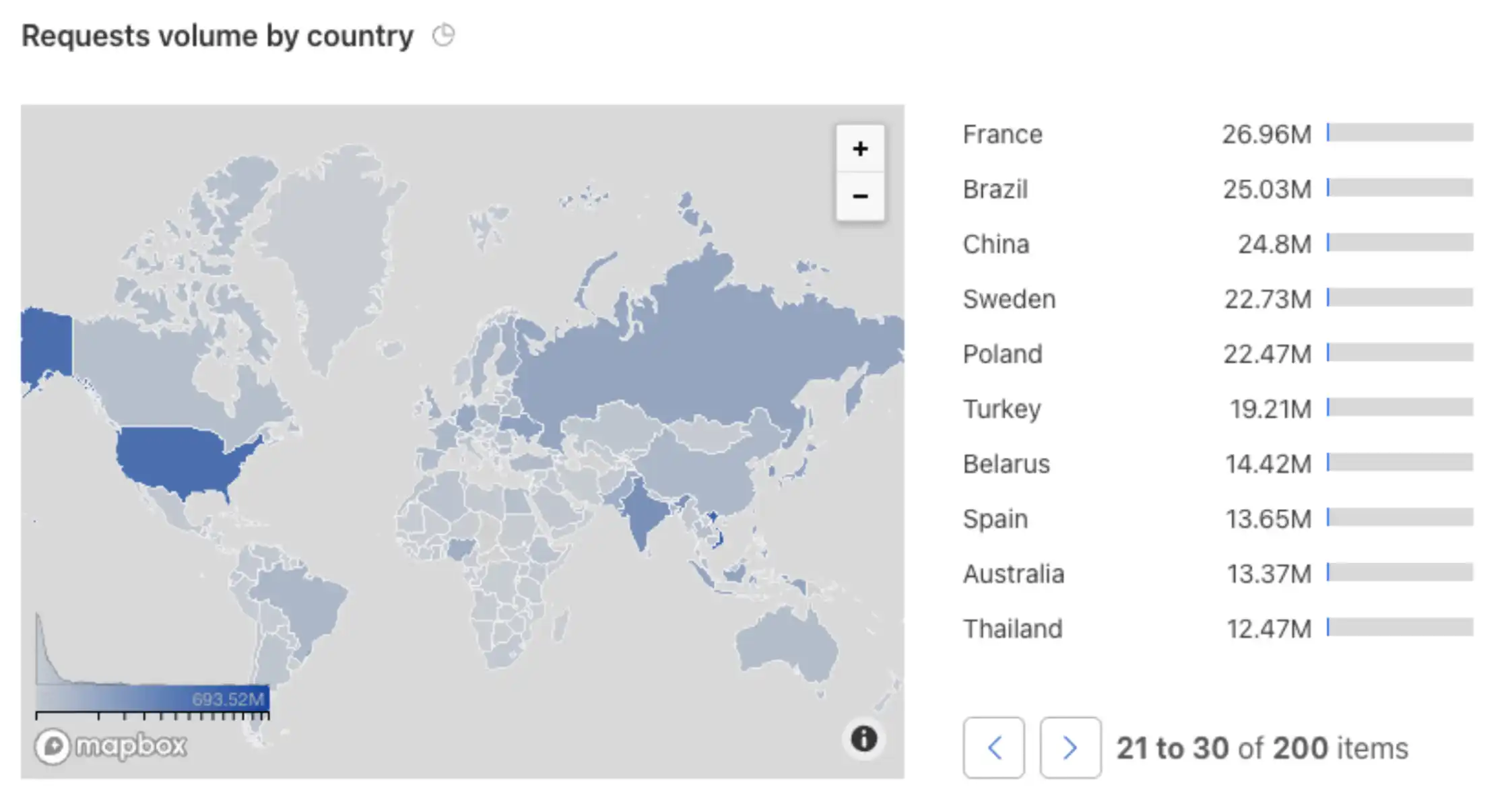
This sends a strong signal: developers, researchers, and AI practitioners in China are actively embracing OpenLedger's vision, seeking a more cost-effective, decentralized, and scalable alternative to traditional AI infrastructure.
Future Outlook
OpenLoRA has already empowered applications in various fields:
• Professional scientific advisors
• Localized legal assistants
• Web3 data-based transaction co-pilots
• On-chain communication real-time translators
In the future, it will support zero-shot LoRA adapters, multi-GPU deployments, and inference capabilities for edge devices, including mobile endpoints.
Why OpenLoRA? Why Now?
AI needs decentralization, which is not only about ideological purity, but also about the practical need for scalability, trust, and innovation. OpenLoRA removes the final technological bottleneck of decentralized AI—large-scale model serving—and achieves a breakthrough in efficiency. This is not just a tool innovation, but a call to participate in shaping the next generation of AI infrastructure. With the help of OpenLedger's ModelFactory and Proof of Contribution mechanism, developers can now transparently fine-tune, deploy, and monetize AI models with precision. The
The birth of OpenLoRA finally enables all of this to be achieved at scale, on demand, and without the burden of exorbitant GPU costs.
Join the OpenLedger ecosystem, follow our X account to get the latest updates, version releases, and ecosystem news on decentralized AI.
This article is contributed content and does not represent the views of BlockBeats.
You may also like

OpenAI Reveals It Has Confidentially Submitted an S-1 to the SEC, Keeping the Door Open for a Future IPO
On June 9, according to an OpenAI announcement, the company recently confidentially submitted a draft S-1 registration statement to the U.S. Securities and Exchange Commission (SEC), beginning the preliminary compliance process for a potential initial public offering. OpenAI said it chose to disclose this proactively because it expected the news might leak; however, the company has not yet set a specific listing timeline, and related arrangements may still take some time.

Latest research from 13 top universities including Cornell University: The current state, challenges, and misconceptions of the fusion of Crypto and AI
Deconstructing Anthropic: The Best AI Company, Possibly Also a Type of Organizational Invention
Apollo and Blackstone Reportedly Back $35 Billion Anthropic Chip Financing as Deal Details Remain Unclear
On June 9, according to currently available news alerts, Apollo and Blackstone Group participated in a $35 billion financing for an Anthropic “chip project.” Based on the original wording of the report, the funding has already been raised, but public information remains limited. The financing structure, use of proceeds, project entity, and whether Apollo and Blackstone participated through equity, debt, or project financing have not yet been disclosed.

Humanity Protocol Security Incident Escalates: More Than $31 Million Stolen From Related Addresses as Attacker Continues Selling H for ETH
On June 9, according to monitoring by Onchain Lens, more than $31 million has been stolen from addresses linked to Humanity Protocol, and the attack is still ongoing, with the hacker continuously swapping H tokens for ETH. Project founder Terence Kwok later confirmed the security incident on X, saying the issue involved a private key leak.

Bloomberg: As Bitcoin Weakens, Stablecoins and RWA Continue to Drive Expansion in Crypto Businesses
In June, Bloomberg reported that despite Bitcoin falling below $60,000 last week, wiping out about $235 billion in market value within seven days, and dropping close to 50% from last year’s peak, some core businesses in the crypto industry are still expanding, mainly in stablecoins, real-world asset tokenization (RWA), payments, and infrastructure. The report also noted that overall altcoin activity has contracted significantly: altcoin market capitalization has fallen from a peak of about $431 billion in November 2021 to around $170 billion, and among the tens of millions of tokens issued in recent years, fewer than 1,700 still maintain meaningful trading activity.

Galaxy Deep Research Report: How Hyperliquid's HIP-4 Upgrade Changes the Landscape of Prediction Markets?
Binance Research: RWA Market Expected to Expand Nearly 6x from Early 2025, with Public Equities and Onchain Payments Heating Up Together
In June, Binance Research said in its monthly market report that the real-world asset (RWA) market is expected to grow by about 589% from the beginning of 2025. Bond- and money market fund-related RWA expanded by about $6.5 billion, up 83% year over year, while publicly traded equity RWAs grew by about 422%. The report also noted that monthly crypto debit card transaction volume exceeded $747 million in May, up 48.6% year to date.

Japan to Assess a Framework for Yen Stablecoins and Crypto ETFs as Asia’s Compliant Payments Narrative Heats Up
Recently, according to the original report, Japan is considering the launch of yen stablecoins and cryptocurrency ETFs. Public information remains limited at this stage, and there is still no complete policy text, regulatory draft, or clear implementation timeline, so this is better characterized as a “policy discussion” rather than formal implementation. The original wording also noted that advancing stablecoin regulation in Asia is driving XRP usage and supporting growth in the XRPL ecosystem. However, based on currently available public information, there is not enough evidence to directly establish a clear causal relationship between this round of discussion in Japan and XRP or XRPL.

ZachXBT: Humanity private key leak and abnormal surge in H token should be viewed separately
On June 9, according to related disclosures, on-chain investigator ZachXBT posted an update on Humanity’s roughly $31 million security incident, saying that after further analyzing fund flows, he currently tends to believe the project team was not involved in an “inside job” or a self-staged attack. According to him, the official explanation about the private key leak was broadly accurate, but before the token unlock, the price of H had been artificially pushed higher, and the hacker later took advantage of that market environment; therefore, the private key leak and the earlier abnormal price pumping should be regarded as two separate and independent events. This reframing has shifted the market’s understanding of the nature of the incident. Earlier discussion around Humanity had focused on whether the team directly participated in the attack or used the security incident to cover up internal operations. ZachXBT’s latest remarks shift the focus from “whether it was self-theft” to “whether there were pre-unlock market structure issues.” He also questioned whether the team may have.

Morning Report | OpenAI has submitted an S-1 registration statement draft to the U.S. SEC; Morpho completes $175 million financing

Morning Report | BitMine increased its holdings by 126,971 ETH last week; trader Eugene announced his exit from the crypto market

Wang Chuan: How can one not feel anxious after the neighbor Old Wang made thirty times profit by investing in storage stocks? (Seven) - A quarter-century cycle
Cryptocurrency CEXs are flocking to sell US stocks, and traditional brokerages are facing an "uninvited guest."
$75 billion in foreign capital has fled, and South Korean retail investors have absorbed it all using leverage

Japan’s Three Megabanks Plan Joint Stablecoin Issuance in Fiscal 2026
MUFG, SMBC, and Mizuho reportedly plan to jointly issue fiat-pegged stablecoins in fiscal 2026, signaling Japan’s growing push into bank-led digital payment infrastructure.

Humanity Discloses H Token Dual-Chain Attack Details, With Losses on Ethereum and BSC Exceeding $36 Million
Humanity said the H token attack across Ethereum and BSC caused more than $36 million in losses after leaked ProxyAdmin keys enabled malicious contract upgrades and token minting.
White House Discusses CLARITY Act With Law Enforcement Ahead of Senate Vote
The White House discussed the CLARITY Act with law enforcement ahead of a Senate vote, focusing on illicit finance risks and developer protections.
OpenAI Reveals It Has Confidentially Submitted an S-1 to the SEC, Keeping the Door Open for a Future IPO
On June 9, according to an OpenAI announcement, the company recently confidentially submitted a draft S-1 registration statement to the U.S. Securities and Exchange Commission (SEC), beginning the preliminary compliance process for a potential initial public offering. OpenAI said it chose to disclose this proactively because it expected the news might leak; however, the company has not yet set a specific listing timeline, and related arrangements may still take some time.
Latest research from 13 top universities including Cornell University: The current state, challenges, and misconceptions of the fusion of Crypto and AI
Deconstructing Anthropic: The Best AI Company, Possibly Also a Type of Organizational Invention
Apollo and Blackstone Reportedly Back $35 Billion Anthropic Chip Financing as Deal Details Remain Unclear
On June 9, according to currently available news alerts, Apollo and Blackstone Group participated in a $35 billion financing for an Anthropic “chip project.” Based on the original wording of the report, the funding has already been raised, but public information remains limited. The financing structure, use of proceeds, project entity, and whether Apollo and Blackstone participated through equity, debt, or project financing have not yet been disclosed.
Humanity Protocol Security Incident Escalates: More Than $31 Million Stolen From Related Addresses as Attacker Continues Selling H for ETH
On June 9, according to monitoring by Onchain Lens, more than $31 million has been stolen from addresses linked to Humanity Protocol, and the attack is still ongoing, with the hacker continuously swapping H tokens for ETH. Project founder Terence Kwok later confirmed the security incident on X, saying the issue involved a private key leak.
Bloomberg: As Bitcoin Weakens, Stablecoins and RWA Continue to Drive Expansion in Crypto Businesses
In June, Bloomberg reported that despite Bitcoin falling below $60,000 last week, wiping out about $235 billion in market value within seven days, and dropping close to 50% from last year’s peak, some core businesses in the crypto industry are still expanding, mainly in stablecoins, real-world asset tokenization (RWA), payments, and infrastructure. The report also noted that overall altcoin activity has contracted significantly: altcoin market capitalization has fallen from a peak of about $431 billion in November 2021 to around $170 billion, and among the tens of millions of tokens issued in recent years, fewer than 1,700 still maintain meaningful trading activity.


