
Perhaps tariffs only scratched the surface -- what are the challenges in the Chinese market?

Original Title: When it comes to tariffs, China is a special case
Original Author: @stevesi
Original Translation: zhouzhou, BlockBeats
Editor's Note: This article discusses the significant challenges U.S. tech companies face in China. Despite the attractiveness of the Chinese market to foreign businesses, issues such as inadequate intellectual property protection, heavy government intervention, and rampant piracy make conducting business in China exceptionally difficult. Companies like Microsoft have tried various approaches but have consistently struggled to break through the complex barriers of the Chinese market. The article emphasizes that while tariffs are obvious, the true issues in China lie in soft restrictions, regulatory mazes, and cultural differences, calling for a deeper understanding and discussion of the challenges in the Chinese market.
The following is the original content (slightly reorganized for better readability):
There has been much discussion about how the United States can benefit from China's powerful manufacturing sector, with tariffs often being the focus of international trade debates. However, what is often overlooked is how difficult it is for U.S. companies to enter the Chinese market and establish a sustainable business—especially in the service and intellectual property sectors.
Tariffs are just the tip of the iceberg. Beneath the surface lies a vast and intricate network of "soft barriers," regulatory requirements, and cultural differences, making it nearly impossible for U.S. companies to enter this market in a fair and sustainable manner.
Having worked at Microsoft for 15 years and having lived and worked in China, I have personally witnessed all of this. These experiences have been more challenging and enlightening than any tariff dispute.
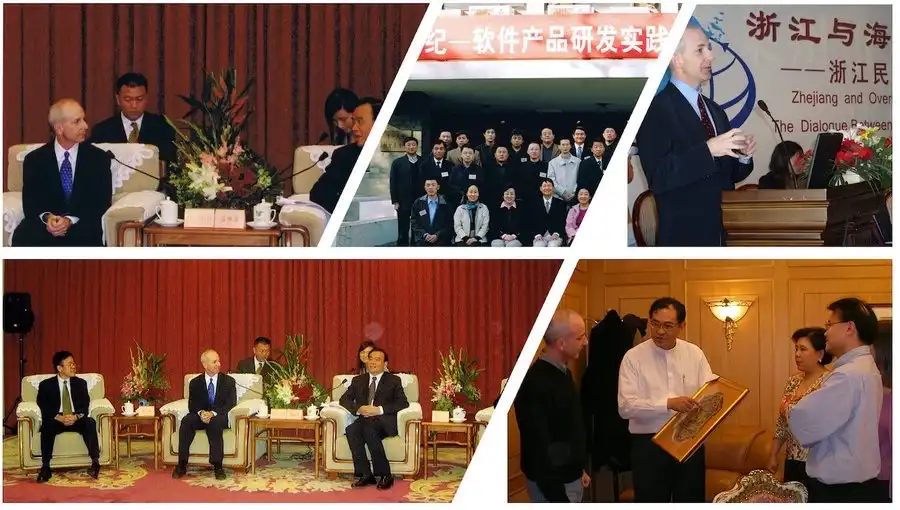
Over the years, I have participated in many events in China related to cooperation and piracy.
Microsoft's first attempt in Asia was to enter the Japanese market in the late 1980s. This was not easy. We faced some technical barriers, such as the absence of a UNICODE standard, a strong local preference for domestic products, and government policies that overtly or covertly favored Japanese companies. In many ways, this was not so different from the "Buy American" policies seen in the United States.
However, through perseverance, respect for local customs, and significant investment in product localization, we eventually succeeded. Japan's deeply rooted respect for intellectual property played a crucial role. By the mid-1990s, Microsoft Office was one of the most profitable businesses in Japan, with both corporate users and ordinary consumers loving the product, the distribution approach we tailored for the Japanese market, and the software experience we provided.
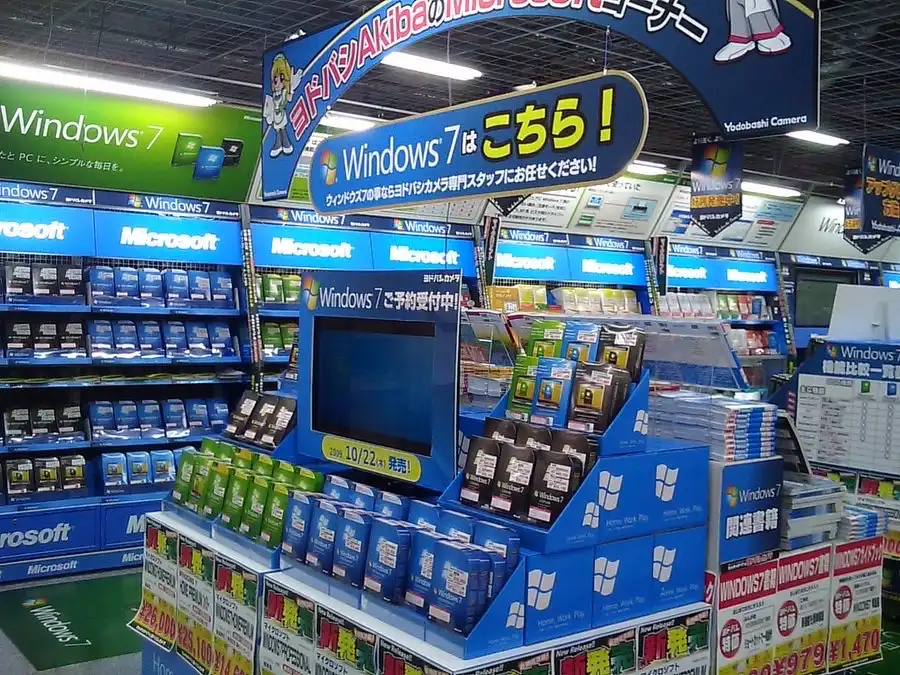
Windows 7 Released in Japan.
However, the situation in China was completely different.
From the beginning, we encountered a series of complex issues. An early version of Windows was even completely banned from sale because some of the localization work was done in Taiwan. And that was just the beginning. We responded sincerely time and time again: we established a large local development team, developed a popular Input Method Editor, built advanced research and development centers, and strictly complied with all regulations for doing business in China—even hiring locals as CCP representatives in our office.
Despite our efforts, we still hit a wall time and time again.
Software piracy was the most obvious and frustrating challenge. Although software piracy is a global issue, the scale in China was shocking. Around 90% of Microsoft products in China were pirated. Imagine, a country with 200 million personal computers, yet the revenue generated was similar to Italy, which has only a quarter of the number of computers and a "mere" 50% piracy rate.
In the past, we often consoled ourselves, believing that while these users were using our products for free now, they would be willing to pay for them in the future because they liked our products, and as soon as the government truly started valuing intellectual property, our revenue would increase.
Take a stroll through those bustling computer markets, and this problem would become even more apparent. There were five or more floors filled with computers—from pre-built systems to DIY kits, everything you could think of. You could choose a system, and they would assemble it for you on the spot.
After assembly, they would give you a software menu, and once you made your selection, you'd soon receive a custom-made CD containing all the software suites you wanted—Windows, Office, Photoshop—along with a serial number in a text file in the root directory, sometimes even throwing in a few pirated movies. The whole package cost only 100 RMB, roughly $12 at the time.
Time and time again, we pled with government officials in meetings. Through countless banquets and numerous toasts with baijiu, we discussed collaboration, innovation, and the value of intellectual property rights. But the response remained consistent: the government always used poverty as an excuse, claiming they couldn't afford genuine software, while they themselves drove around in black Mercedes and indulged in luxurious meals at the high-end Ferrari showroom upstairs.
Eventually, some officials began to express their attitude more openly: "We do not agree with your so-called concept of intellectual property," they told us, "we believe knowledge should be disseminated and shared."
In theory, this is a noble idea—open-source advocates also hold similar views—but in reality, it is merely a rationalization for plagiarizing and reselling our work without any compensation.
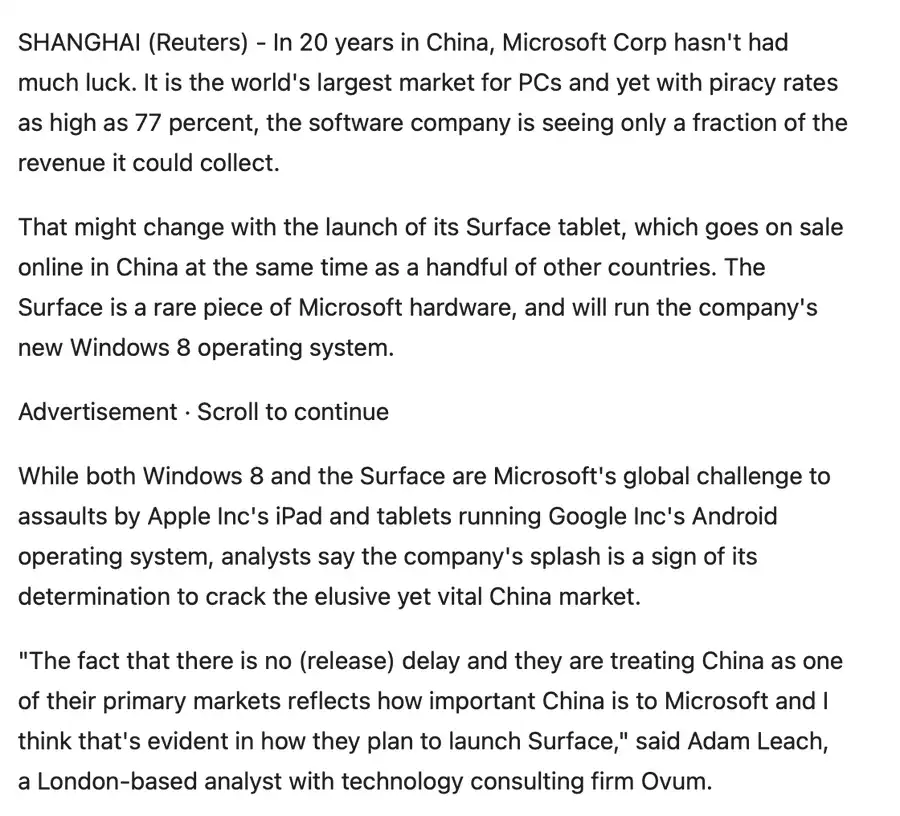
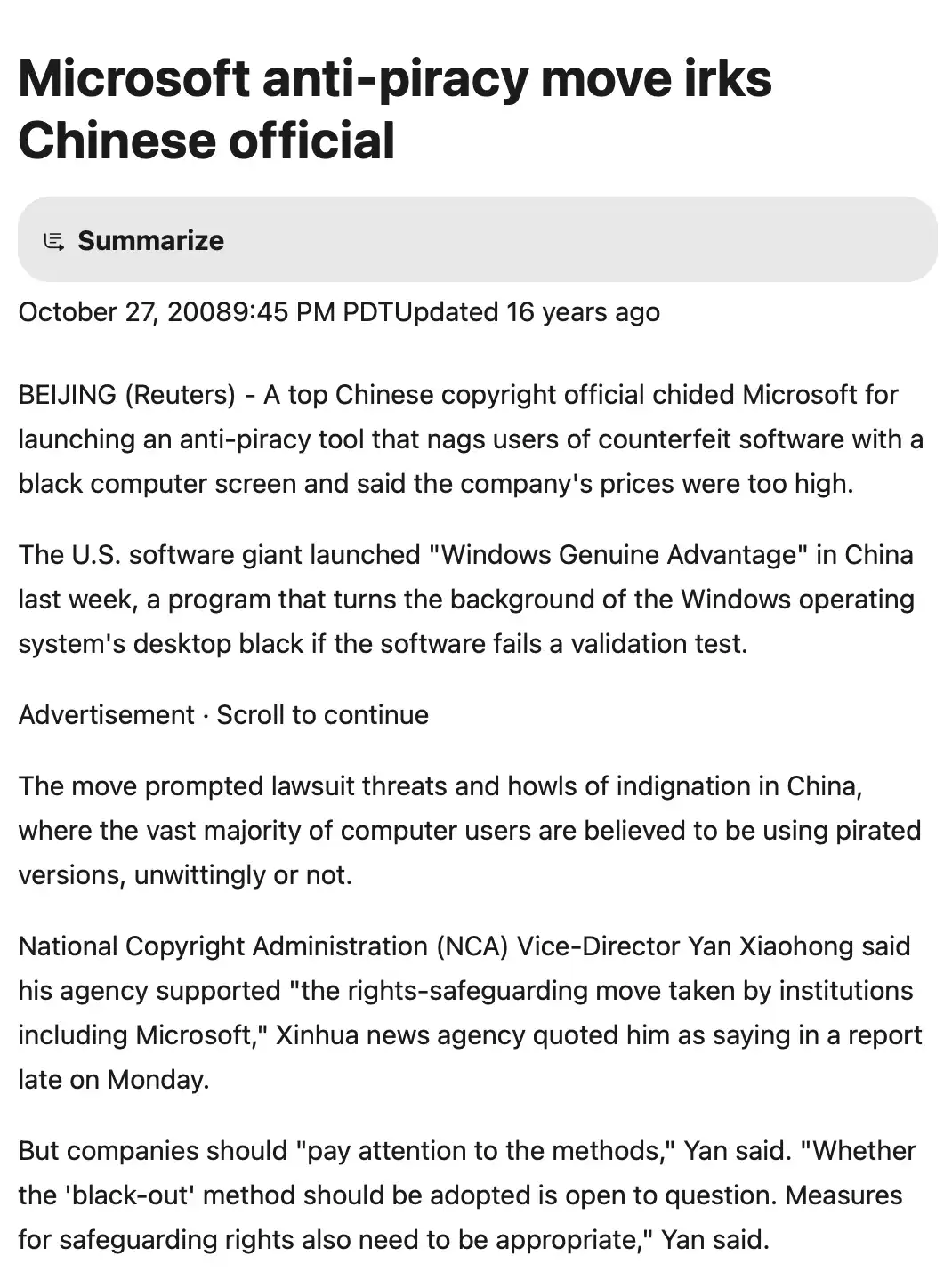
In Windows (later in Office), we gradually introduced more robust "anti-piracy" measures, but we soon found that users simply turned to using older versions of the software that were easier to crack—versions that were not only more easily pirated but also more vulnerable to hacking. We would showcase the design and related plans to the government before release, but still faced strong resistance from them. They told us that our "approach" did not meet market demand—such as a simple registration wizard program.
So you would see, on the airport flight information screens, warnings of "Windows not being registered." The cash registers at my supermarket still ran on Windows XP released a decade ago, simply because they were unwilling to pay for the newer version. PC manufacturers started shipping without pre-installed Windows, even openly claiming that they were doing so to comply with U.S. antitrust laws.
Moreover, the issue is not just limited to software. Companies in various industries in the U.S. and Europe—including pharmaceuticals, fashion, and publishing—all face similar dilemmas. I remember visiting a large pharmaceutical factory on the outskirts of Shanghai. Those in the tech industry may be more familiar with Foxconn and device manufacturers, but the pharmaceutical industry is actually larger in scale. Officials said these factories were producing for Western companies, but everyone knows that some of the products will be resold in the local market, and the enterprises that developed these products would receive no compensation.
Even consumer goods were not immune. Once, while trekking in the rain with my Microsoft China colleagues, I noticed that each of them was wearing the same North Face jacket as me. However, while my clothes remained dry, theirs were already soaked—turns out, they were wearing knockoffs manufactured in the same factory, with an identical logo, but using inferior materials.
I once firmly believed that we could find a successful path in China. I advocated for expanding local R&D, gave speeches everywhere, led teams to expand, and always held hope, believing that we could, like in Japan, eventually achieve difficult but genuine success. However, as time passed, I gradually realized: compromises have no end, and a truly sustainable long-term business model simply does not exist.
We are not alone. Google has exited China, and Meta is nearly completely blocked. Even in this era of cloud computing and subscription software, which are harder to pirate, Microsoft's revenue from China is still less than 1% of its global total revenue. Even Apple — one of the few American success stories in China — faces significant pressure from government intervention and local competition. Automakers like Ford have already retreated from the market, and BMW and Volkswagen's market share is only half of what it was a few years ago.
When it comes to fair trade, people often easily focus on tariffs. Tariffs are visible, quantifiable, and politically convenient. However, in China, tariffs are far from the biggest obstacle. The real challenges are much harder to quantify: soft restrictions, regulatory mazes, cultural differences, and the constantly evolving definitions of fairness and property rights.
Yes, every country has its form of protectionism — including the United States. The relationship between the European Union and U.S. tech companies is also fraught with friction. But over the past few decades, we have found solutions in many regions. Yet, in China, after 25 years of effort, we are still waiting for a substantial breakthrough for the tech industry to operate here.
So, when we discuss international trade, let's not just focus on tariffs. The real story — especially in China — is much more complex and much more important.
You may also like

Meet the new WEEX trial fund—your gateway to greater profits

WEEX Labs Lands at Dutch Blockchain Week: A Disruptive Crypto × AI Conversation Sets Sail in Amsterdam

SK Hynix Reportedly Plans U.S. ADR Listing as Early as August, With SEC Approval Possible in Late June
SK Hynix may pursue a U.S. ADR listing as early as August, with SEC approval reportedly possible in late June amid strong AI chip supply chain demand.

SpaceX vs Tesla vs xAI: Which Elon Musk Trade Has the Biggest Upside in 2026?
OpenAI Reveals It Has Confidentially Submitted an S-1 to the SEC, Keeping the Door Open for a Future IPO
On June 9, according to an OpenAI announcement, the company recently confidentially submitted a draft S-1 registration statement to the U.S. Securities and Exchange Commission (SEC), beginning the preliminary compliance process for a potential initial public offering. OpenAI said it chose to disclose this proactively because it expected the news might leak; however, the company has not yet set a specific listing timeline, and related arrangements may still take some time.

Latest research from 13 top universities including Cornell University: The current state, challenges, and misconceptions of the fusion of Crypto and AI
Deconstructing Anthropic: The Best AI Company, Possibly Also a Type of Organizational Invention
Apollo and Blackstone Reportedly Back $35 Billion Anthropic Chip Financing as Deal Details Remain Unclear
On June 9, according to currently available news alerts, Apollo and Blackstone Group participated in a $35 billion financing for an Anthropic “chip project.” Based on the original wording of the report, the funding has already been raised, but public information remains limited. The financing structure, use of proceeds, project entity, and whether Apollo and Blackstone participated through equity, debt, or project financing have not yet been disclosed.

Humanity Protocol Security Incident Escalates: More Than $31 Million Stolen From Related Addresses as Attacker Continues Selling H for ETH
On June 9, according to monitoring by Onchain Lens, more than $31 million has been stolen from addresses linked to Humanity Protocol, and the attack is still ongoing, with the hacker continuously swapping H tokens for ETH. Project founder Terence Kwok later confirmed the security incident on X, saying the issue involved a private key leak.

Bloomberg: As Bitcoin Weakens, Stablecoins and RWA Continue to Drive Expansion in Crypto Businesses
In June, Bloomberg reported that despite Bitcoin falling below $60,000 last week, wiping out about $235 billion in market value within seven days, and dropping close to 50% from last year’s peak, some core businesses in the crypto industry are still expanding, mainly in stablecoins, real-world asset tokenization (RWA), payments, and infrastructure. The report also noted that overall altcoin activity has contracted significantly: altcoin market capitalization has fallen from a peak of about $431 billion in November 2021 to around $170 billion, and among the tens of millions of tokens issued in recent years, fewer than 1,700 still maintain meaningful trading activity.

Galaxy Deep Research Report: How Hyperliquid's HIP-4 Upgrade Changes the Landscape of Prediction Markets?
Binance Research: RWA Market Expected to Expand Nearly 6x from Early 2025, with Public Equities and Onchain Payments Heating Up Together
In June, Binance Research said in its monthly market report that the real-world asset (RWA) market is expected to grow by about 589% from the beginning of 2025. Bond- and money market fund-related RWA expanded by about $6.5 billion, up 83% year over year, while publicly traded equity RWAs grew by about 422%. The report also noted that monthly crypto debit card transaction volume exceeded $747 million in May, up 48.6% year to date.

Japan to Assess a Framework for Yen Stablecoins and Crypto ETFs as Asia’s Compliant Payments Narrative Heats Up
Recently, according to the original report, Japan is considering the launch of yen stablecoins and cryptocurrency ETFs. Public information remains limited at this stage, and there is still no complete policy text, regulatory draft, or clear implementation timeline, so this is better characterized as a “policy discussion” rather than formal implementation. The original wording also noted that advancing stablecoin regulation in Asia is driving XRP usage and supporting growth in the XRPL ecosystem. However, based on currently available public information, there is not enough evidence to directly establish a clear causal relationship between this round of discussion in Japan and XRP or XRPL.

ZachXBT: Humanity private key leak and abnormal surge in H token should be viewed separately
On June 9, according to related disclosures, on-chain investigator ZachXBT posted an update on Humanity’s roughly $31 million security incident, saying that after further analyzing fund flows, he currently tends to believe the project team was not involved in an “inside job” or a self-staged attack. According to him, the official explanation about the private key leak was broadly accurate, but before the token unlock, the price of H had been artificially pushed higher, and the hacker later took advantage of that market environment; therefore, the private key leak and the earlier abnormal price pumping should be regarded as two separate and independent events. This reframing has shifted the market’s understanding of the nature of the incident. Earlier discussion around Humanity had focused on whether the team directly participated in the attack or used the security incident to cover up internal operations. ZachXBT’s latest remarks shift the focus from “whether it was self-theft” to “whether there were pre-unlock market structure issues.” He also questioned whether the team may have.

Morning Report | OpenAI has submitted an S-1 registration statement draft to the U.S. SEC; Morpho completes $175 million financing

Morning Report | BitMine increased its holdings by 126,971 ETH last week; trader Eugene announced his exit from the crypto market

Wang Chuan: How can one not feel anxious after the neighbor Old Wang made thirty times profit by investing in storage stocks? (Seven) - A quarter-century cycle
Cryptocurrency CEXs are flocking to sell US stocks, and traditional brokerages are facing an "uninvited guest."
Meet the new WEEX trial fund—your gateway to greater profits
WEEX Labs Lands at Dutch Blockchain Week: A Disruptive Crypto × AI Conversation Sets Sail in Amsterdam
SK Hynix Reportedly Plans U.S. ADR Listing as Early as August, With SEC Approval Possible in Late June
SK Hynix may pursue a U.S. ADR listing as early as August, with SEC approval reportedly possible in late June amid strong AI chip supply chain demand.
SpaceX vs Tesla vs xAI: Which Elon Musk Trade Has the Biggest Upside in 2026?
OpenAI Reveals It Has Confidentially Submitted an S-1 to the SEC, Keeping the Door Open for a Future IPO
On June 9, according to an OpenAI announcement, the company recently confidentially submitted a draft S-1 registration statement to the U.S. Securities and Exchange Commission (SEC), beginning the preliminary compliance process for a potential initial public offering. OpenAI said it chose to disclose this proactively because it expected the news might leak; however, the company has not yet set a specific listing timeline, and related arrangements may still take some time.
Latest research from 13 top universities including Cornell University: The current state, challenges, and misconceptions of the fusion of Crypto and AI

Popular coins
Latest Crypto News


