
TRX ETF Impacting SEC, "Three Musketeers" Reshaping the New Web3 Landscape



Article Source: Huobi HTX
The frontman of the Chinese public chain has emerged, and Justin Sun has once again captured the market's attention.
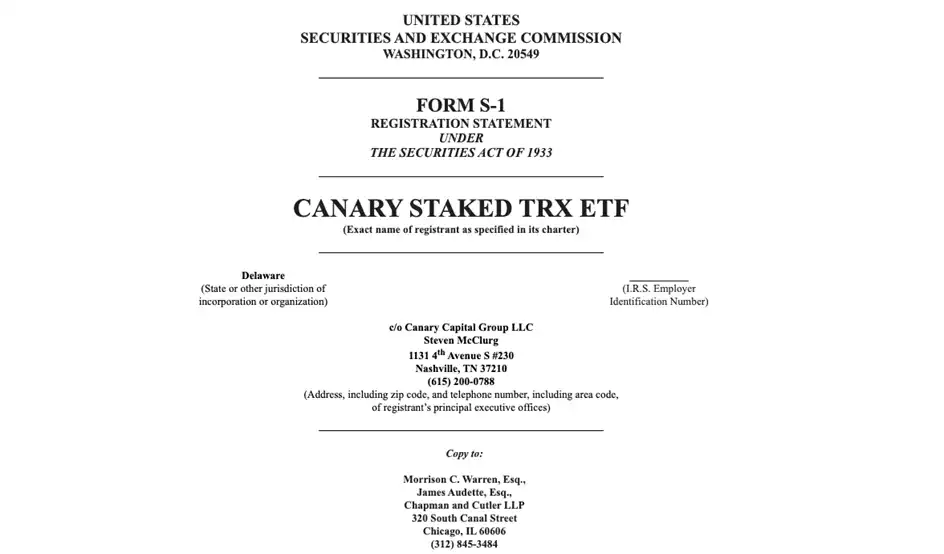
Recently, the U.S. asset management giant Canary Capital officially submitted the S-1 registration statement for a TRX ETF to the U.S. Securities and Exchange Commission (SEC) — the TRX ETF officially submitted the S-1. This is the first time TRON has attempted to enter the U.S. capital market in a "regular army" capacity — a compliant gamble and an image reshaping. Following Justin Sun's pride as a Chinese entrepreneur appearing on the cover of Forbes, TRON is also striving for new heights never reached by a Chinese public chain, bringing a milestone glory to the Chinese Web3.
TRX ETF S-1 Registration Statement: https://www.sec.gov/Archives/edgar/data/2064768/000199937125004423/canary-s1_041825.htm
Looking back at the cryptocurrency market from 2017 to the present, some projects have harvested traffic with meme coins, some projects have become overnight fortunes through regulatory arbitrage, and countless projects have circumvented SEC scrutiny under the guise of "backdoor listings." However, for over a decade, Justin Sun has always adhered to "inheritance, perseverance, and construction," believing that "the market's longevity relies on regulatory compliance and industry faith," which has also established TRON's dominance as the "on-chain dollar" — with the USDT issued on its network occupying over 30% of the stablecoin market share.
But his ambitions clearly extend beyond TRON.
Around this long-standing public chain, Justin Sun has quietly built a complete crypto ecosystem based on compliance, combining a technical foundation, traffic entry points, and value anchoring — the TRON, HTX Exchange Platform, USDD Stablecoin trinity, forming his new strategic "cryptocurrency world triumvirate."
Huobi HTX: Justin Sun Group's "Traffic Engine + Ecosystem Hub"
A public chain is just the underlying foundation, while traffic is the fundamental driver of ecosystem operation. In Justin Sun's ecosystem strategy, Huobi HTX plays a key role in introducing and retaining users, truly driving the entire ecosystem cycle.
How powerful is Huobi HTX?
In the "cooling down" Q1 2025 quarter of the overall crypto market, Huobi HTX delivered an impressive report card.
According to CoinGecko's "2025 Q1 Crypto Industry Report," Huobi HTX is the only platform among the Top 10 exchanges to achieve a growth in spot trading volume. Against the backdrop of an 18.6% decline in the total cryptocurrency market cap, Huobi HTX still managed to achieve a 11.4% increase in spot trading volume month-on-month, while the spot trading volumes of other Top 10 exchanges during the same period generally experienced declines ranging from 1.8% to 34.0%.
Not only in spot trading, Huobi HTX also demonstrated strong growth across its entire product ecosystem:
User and trading volumes have been steadily increasing, especially with outstanding performance in the CIS region and markets such as the Euro stablecoin; contract, yield farming, staking, and other product lines have been continuously optimized, significantly improving user retention through strategies such as fee reductions, enhanced yields, and product diversification.
Meanwhile, Huobi HTX has continued to deepen its ecological partnerships: collaborating with global compliance institutions like Fireblocks to further enhance platform security and compliance, improving the overall trading experience.
Especially worth mentioning is the deep cooperation between Huobi HTX and the TRON Meme ecosystem's Sunpump, which not only bridges the entire process from traffic preheating, initial trading, to subsequent staking and airdrop incentives, establishing a complete "new coin cold start model," but also continuously brings Web3 players to the Huobi HTX platform, converting them into trading users and ecosystem participants.
These achievements reflect Huobi HTX's resilience in a "bear market" environment, indirectly proving that Huobi HTX is leveraging trading as an entry point, aiming for ecosystem development, and becoming the most dynamic part of Justin Sun's ecosystem layout.
USDD: Ambitions of a Stablecoin
A complete ecosystem cannot do without the trump card of a "Stablecoin".
USDD is a decentralized stablecoin project on the TRON blockchain, officially launched on May 5, 2022, and upgraded to USDD 2.0 on January 25 this year. USDD 2.0 ensures its 1:1 peg to the US dollar through multiple mechanisms such as over-collateralization, liquidation and auctions, risk management and real-time monitoring, PSM (Peg Stability Module), decentralized governance, etc., with ample stability and multiple security measures.
As of April 21, the total supply of USDD 2.0 has exceeded 350 million, showing its continued adoption in the global cryptocurrency market. This widespread user adoption indicates that USDD's position in the DeFi community is constantly rising.
In Justin Sun's ecosystem layout, stablecoins carry the grand vision of decentralized finance—breaking through traditional financial barriers and providing a more free, transparent, and efficient cross-border payment and asset management solution through a decentralized payment system.
Breaking the Impossible Triangle, Justin Sun's Dream May Become Reality
In fact, since gracing the cover of Forbes Global Edition, Justin Sun has been continuously referred to in the crypto community as the "counter-trend growth engine" and the unlocker of the blockchain field's "Impossible Triangle"—finding a balance between regulatory compliance, technological innovation, and ecosystem expansion.
Today, he is entering the U.S. capital market with TRX ETF, using Huobi HTX as a traffic entry point, and driving the on-chain economy with a stablecoin, attempting to break the "Impossible Triangle" that plagues all Web3 projects:
● Regulatory Compliance vs Decentralization Narrative
● User Growth vs Market Downturn
● Project Native Token vs Mainstream Financial Acceptance
The S-1 registration application for TRX ETF is a historic step for the Chinese public chain to impact the global financial market and a shining moment for Justin Sun's "Three Musketeers" to leverage the "Impossible Triangle". Once TRX ETF successfully lands, Justin Sun's vision of "enabling 8 billion people worldwide to achieve financial freedom" may no longer be just a slogan but a dream truly coming into reality.
This article is from a submission and does not represent the views of BlockBeats.
You may also like

Dialogue with OmenX Founder: Why does the prediction market need an evolution from "spot" to "derivatives"?

When the P2P illicit funds from ten years ago turned into 60,000 bitcoins

Morning News | CME Group launches Nasdaq Cryptocurrency Index futures; Asset management giant Janus Henderson strategically invests in Ethena

Why did Oracle deliver the strongest financial report in history, yet its stock price fell?

Bitcoin Layer 2 Network Botanix: Why Did We Choose to Dissolve?

Morning Report | OpenAI has submitted an S-1 registration statement draft to the U.S. SEC; Morpho completes $175 million financing

Galaxy Deep Research Report: How Hyperliquid's HIP-4 Upgrade Changes the Landscape of Prediction Markets?

Latest research from 13 top universities including Cornell University: The current state, challenges, and misconceptions of the fusion of Crypto and AI
Deconstructing Anthropic: The Best AI Company, Possibly Also a Type of Organizational Invention

Every exchange is a "Universal Exchange."

The counterattack of traditional finance: Alliance chains are quietly reviving
Pantera Capital Partner: How Tokenization is Restructuring the Private Equity and Early Investment Ecosystem?

Mastercard Launches Agent Pay for AI, Plans to Record AI Agent Payment Authorizations on Polygon
Mastercard launched Agent Pay for AI, a new payment protocol designed to help AI agents make small payments such as pay-per-use access to data and APIs. The system plans to record human-granted AI agent permissions on Polygon, focusing on verifiable authorization, identity, and payment controls.

Curve Deploys Llamalend v2 on Optimism With 250,000 OP Incentives
Curve launched Llamalend v2 on Optimism with 250,000 OP incentives from the Optimism Foundation. The upgrade expands Llamalend beyond its earlier crvUSD-focused model, adding broader collateral support, LlamaRisk market reviews, and the ability to use Curve LP tokens as collateral.

Raydium Old Liquidity Pool Reportedly Exploited, With $1.34 Million Moved to Ethereum and Tornado Cash
An old Raydium liquidity pool was reportedly exploited for around $1.34 million in USDC, RAY, and wSOL, with the stolen funds bridged to Ethereum and deposited into Tornado Cash. The incident highlights the tail risks of legacy DeFi pools, old contracts, and cross-chain fund laundering paths.
Kalshi Executive Challenges “SBF Backed AI Unicorns” Narrative, Says Leopold Aschenbrenner Was Key Figure
Kalshi executive John Wang questioned the “SBF backed AI unicorns” narrative, saying Leopold Aschenbrenner was the key figure behind major AI investment decisions.

New York Proposes Stricter Stablecoin Issuer Rules Aligned With Federal GENIUS Act
NYDFS proposed stricter stablecoin issuer rules aligned with the GENIUS Act, covering reserves, custody, redemption timelines, audits, and capital buffers.

CryptoQuant Says Bitcoin Profitable Supply Is Near 45% Pressure Zone as On-Chain Data Points to Market Repricing
CryptoQuant said Bitcoin’s profitable supply is nearing the 45% pressure zone, signaling rising market stress, unrealized losses, and a possible on-chain repricing phase.
Dialogue with OmenX Founder: Why does the prediction market need an evolution from "spot" to "derivatives"?
When the P2P illicit funds from ten years ago turned into 60,000 bitcoins
Morning News | CME Group launches Nasdaq Cryptocurrency Index futures; Asset management giant Janus Henderson strategically invests in Ethena
Why did Oracle deliver the strongest financial report in history, yet its stock price fell?
Bitcoin Layer 2 Network Botanix: Why Did We Choose to Dissolve?
Morning Report | OpenAI has submitted an S-1 registration statement draft to the U.S. SEC; Morpho completes $175 million financing


