
Who Ate Hyperliquid's Cake: The Perp DEX Hunted by CEX



Original Article Title: The perverse incentives of building in crypto: Hyperliquid and CEXs
Original Article Author: VannaCharmer, Crypto Researcher
Original Article Translation: DysonTide Deep
Editor's Note: The article analyzes the challenges faced by DeFi, especially perp DEX, in its development, pointing out that CEXs, driven by economic incentives, suppress successful on-chain products like Hyperliquid through market manipulation, blackboxing, and public opinion warfare. The article dissects the economic ambush case faced by Hyperliquid and discusses its response strategies, such as decentralized validator nodes and risk parameter optimization. Finally, the author expresses approval of the Hyperliquid team's future vision of achieving full financial on-chainization, believing that founder Jeff's perseverance and ability will drive industry progress.
The following is the original article content (slightly reorganized for better readability and comprehension):
Entrepreneurship in the crypto field is fraught with difficulties. This is not only due to the numerous technical challenges but also because when you create a successful product, various interest groups are economically incentivized to become your adversaries. This article aims to expose the systemic flaws of the public development model and how CEXs disrupt DeFi through economic motivations, especially the development of perpetual contract decentralized exchanges (perp DEX).
Industry Background Insight
Over the years, CEXs, along with law firms, market makers, and AWS cloud services, have collectively formed the most powerful "money-printing machine" in the crypto world—raking in billions of dollars through high fees, off-book transactions (token listings), and other gray-area operations. They have too many vested interests to maintain: some directly exploit retail funds flow, and all CEXs have ambiguous cooperation with market makers. Why else would each of them have a "market maker program"? Just look at how FTX engages in self-trading through Alameda or how Coinbase suppresses Solana to promote its Layer2 network, Base. Economic interests dictate that CEXs cannot act in goodwill.
In fact, CEXs have engaged in even more nefarious off-chain blackboxing, but the public is unaware of it. The allure of the crypto world lies precisely in the fact that all games are played openly and transparently. However, public development is a double-edged sword: others may exploit product vulnerabilities for profit. As long as you are not completely destroyed, you will become stronger—think of Solana's multiple downtime events.
Do you think the process of full financial on-chainization will be smooth sailing?

Core Contradiction Analysis
Now, let's put ourselves in the shoes of a CEX. When you see a team like Hyperliquid:
· Iterating to develop excellent on-chain products based on user feedback
· Building the most outstanding on-chain trading venue
· Completing last year's most significant wealth creation event and having a large amount of organic KOL-driven promotion
Undeniably, Hyperliquid has built an extremely successful product, with its market share severely encroaching on the territory of top CEXs.
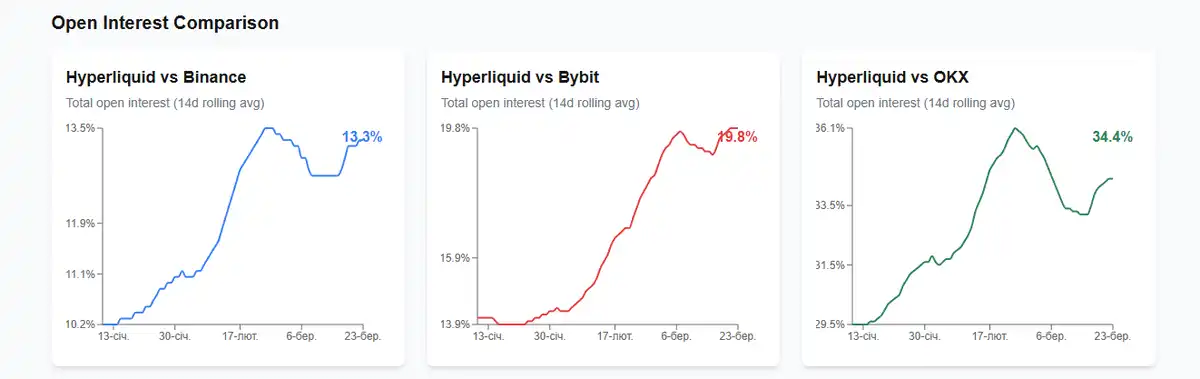
CEX Motivation Breakdown
Profit Incentive
As a CEX, you are completely excluded from Hyperliquid's profit ecosystem — not only are they eating away at your market share, but they also refuse to pay listing fees. Faced with this unconventional and continuously customer-poaching competitor, would you just sit back and do nothing? Clearly not. Thus, we see the current situation: the CEX has launched a clever sniper attack that benefits itself (while harming ordinary investors). Event recap:
· Wallet 0xde9 funded by Binance/OKEx established a massive short position equivalent to 40% of HL's circulating supply
This intentional liquidation transferred JELLY shorts to wallet 0xde9 of HLP while receiving dual funding support from Binance and OKEx
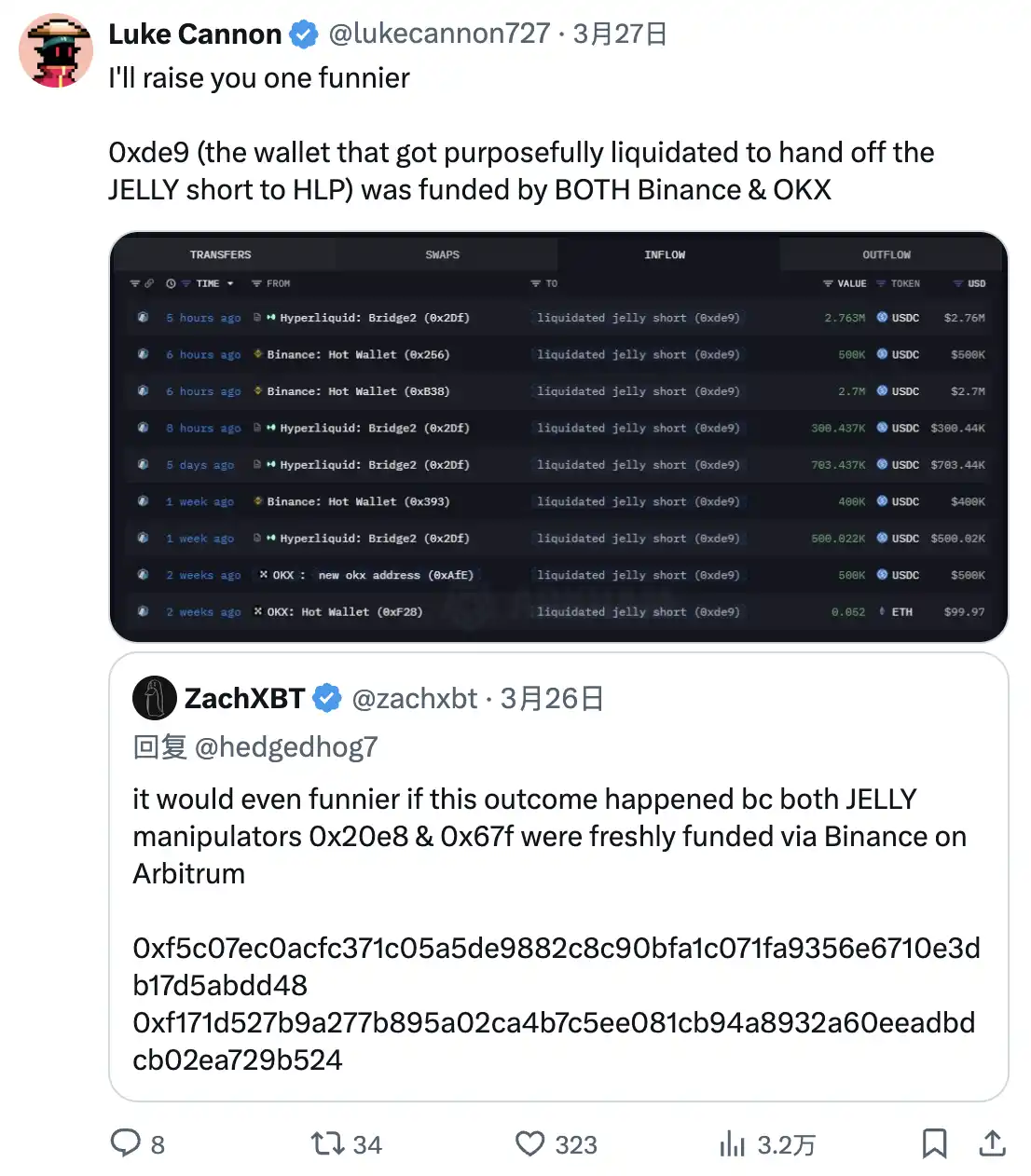
· JELLY token experiences a sudden on-chain surge
· CEX conveniently launches JELLY perpetual contracts
· After HL's short position is liquidated, the funds are transferred to HLP's insurance fund
· Hyperliquid's Validator Council (still in a centralized phase) urgently delists the JELLY contract, liquidates through an oracle manipulation to profit, and pledges full user reimbursement
· CEX simultaneously initiates a FUD propaganda war
This move can be seen as strategic: the CEX forces Hyperliquid founder Jeff to face the dilemma of "liquidation or delisting."
While protecting user choice is understandable, the consequence has been to provide CEX with regulatory leverage—government-friendly exchanges like Binance/Coinbase can easily use the "offshore CEX with no KYC/AML" label to launch legal attacks against HL.
What Should HL Do
With the launch of HyperEVM and the progression towards a decentralized validator set, Hyperliquid may still turn the tide. At the current stage, the team has chosen a centralized approach to deliver a high-performance product, a strategy that has proven successful. I firmly believe the team can gradually achieve decentralization—after all, in the current architecture, centralization vulnerabilities and economic attacks are indeed HL's only fatal weaknesses.
Areas for HL Improvement:
· Token Supply: Implement strict position limits relative to circulation and liquidity
· Dynamic Risk Parameters: Adjust collateral ratios based on market volatility, increase margin requirements for low-liquidity assets
· Delist obscure meme coins—these are the most easily manipulated low-liquidity, low-market-cap assets
The HL team must have learned lessons from this. Looking back at their past performance, they should be capable of handling and building a more robust system. The primary risks still lie in potential attacks from North Korean hackers and similar economic sniper attacks as seen recently.
Source: Original Article Link
You may also like

Bitcoin Trading Guide 2026: Strategies for Experienced Traders

What Is XAUT and PAXG? Why Tokenized Gold Is Booming in 2026

Cryptocurrency CEXs are flocking to sell US stocks, and traditional brokerages are facing an "uninvited guest."

Will the SpaceX IPO Hurt Bitcoin? Here's What Traders Are Watching
Foreign selling in the South Korean stock market accelerates, with cumulative net sales reportedly reaching $75 billion this year
On June 9, The Kobeissi Letter, citing Goldman Sachs data, reported that global investors are selling South Korean stocks at an unusually rapid pace. In the latest trading session, foreign investors sold about $801 million worth of Kospi constituent stocks again; total foreign outflows last week reached about $10 billion, and the market has been in net foreign selling on nearly every trading day over the past month. According to the data cited in the report, foreign investors have sold about $75 billion worth of South Korean stocks so far this year. Meanwhile, South Korean retail and institutional investors together recorded roughly $69 billion in net buying over the same period, suggesting that the market’s main buying support has come from domestic capital rather than returning overseas funds. The information currently disclosed still mainly comes from The Kobeissi Letter’s retelling and Goldman Sachs data summaries, while public details on the statistical period and the specific definition of “selling” remain relatively limited.

Fortune Warns of Strategy’s Financing Structure Risks as Bitcoin Premium Narrows
Fortune warned that Strategy’s Bitcoin treasury model faces growing financing risks as MSTR’s net asset premium narrows and preferred stock dividend pressure increases.

Ferrari Challenge Le Mans: Carl Moon to Dominate in WEEX Livery

Sahara AI Responds to SAHARA’s Sharp Drop: No Contract or Product Security Issues Found, Internal Investigation Underway
Sahara AI responded to SAHARA’s 60% price drop, saying no token contract or product security issues have been found and an internal investigation is underway.

WEEX Deposit/Withdrawal Dynamic Island: Your Asset Status, Always in Sight

Scaling Crypto Derivatives: The Digital Asset Infrastructure Behind High-Volume Trading
In the fast-moving digital asset ecosystem, derivatives platforms face an extreme architectural test. High-leverage futures markets demand more than just standard security—they require absolute operational precision, zero-latency matching engines, and ironclad structural scalability, all while navigating intense market volatility.
As global platforms scale to meet these demands, the industry is shifting away from rigid, monolithic setups toward a more agile, "decoupled" infrastructure philosophy.
The Blueprint for High-Volume Copy TradingFor elite global exchanges like WEEX (founded in 2018), this architectural choice becomes critical when scaling high-volume retail features like social copy trading. When thousands of users automatically mirror the real-time strategies of elite traders simultaneously, it triggers sudden, monumental spikes in concurrent transactional volume.
To prevent execution latency or settlement bottlenecks during these peak volatility events, a platform's primary engine must remain entirely dedicated to risk management, copy-trade synchronization, and order matching.
The Architectural Rule: New-generation platforms must separate front-end user execution engines from heavy backend infrastructural overhead to eliminate operational friction.
By separating these layers, platforms can maintain complete sovereignty over their trading environments and user experiences while strategically aligning with institutional-grade infrastructure ecosystems. This strategic framework allows modern exchanges to leverage advanced Digital Asset Custody infrastructure such as Cobo’s behind the scenes, ensuring that backend wallet management scales elastically alongside trading spikes.
Capitalizing on Market Momentum and 400× LeverageIn a derivatives arena where platforms offer up to 400× leverage on perpetual contracts, capital efficiency and market agility are core business metrics. To capture market momentum, an exchange needs the ability to rapidly expand its asset offerings, supporting everything from legacy crypto assets to sudden, trending altcoins across a massive library of trading pairs.
Adopting a flexible, scalable Wallet-as-a-Service (WaaS) solution such as Cobo’s could completely rewrite the development timeline for high-growth exchanges. Instead of spending months of engineering capital building out custom backend wallet architectures for every new blockchain network, platforms can deploy localized infrastructure in days.
This agility allows platforms to instantly scale their listings to over a thousand trading pairs without compromising security or delaying time-to-market. It mirrors the exact operational advantages seen during high-velocity market events, similar to how advanced wallet infrastructure empowers platforms during sudden asset surges; allowing exchanges to pass that speed and liquidity directly to their global user base.
A Mature Foundation for GrowthThe synergy between trusted infrastructure ecosystems and global trading platforms represents the natural evolution of a maturing crypto market. As WEEX continues to scale its global spot and derivatives offerings for over 6 million users, adopting robust backend paradigms proves that platforms no longer have to compromise between cutting-edge trading velocity and uncompromised structural security.

Morning Report | BitMine increased its holdings by 126,971 ETH last week; trader Eugene announced his exit from the crypto market

Wang Chuan: How can one not feel anxious after the neighbor Old Wang made thirty times profit by investing in storage stocks? (Seven) - A quarter-century cycle

Get Paid to Onboard? Try WEEX’s New Homepage with Rewards for Registration, Deposit & Trade

WEEX Custom Layout: Build Your Perfect Trading Workspace in Seconds

See “Buy Walls” & “Sell Walls” Instantly: WEEX Launches the Depth Chart for Smarter Trades

What Is Quick Trade on WEEX? 2 Ways WEEX Ends Chart-Panel Jumping
Morning News | Five major virtual asset platforms in South Korea have experienced 57 incidents of hacking and system failures in six years; Grayscale submits registration application for Canton ETF
Should we escape the peak? The principle of the tail-end market in the stock market
Bitcoin Trading Guide 2026: Strategies for Experienced Traders
What Is XAUT and PAXG? Why Tokenized Gold Is Booming in 2026
Cryptocurrency CEXs are flocking to sell US stocks, and traditional brokerages are facing an "uninvited guest."
Will the SpaceX IPO Hurt Bitcoin? Here's What Traders Are Watching
Foreign selling in the South Korean stock market accelerates, with cumulative net sales reportedly reaching $75 billion this year
On June 9, The Kobeissi Letter, citing Goldman Sachs data, reported that global investors are selling South Korean stocks at an unusually rapid pace. In the latest trading session, foreign investors sold about $801 million worth of Kospi constituent stocks again; total foreign outflows last week reached about $10 billion, and the market has been in net foreign selling on nearly every trading day over the past month. According to the data cited in the report, foreign investors have sold about $75 billion worth of South Korean stocks so far this year. Meanwhile, South Korean retail and institutional investors together recorded roughly $69 billion in net buying over the same period, suggesting that the market’s main buying support has come from domestic capital rather than returning overseas funds. The information currently disclosed still mainly comes from The Kobeissi Letter’s retelling and Goldman Sachs data summaries, while public details on the statistical period and the specific definition of “selling” remain relatively limited.
Fortune Warns of Strategy’s Financing Structure Risks as Bitcoin Premium Narrows
Fortune warned that Strategy’s Bitcoin treasury model faces growing financing risks as MSTR’s net asset premium narrows and preferred stock dividend pressure increases.


