
Will Ethereum See a Strong Breakout After the End of the Staking Net Outflow?

Original Title: "Ethereum Staking Key Reversal: Entry Funds Double Exit Funds"
Original Author: KarenZ, Foresight News
As 2025 comes to a close, the Ethereum network has experienced a key turning point: the validator "entry queue" has reversed and surpassed the "exit queue."
This means that after months of market dynamics, the funds attempting to stake Ethereum and become validators now far exceed the funds looking to unstake and exit.
This change is not just a numerical shift, but also a barometer of market sentiment and network fundamentals, signaling a gradual easing of selling pressure that has persisted for months. It also indicates that with factors such as returning institutional confidence, the Pectra upgrade optimization, DeFi deleveraging, and other drivers at play, the Ethereum network is entering a new phase of security enhancement and capital accumulation.
Ethereum Validator Queue Reversal
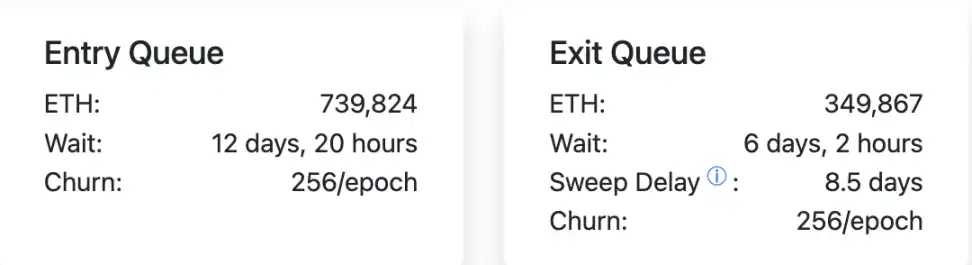
According to the latest data from the Ethereum Validator Queue, there are currently approximately 739,824 ETH in line to enter the network, with an estimated wait time of 12 days and 20 hours; the exit queue has only 349,867 ETH, requiring about 6 days to clear.
Furthermore, the current total staked Ethereum is around 35.50 million ETH, accounting for 29.27% of the total supply, with the number of active validators reaching 983,600.
What is the Validator Queue? Why is it Important?
In the Ethereum proof-of-stake (PoS) mechanism, to ensure consensus stability, the protocol dictates that nodes cannot enter and exit at will, but rather must adjust through a "Churn Limit" mechanism.
Currently, the maximum number of validators that can join (activate) or exit in each epoch (approximately 6 minutes and 24 seconds) is set at 256 ETH, equivalent to a processing capacity of about 57,600 ETH per day.
· Entry Queue: The queue for staking 32 ETH to apply as a validator. Queue growth indicates strong staking demand, with funds bullish on long-term returns.
· Exit Queue: The queue for withdrawing funds. Queue growth typically signals selling pressure, liquidity demand, or deleveraging behavior.
Therefore, the validator queue is not only an indicator of network health, but also a barometer of market sentiment.
How Will the Validator Queue Change in 2025?
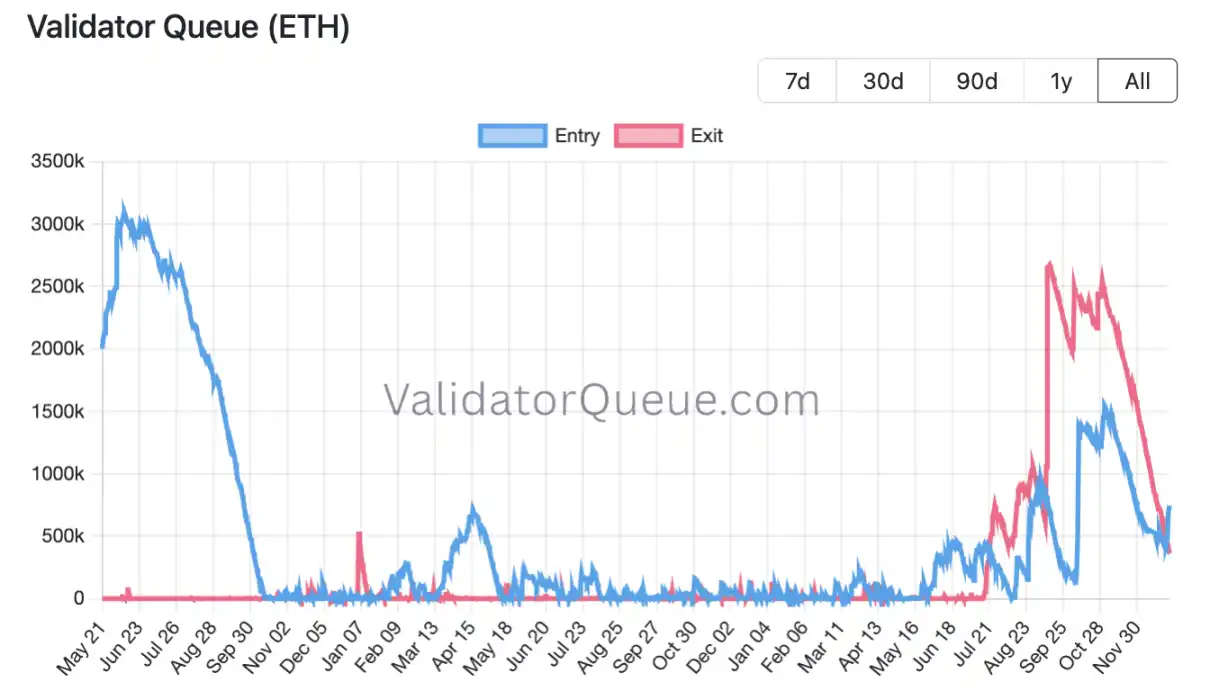
Throughout the year 2025, the Ethereum validator queue experienced significant fluctuations:
· First half of the year to autumn: Multiple record-high queue exits, mainly due to institutional rotation, profit-taking, DeFi deleveraging (such as Aave's surging borrowing rates leading to stETH loop liquidations), and individual security incidents (such as Kiln exiting all Ethereum validator nodes in September).
· Mid-September: Queue exits peaked at 2.67 million ETH, with a waiting time of up to 46 days.
· September to October: Brief "queue entries" surge, later dominated by "queue exits" again.
· November: "Queue entries" grew back to over 1.5 million ETH, but "queue exits" briefly surpassed 2.5 million ETH.
· End of December: "Queue entries" reversed, with approximately 739,824 ETH currently queued to enter the network, while "queue exits" have only 349,867 ETH.
The Four Core Drivers Behind the December Reversal
This reversal was not accidental but the result of the combined forces of capital, technology, and the macro environment:
Large Stakes from Treasury Companies like BitMine
Just two days before the reversal (December 25-27), BitMine staked a total of 342,560 ETH (approximately $1 billion), directly driving the queue reversal.
Furthermore, BitMine had previously stated its intention to launch dedicated staking infrastructure — the Manufacturing Validator Network (MAVAN) — in the first quarter of 2026, demonstrating its long-term commitment to the Ethereum staking ecosystem.
Simultaneously, another leading treasury company, SharpLink, fully staked nearly 100% of its ETH, further bolstering the momentum of fund inflows.
Despite facing challenges in the current crypto treasury race, with some institutions slowing down their ETH accumulation, and even cases of sell-offs like ETHZilla, the bold moves by top players like BitMine and SharpLink have largely shored up the Ethereum staking ecosystem's fundamentals.
Pectra Upgrade Optimizes Staking Experience
The Pectra upgrade implemented in May 2025 introduced key improvements through EIP-7251: increasing the maximum effective validator balance from 32 ETH to 2048 ETH, enabling reward compounding, and validator consolidation. This reduced the operational costs for institutions managing thousands of validator nodes and provided technical convenience for large fund entry.
Kiln Re-Staking Reopened
Following a security incident in September 2025, Kiln underwent a massive validator exodus. While it is unclear when Kiln resumed staking, data from Beaconcha.in shows that Kiln currently holds a 1.68% share in the Ethereum staking ecosystem.
DeFi Deleveraging Nearing Completion
In the previous months of June and July, a rise in Aave's borrowing rates forced the closure of stETH leveraged-loop strategies, leading to temporary selling pressure. Recently, as the deleveraging process gradually unfolded, the related exit demands have subsided, with market entry demands taking the lead.
Partial Institutional Bottom Fishing
After multiple days of market adjustment, some institutions are bullish on the long-term value of ETH. Trend Research is prepared to continue accumulating ETH with $1 billion. On December 25, according to a conversation with Ai Yi and Jack Yi himself, the actual cost of ETH that Trend Research has been accumulating since November is around $3150, meaning their current holding of 645,000 ETH is experiencing an unrealized loss of approximately $143 million. After an additional $1 billion injection, the average cost expectation for ETH is projected to be around $3050.
Summary
The Ethereum validator "queue in" surpassing "queue out" marks the initial formation of a staking net inflow-dominant trend since July. This shift is not merely a numerical leap but a crucial signal of market confidence rebuilding. Of course, whether this leading trend can sustain stability remains to be tested over time.
While Ethereum spot ETFs have not yet shown significant net inflows, the on-chain fundamentals' improvement is evident. As Joseph Chalom, Co-CEO of SharpLink Gaming, mentioned earlier this month, the surge in stablecoins, tokenized RWAs, and the growing interest of sovereign wealth funds could drive Ethereum's TVL to grow tenfold by 2026.
Standing on the tail of 2025, has Ethereum prepared itself for a breakthrough year in 2026? The answer is left to time to reveal.
You may also like

Morning News | The draft amendment to the People's Bank of China Law aims to clarify the legal status of digital renminbi; South Korea will transfer about 40 unregistered virtual asset service providers to law enforcement agencies

Interpreting the Ethereum Foundation's new structure: Reaffirming self-sovereignty amid institutional trends

Interview with NDV Founder Jason Huang: Popping the AI Bubble and the Myth of Microstrategy, Seeking the Ultimate Ace in the Crypto Market
Morning Report | Former Ethereum Foundation researcher establishes Ethlabs; EU Parliament Economic Committee passes digital euro regulatory proposal

Dragonfly partner Haseeb: The fastest-growing companies in the future may all be stuck at 149 people

How xBubble Breaks the Deadlock in VC's Heavy Investment in the OPC Economy

The encrypted unicorn Blockstream is deeply embroiled in a serious fraud case

Morning Report | The South Korean Financial Services Commission plans to expand the regulatory sandbox to include virtual assets; the parent company of the New York Stock Exchange, ICE, has reached a partnership with OKX to jointly establish a cryptocu...

Exclusive Interview with Strategy CEO: Putting Aside the Sale of 32 BTC, the 60 Trillion AI Intelligence is the Ultimate Fate of Bitcoin

TRON revitalizes the image of the bull, creating a more approachable brand character

Will the STRC issuance price discussed with ChatGPT really fall into a death spiral?

The foundation retreats, Ethlabs steps forward: Ethereum welcomes its largest restructuring in history

NYSE Parent ICE and OKX Launch Joint Venture: What It Means for Tokenized Stocks
ICE and OKX have announced a joint venture focused on tokenized stocks, but stock futures are already live across crypto markets. Here's what the partnership means, how stock futures work, and why traders are paying attention.

How to Trade Apple and Nvidia on a Crypto Exchange in 2026 (Without Buying Shares)
Morning Report | Secret Network loses $4.67 million due to cross-chain vulnerability; Michael Saylor releases Bitcoin Tracker information again, may disclose increased holdings data next week
Kalshi's biggest competitor is not Polymarket

The second half of the computing power battle: Intel CEO Pat Gelsinger reveals how AI is reshaping the global semiconductor supply chain
B.AI partners with MiniMax to launch a limited-time free experience of M3, enabling zero-threshold implementation of Agentic productivity through full-stack infrastructure
Morning News | The draft amendment to the People's Bank of China Law aims to clarify the legal status of digital renminbi; South Korea will transfer about 40 unregistered virtual asset service providers to law enforcement agencies
Interpreting the Ethereum Foundation's new structure: Reaffirming self-sovereignty amid institutional trends
Interview with NDV Founder Jason Huang: Popping the AI Bubble and the Myth of Microstrategy, Seeking the Ultimate Ace in the Crypto Market
Morning Report | Former Ethereum Foundation researcher establishes Ethlabs; EU Parliament Economic Committee passes digital euro regulatory proposal
Dragonfly partner Haseeb: The fastest-growing companies in the future may all be stuck at 149 people
How xBubble Breaks the Deadlock in VC's Heavy Investment in the OPC Economy


