
Without Interest Rate Perpetuals, Will DeFi Ever be Whole?


Original Article Title: Interest Rate Perpetuals: DeFi's missing piece
Original Article Author: @defiance_cr
Original Article Translation: zhouzhou, BlockBeats
Editor's Note: DeFi lacks a rate perpetual contract tool similar to CME, leading to significant interest rate fluctuations and an inability to hedge risks. Introducing rate perps can help both lenders and borrowers lock in rates, achieve arbitrage and risk management, and promote the integration of DeFi and TradFi, enhancing market efficiency and stability.
The following is the original content (slightly reorganized for readability):
At the Chicago Mercantile Exchange (CME), the daily trading volume of interest rate futures exceeds one trillion dollars. This massive volume is primarily driven by banks and asset managers who operate by hedging the risk between floating-rate and fixed-rate loans already issued.
In DeFi, we have already established a thriving floating-rate lending market, with a total locked value exceeding 300 billion dollars. Pendle's incentivized order book has liquidity exceeding 200 million dollars in a single market, demonstrating a strong market demand for spot interest rates.
However, we still lack a DeFi-native tool like CME interest rate futures to hedge interest rate risk for both lenders and borrowers (excluding IPOR swaps, as they are too complex).
To understand why we need this tool, we first need to understand how interest rates operate in DeFi.
Take AAVE as an example, where its interest rates are dynamically adjusted based on supply and demand. However, AAVE's supply and demand are not isolated but nested within the broader context of the global economy.
Comparing AAVE's smoothed USDC floating rate with CME's 10-year Treasury futures price on a chart, we can see this macroeconomic correlation:
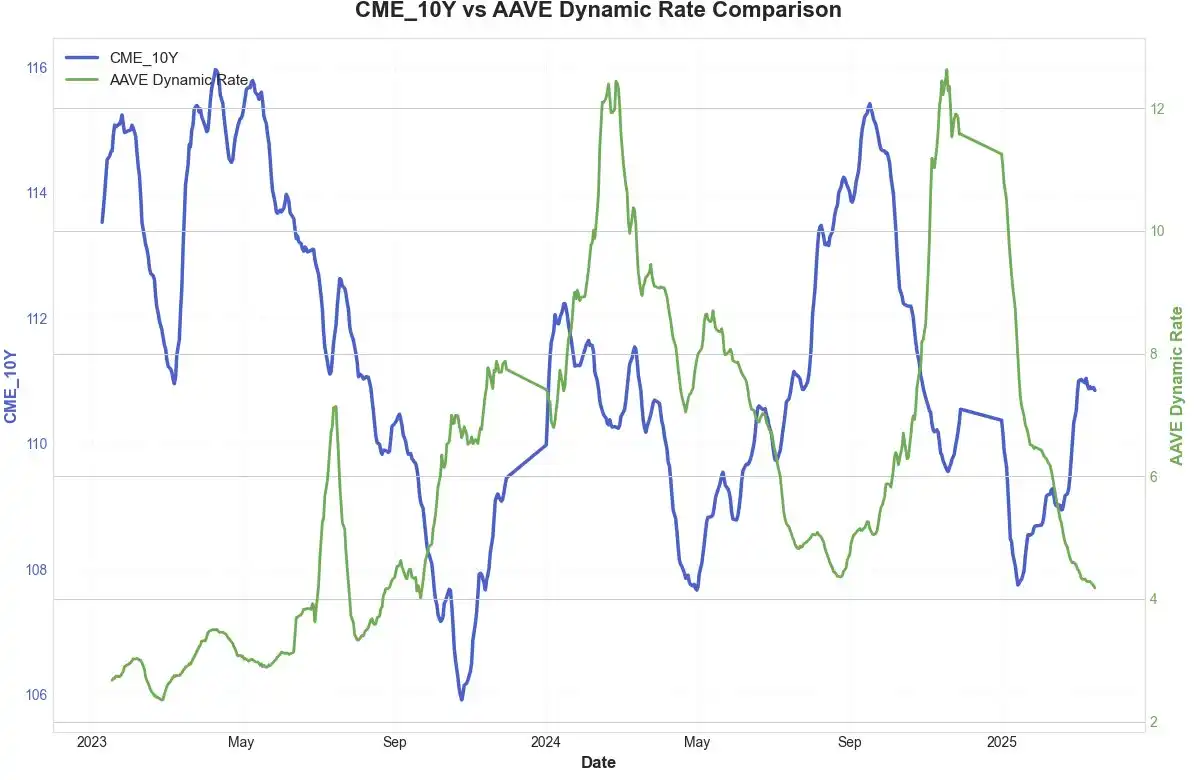
AAVE's USDC rate trend aligns with global rates but with some lag. The primary reason for this lag is the lack of an immediate linkage mechanism between global rates and AAVE rates.
It is precisely this discontinuity that allows the supply and demand dynamics of the crypto market to play a stronger role in interest rate formation. When we eliminate the smoothing process and directly compare AAVE's rate with the global 10-year Treasury rate on a chart, this phenomenon becomes more pronounced:
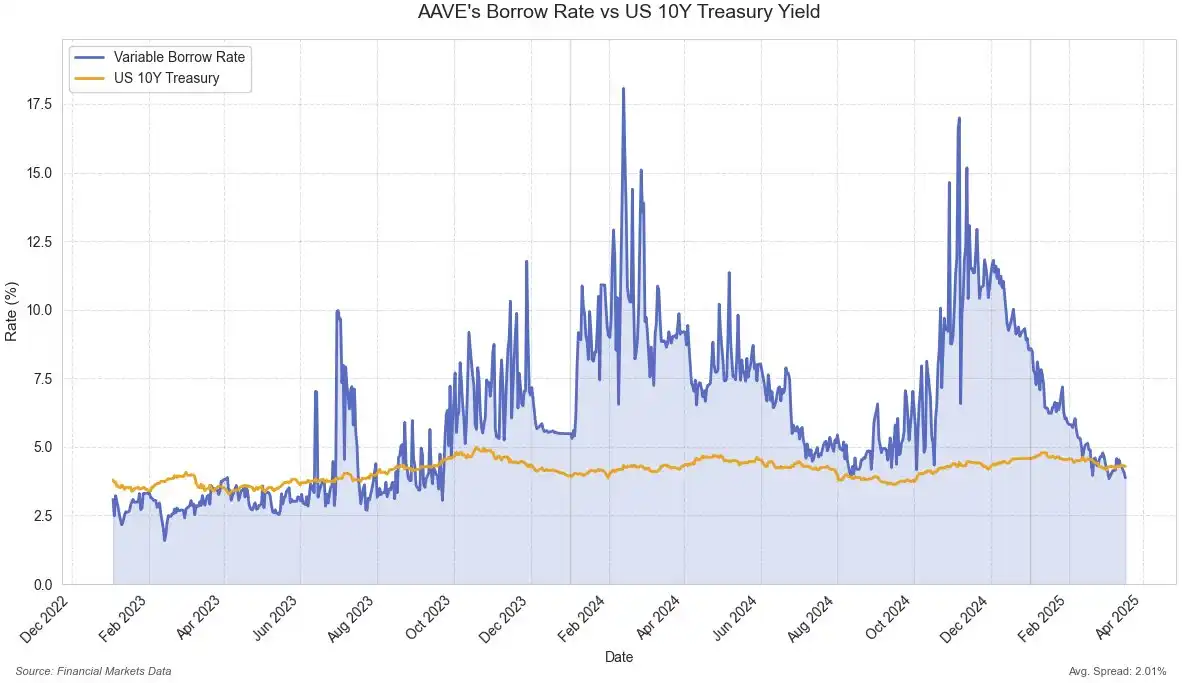
The interest rate of AAVE is highly volatile, and most of the time, it carries a significant premium compared to the U.S. 10-year Treasury bond rate.
The fundamental reason for this premium is still the lack of a direct link between these two markets. If there were a simple, two-way connection mechanism between DeFi and TradFi interest rates for hedging or arbitrage, it would better integrate the two ecosystems.
And the **Interest Rate Perpetual Swap** is precisely the best way to achieve this. Perp has already been validated by the market as a fit product-market fit (PMF). If a perpetual market covering AAVE rates and U.S. Treasury rates could be established, it would bring about significant change.
For example:
- For borrowers, they can long a perpetual swap tied to the AAVE borrowing rate. If the borrowing annual rate surges from 5% to 10%, the price of this perpetual swap will rise, thus hedging against the risk of increased costs.
Conversely, if the rate decreases, borrowing becomes cheaper, but the perpetual position incurs losses, akin to paying an "insurance premium." In this way, borrowers effectively lock in a fixed rate by borrowing + longing the perpetual swap.
- For stablecoin lenders, they can short a perpetual swap based on the stablecoin lending rate. If lending returns decline, the short position in the perpetual swap profits, offsetting the loss from reduced loan income; if returns increase, the short incurs losses, but interest income rises, creating a hedge.
Moreover, these contracts can also utilize high leverage. In the interest rate markets on CME, 10x leverage is a common setup.
Having a liquid interest rate market can also reduce cascading liquidations during market stress. If market participants hedge in advance, they will not be forced to make large withdrawals or close positions due to interest rate fluctuations.
More importantly, this also opens the door to truly long-term fixed-rate loans—if this interest rate perpetual swap is entirely DeFi-native, it can be used by various protocols for long-term rate hedging, thus providing users with fixed-rate loans.
In traditional finance, hedging interest rate risk is a routine operation, and most long-term loans have interest rate hedging tools behind them.
Introducing this mechanism into DeFi can not only improve efficiency but also attract more TradFi players into this market, truly bridging the gap between DeFi and TradFi.
We can make the market more efficient, and all it takes is the emergence of a perpetual interest rate swap.
You may also like

Morning News | CME Group launches Nasdaq Cryptocurrency Index futures; Asset management giant Janus Henderson strategically invests in Ethena

Why did Oracle deliver the strongest financial report in history, yet its stock price fell?

Bitcoin Layer 2 Network Botanix: Why Did We Choose to Dissolve?

Morning Report | OpenAI has submitted an S-1 registration statement draft to the U.S. SEC; Morpho completes $175 million financing

Galaxy Deep Research Report: How Hyperliquid's HIP-4 Upgrade Changes the Landscape of Prediction Markets?

Latest research from 13 top universities including Cornell University: The current state, challenges, and misconceptions of the fusion of Crypto and AI
Deconstructing Anthropic: The Best AI Company, Possibly Also a Type of Organizational Invention

Every exchange is a "Universal Exchange."

The counterattack of traditional finance: Alliance chains are quietly reviving
Pantera Capital Partner: How Tokenization is Restructuring the Private Equity and Early Investment Ecosystem?

Mastercard Launches Agent Pay for AI, Plans to Record AI Agent Payment Authorizations on Polygon
Mastercard launched Agent Pay for AI, a new payment protocol designed to help AI agents make small payments such as pay-per-use access to data and APIs. The system plans to record human-granted AI agent permissions on Polygon, focusing on verifiable authorization, identity, and payment controls.

Curve Deploys Llamalend v2 on Optimism With 250,000 OP Incentives
Curve launched Llamalend v2 on Optimism with 250,000 OP incentives from the Optimism Foundation. The upgrade expands Llamalend beyond its earlier crvUSD-focused model, adding broader collateral support, LlamaRisk market reviews, and the ability to use Curve LP tokens as collateral.

Raydium Old Liquidity Pool Reportedly Exploited, With $1.34 Million Moved to Ethereum and Tornado Cash
An old Raydium liquidity pool was reportedly exploited for around $1.34 million in USDC, RAY, and wSOL, with the stolen funds bridged to Ethereum and deposited into Tornado Cash. The incident highlights the tail risks of legacy DeFi pools, old contracts, and cross-chain fund laundering paths.
Kalshi Executive Challenges “SBF Backed AI Unicorns” Narrative, Says Leopold Aschenbrenner Was Key Figure
Kalshi executive John Wang questioned the “SBF backed AI unicorns” narrative, saying Leopold Aschenbrenner was the key figure behind major AI investment decisions.

New York Proposes Stricter Stablecoin Issuer Rules Aligned With Federal GENIUS Act
NYDFS proposed stricter stablecoin issuer rules aligned with the GENIUS Act, covering reserves, custody, redemption timelines, audits, and capital buffers.

CryptoQuant Says Bitcoin Profitable Supply Is Near 45% Pressure Zone as On-Chain Data Points to Market Repricing
CryptoQuant said Bitcoin’s profitable supply is nearing the 45% pressure zone, signaling rising market stress, unrealized losses, and a possible on-chain repricing phase.

Bitcoin Falls Below 200-Week Moving Average as On-Chain Data Shows Over Half of Supply in Loss
Bitcoin dropped below its 200-week moving average as on-chain data showed over 50% of circulating supply is now in loss, signaling rising market stress.

CFTC Reportedly Plans New Prediction Market Rules Focused on Manipulation Risk and Public Interest Review
The CFTC is reportedly preparing new prediction market rules focused on manipulation risk, public interest review, and retail trader protections.
Morning News | CME Group launches Nasdaq Cryptocurrency Index futures; Asset management giant Janus Henderson strategically invests in Ethena
Why did Oracle deliver the strongest financial report in history, yet its stock price fell?
Bitcoin Layer 2 Network Botanix: Why Did We Choose to Dissolve?
Morning Report | OpenAI has submitted an S-1 registration statement draft to the U.S. SEC; Morpho completes $175 million financing
Galaxy Deep Research Report: How Hyperliquid's HIP-4 Upgrade Changes the Landscape of Prediction Markets?
Latest research from 13 top universities including Cornell University: The current state, challenges, and misconceptions of the fusion of Crypto and AI


